
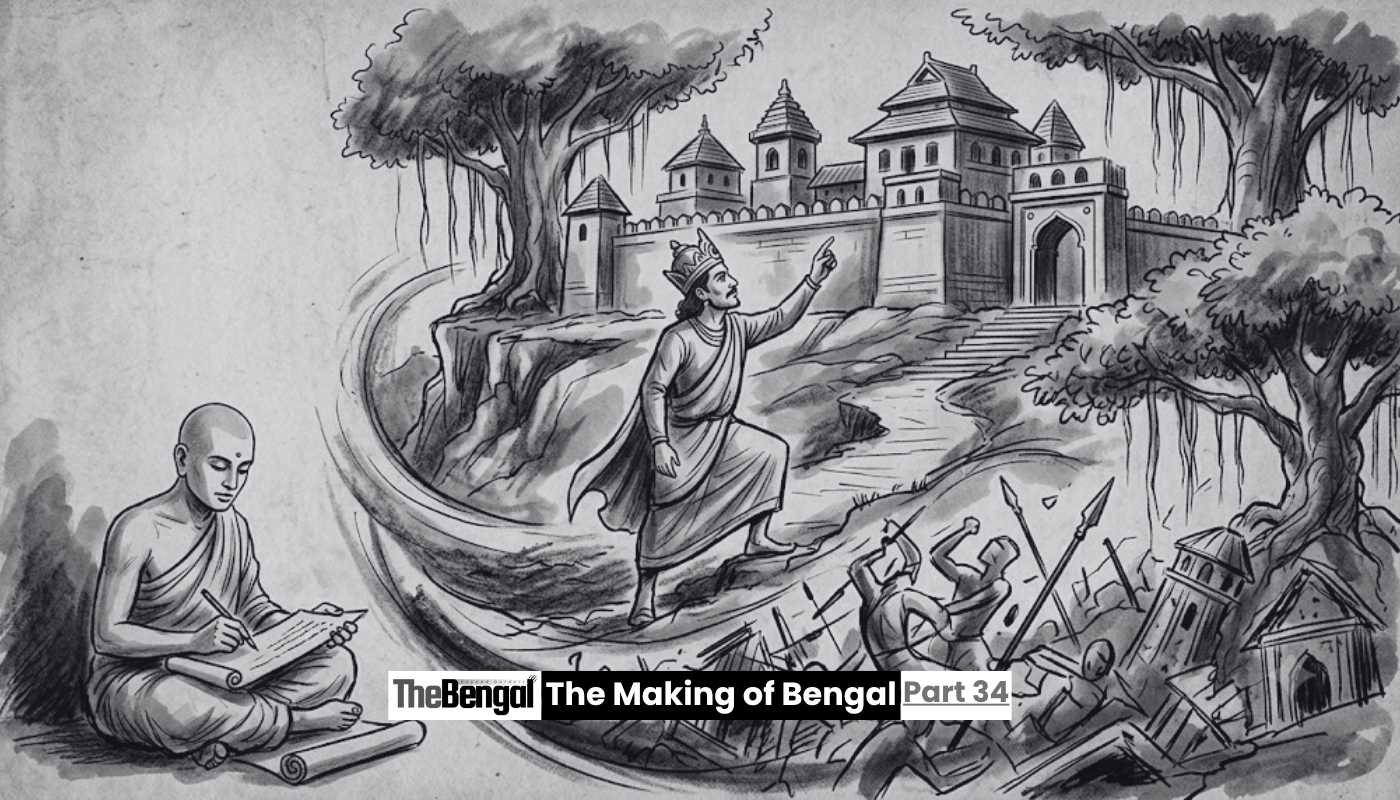

This article is part of The Making of Bengal, a long-form historical series by The Bengal. The previous chapter followed the unusual, semi-legendary story of Gopala’s election by Bengal’s exhausted regional chieftains around 750 CE. This chapter turns to what came next, the roughly two decades of actual rule that turned a negotiated compromise candidate into the founder of one of early medieval India’s most enduring dynasties.
A Reign With Almost No Direct Record
There is something quietly remarkable about how little survives from Gopala’s own reign, especially set against everything else this series has documented. Earlier chapters relied on the Mahasthan Brahmi inscription, the Damodarpur copperplates, the Rohtasgarh seal, the Doobi plates, and dozens of other pieces of direct contemporary evidence to reconstruct Bengal’s political history in real detail. For Gopala, none of that survives. Banglapedia states the problem plainly: there are simply not adequate sources to know the details of his reign, and nothing definite is known about his origins beyond the names of his father and grandfather, already discussed in the previous chapter of this series.
Everything historians can say about Gopala’s actual rule comes instead from indirect evidence: later Pala inscriptions issued by his son and successors looking back at his achievements, and the account of Taranatha, the Tibetan Buddhist historian writing in the late sixteenth and early seventeenth centuries, nearly eight hundred years after Gopala’s death. This is an unusual position for a series that has, until now, generally been able to anchor its most significant figures in physical, dateable inscriptions. Gopala’s reign has to be reconstructed almost entirely in retrospect, through the shadow he cast on what came afterward.
Locating a Kingdom Without a Map
Even the most basic geographic question, where exactly Gopala’s original kingdom was centred, remains genuinely disputed among historians working from this same thin evidentiary base. The Ramacharitam, a later Pala-era text, refers to Varendra, the region of northern Bengal, as the janakabhu, or birthplace, of the Pala line, suggesting that region may have been Gopala’s original power base. The Manjusrimulakalpa instead places his rise more specifically in Gauda and northwestern Bengal, the same territory earlier held by the Later Guptas discussed in the previous section of this series. Other modern surveys of the dynasty describe his original kingdom as centred instead in Vanga, in southern Bengal. Banglapedia’s own careful conclusion, after weighing these competing traditions, is that Gopala most likely succeeded in establishing his base of power somewhere in the northern and northwestern part of Bengal before expanding outward from there.
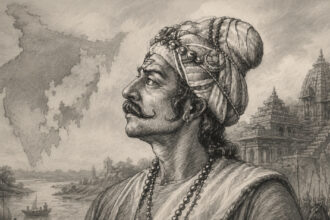
What all of these competing traditions agree on, regardless of where precisely Gopala started, is the scope of what he achieved by the end of his reign. Modern historical surveys describe his kingdom as encompassing Gauda in central Bengal, Pundra, also called Paundravardhana or Varendra, in the north, and Vanga in the south, along with substantial portions of eastern Bihar, particularly Magadha, the same Magadha that had once administered Bengal directly through the Mauryan officials examined at the very beginning of this series, and had more recently served as the reduced territorial base of the Later Guptas discussed in the previous section. Taranatha specifically credits Gopala with the conquest of Magadha, an achievement that, if accurate, meant Bengal’s newly elected king had not merely stabilised his own delta territory but had pushed his authority westward into land that generations of outside empires had once used to govern Bengal from the opposite direction.
Building Where Others Had Only Fought
If Gopala’s military and administrative achievements survive mostly as inference and later tradition, his religious and institutional legacy is somewhat more concrete, even if it too rests heavily on later attribution rather than contemporary inscription. Gopala is traditionally credited with founding the Odantapuri Mahavihara, a major Buddhist monastery near modern Bihar Sharif in Bihar, built specifically as a residential centre for advanced Buddhist study, following a model that would later be perfected at the far more famous Nalanda, and that Gopala’s own successors would go on to develop even further at sites like Somapura, the subject of a later chapter in this series.
This detail carries real weight when set against the wider pattern this series has already traced through Bengal’s religious history. Buddhism, first planted under Ashoka, had flourished for centuries through the Gupta and post-Gupta periods, weathered a century of political anarchy under matsyanyaya, and now found in Gopala a ruler prepared to invest state resources directly into rebuilding its institutional infrastructure, at exactly the moment Magadha’s own older centres of Buddhist learning had themselves suffered from generations of instability. Later sources describe Gopala’s architectural initiatives at Odantapuri as introducing early examples of what would become the distinctive Pala building style, sturdy brick construction paired with terracotta ornamentation, a visual and structural template his son and grandson would later use to build the far grander monastic universities that made the Pala period one of the genuine high points of Buddhist scholarship anywhere in Asia.
Whether Gopala himself was personally a devout Buddhist remains, like so much else about his reign, a matter of some uncertainty. Wikipedia’s own summary is careful on this point, noting that while several sources written considerably after his death describe him as Buddhist, it is not entirely clear this reflects his own actual religious conviction rather than later Pala tradition projecting the dynasty’s later, unmistakably Buddhist identity backward onto its founder.
Recognition Rather Than Reconquest
What distinguishes Gopala’s consolidation of Bengal from earlier unifications this series has followed, particularly Shashanka’s, is the apparent manner in which it happened. Where Shashanka’s rise, examined in detail in the previous section of this series, involved calculated feudatory politics, strategic alliances, and eventually open warfare against the combined forces of Harsha and Bhaskaravarman, sources describing Gopala’s ascension emphasise instead that several independent chiefs recognised his political authority relatively without significant struggle, a genuinely striking contrast if accurate, and one that fits naturally with the consensus-based election explored in the previous chapter. A king chosen by an assembly of exhausted regional leaders, rather than one who had fought his way to the throne, may simply have faced less organised resistance once he was actually in power, his legitimacy already broadly agreed upon before he needed to defend it by force.
A Foundation Built to Last
Gopala died sometime around 770 CE, after a reign most modern historians place at approximately twenty years, though the Manjusrimulakalpa’s own account stretches that figure considerably further, to twenty-seven years, and credits him with living to roughly eighty years of age. Whatever the precise numbers, the outcome by the time of his death is not seriously disputed. He left his son Dharmapala not a fragile, contested inheritance but a genuinely substantial and stable kingdom, one already spanning Gauda, Pundra and Vanga together with real influence extending into Magadha.
That inheritance would prove to be only the foundation. Dharmapala would go on to transform his father’s regional kingdom into a genuine imperial power, contesting for control of Kannauj itself against the Pratiharas and Rashtrakutas in a rivalry historians call the tripartite struggle, and founding the Vikramashila monastery that would rank alongside Nalanda as one of the great centres of Buddhist learning anywhere in the medieval world. None of that expansion would have been possible without the specific, patient work this chapter has traced: an elected outsider with no royal bloodline, working from an almost complete absence of surviving contemporary record, who nonetheless managed to reunify a fractured Bengal, extend its reach into Bihar, and rebuild, brick by brick at Odantapuri, the kind of institutional infrastructure that a century of anarchy had left in ruins.
In the next chapter of this series, we turn to the empire Gopala’s foundation made possible, following the Pala dynasty into what many historians consider Bengal’s first genuine golden age.
Sources: Wikipedia, “Gopala I” and “Pala Empire”; Grokipedia, “Gopala I”; Banglapedia, “Gopala”; GKToday, “Pala Empire Foundation”; Vajiram & Ravi, “All About Pala Dynasty”; PWOnlyIAS, “Rise and Fall of the Pala Empire: A Prominent Buddhist Dynasty”; LotusArise, “Pala Dynasty UPSC Notes”; Prepp.in, “Important Rulers of Pala Dynasty.”