

This article is part of The Making of Bengal, a long-form historical series by The Bengal. The previous section closed with Shashanka’s death and the rapid unravelling of the kingdom he had built at Karnasuvarna, examined across four chapters covering his rise, his character, his capital and his contested historical legacy. This chapter opens a new section by following what happened once that kingdom was truly gone, and it is not, by any account, a pleasant story.
A Name Borrowed From the Riverbank
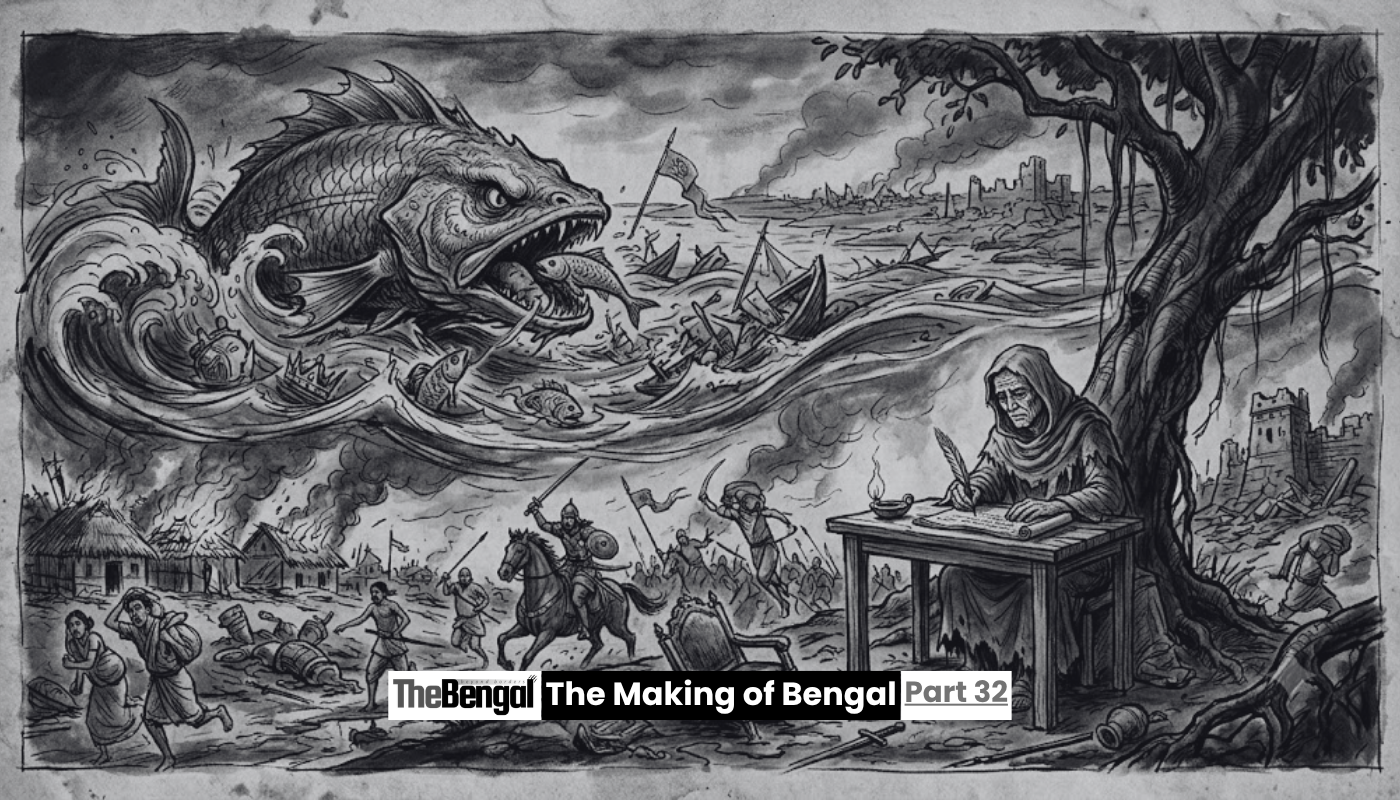
The period this chapter covers has a name that says almost everything about how badly things fell apart. Matsyanyaya, commonly rendered in English as the law of the fish or fish justice, describes a simple and brutal natural pattern: in an unregulated pond, larger fish eat smaller ones without restraint or consequence. Bengali and wider Indian tradition borrowed this image directly from Kautilya’s Arthashastra, the same Mauryan-era statecraft treatise already discussed earlier in this series for its detailed catalogue of Bengal’s textile regions and trade routes. Kautilya used the term specifically to describe what happens to any society once the machinery of law and punishment collapses entirely: without a functioning authority to restrain them, the strong simply consume the weak, exactly as fish do in water.
That this specific term came to define an entire century of Bengal’s history says a great deal about how thoroughly the region’s political order had disintegrated in the wake of Shashanka’s death and the immediate collapse of Gauda, examined in the previous section of this series. This was not a transition from one ruling dynasty to another. It was, for the better part of a hundred years, the near-total absence of dynasty altogether.
A Kingdom That Could Not Hold a King
Just how severe this instability became is captured in a source this series has already encountered once before. The twelfth-century Buddhist text Manjusrimulakalpa, discussed in an earlier chapter regarding its disputed claims about Shashanka’s treatment of Buddhism, offers a second and considerably less contested observation about the period that followed his reign. According to that text, Gauda’s political condition became so paralysed after Shashanka’s death that whoever managed to seize the throne could not expect to hold it for even a full year before being overthrown in turn.
Modern historians studying this period have found little reason to doubt that particular claim, even where they remain skeptical of the same text’s other accusations. Research into the century following Shashanka’s reign describes a Bengal torn into many small, competing kingdoms, locked in constant internecine warfare, with no force strong enough to establish lasting order. The same sources note a documented famine striking the eastern region during this period, adding genuine subsistence crisis to the political chaos already underway, a grim contrast to the careful famine-relief administration recorded on the Mahasthan Brahmi inscription explored much earlier in this series, from an era when Bengal still had a functioning imperial bureaucracy capable of responding to exactly this kind of emergency.
Government Reduced to the Household
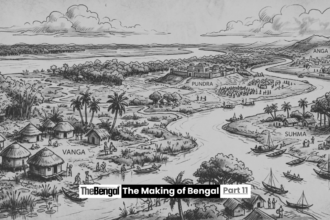
Perhaps the most striking description of this period comes from research summarising how completely political authority had fragmented. With no ruler capable of exercising control over Gauda, Vanga or Samatata, the three territories whose earlier independent and semi-independent histories this series has already traced in detail, authority effectively dissolved down to the smallest possible unit. Kshatriyas, Brahmins, merchants and ordinary townsmen each became, in the words of researchers studying the period, kings in their own homes, exercising whatever power and protection they could muster for themselves and their immediate households, with no larger structure of law or justice standing above them.
This is a genuinely striking image to set against everything the earlier chapters of this series have documented: the careful Mauryan administration recorded at Mahasthangarh, the planned urban centres explored at Chandraketugarh and Bangarh, the sophisticated trade networks reaching from Tamralipta to Rome and China, the deliberate religious and cultural programmes of kings like Shashanka. All of that accumulated administrative and civic infrastructure, built up gradually across nearly a thousand years of documented history, appears to have simply come apart, leaving ordinary households to fend for themselves against whatever stronger neighbour happened to threaten them next.
The Quiet Collapse of Everything Built Before
The consequences of this breakdown extended well beyond politics narrowly defined. Historians studying the period note that while direct evidence of the social consequences of this anarchy remains scarce, indirect deductions from the available record point clearly toward a serious decline in trade and commerce during this century, including a loss of prominence for the port infrastructure this series has followed at length in its chapters on Tamralipta, Gange and Bengal’s maritime and overland trading networks. A region that had spent centuries as a genuine crossroads connecting China, Tibet, Central Asia, the Bay of Bengal and the Mediterranean world could not easily sustain that role once basic internal security had broken down.
Everyday accounts of the period describe conditions in blunt, almost plain terms: the legal system had effectively broken down across the whole province, weaker people were routinely preyed upon by stronger ones, ordinary commerce had ground nearly to a standstill, theft and robbery became commonplace daily occurrences, and the region faced repeated attacks from outside powers as well, with no unified authority left standing to organise a defence.
A Century Without a Single Famous Name
One of the more unusual features of this period, at least by comparison with virtually every other chapter in this series, is how little of it is actually populated by named individuals. Where earlier sections of this series have followed Gangaridai’s war elephants, Ashoka’s missionaries, Shashanka’s coinage and calendar, and a whole cast of kings, pilgrims and administrators, the century of matsyanyaya offers historians almost nothing of the kind. No dominant ruler emerges clearly enough from the fragmentary record to anchor a proper biography. No single capital city rises to prominence the way Karnasuvarna, Chandraketugarh or Mahasthangarh did in earlier eras. What survives instead is mostly description, from later, retrospective sources looking back at a century most contemporaries would likely have preferred to forget entirely.
That absence of documentation is itself a kind of evidence. A century genuinely worth boasting about tends to leave inscriptions commemorating it. A century of anarchy, fragmentation and household-level survival tends to leave behind exactly what matsyanyaya has left behind: a name borrowed from the behaviour of fish, a handful of grim retrospective descriptions, and very little else.
The Chaos That Eventually Produced Its Own Solution
What makes this period genuinely significant to the wider story this series is telling is not simply that it happened, but what it ultimately made possible. A century of unchecked local warfare, economic collapse and the total absence of central authority is, by definition, unsustainable. Somewhere within that prolonged breakdown, the various fragmented power centres across Gauda, Vanga and Samatata eventually reached a point where continuing as they were had become worse, even for the locally powerful, than trying something genuinely new.
Historians studying the period suggest that in the absence of a strong outside authority capable of imposing order, it took the sagacity of a smaller number of regional chieftains, acting together rather than individually, to finally bring this state of lawlessness to an end. What they eventually did, bringing forward a single figure to serve as a unifying ruler chosen by consensus rather than inherited by bloodline or seized by conquest, would prove to be one of the more genuinely unusual moments in the whole of ancient Indian political history, and the direct subject of the next chapter in this series.
In the next chapter of this series, we turn to that resolution directly: how Bengal, after roughly a century without a functioning government, chose its very first elected king.
Sources: Banglapedia, “Matsyanyayam”; Grokipedia, “Gopala I”; The Daily Star, “The First King of Bengal”; Studocu, “Matsyanyayam: Bengal’s Anarchy Preceding the Pala Dynasty (c 750-850 AD)”; THE BOOK NOTES, “Kingdoms in Eastern India – UGC NET History Notes”; Kautilya, Arthashastra.