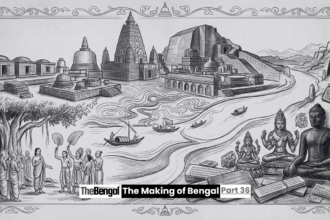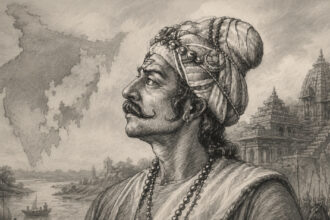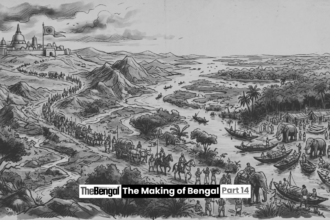

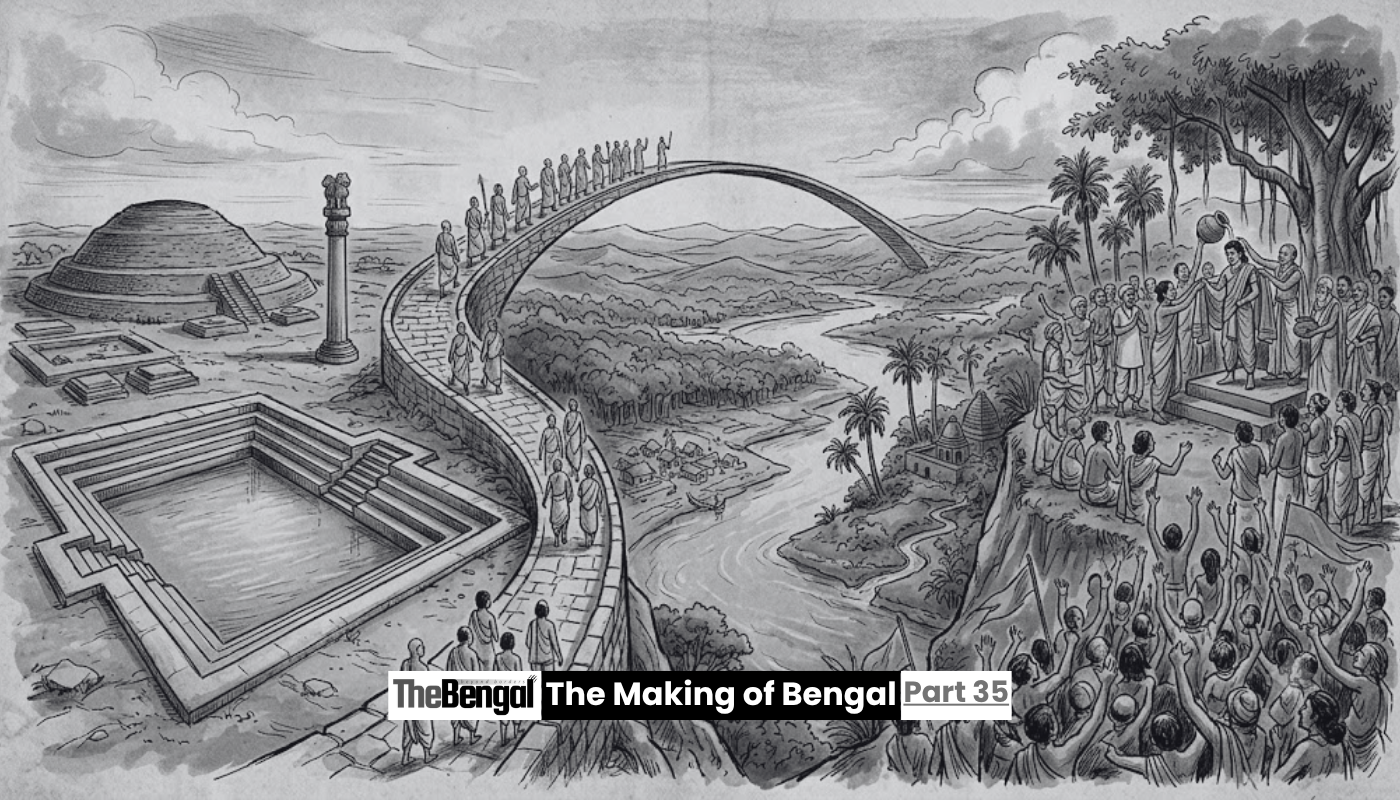

This article is part of The Making of Bengal, a long-form historical series by The Bengal. The previous two chapters followed Gopala’s unusual election by Bengal’s exhausted chieftains and the kingdom he went on to build from it. This chapter closes the section by stepping back to ask what that election actually meant, both within the wider sweep of Indian political history and for how Bengal would remember itself afterward.
An Older Tradition Than It First Appears
It would be easy to read Gopala’s election, examined across the previous two chapters of this series, as a strange one-off, a desperate improvisation by chieftains who had simply run out of other options after a century of matsyanyaya. The wider historical record suggests something more interesting: Gopala’s selection sits within a genuine, if intermittent, Indian tradition of choosing rulers through some form of collective consent rather than pure inheritance or conquest, a tradition considerably older than Bengal’s own eighth-century crisis.
That tradition reaches back most clearly to the ganasanghas, the tribal republics that flourished across northern India, particularly in the Himalayan foothills and the region of modern Bihar, from roughly the sixth century BCE onward. The most celebrated of these was the Vajji confederacy, a union of republics including the Licchavis, Vaidehas, Nayas and Mallas, governed from the city of Vaishali. According to the surviving record, the Licchavis alone maintained an assembly of more than seven thousand representatives, drawn from leading families, who elected their own leadership, including a president, vice-president, military commander and treasurer, a structure detailed in Buddhist canonical texts like the Mahavagga. Archaeological remains at Vaishali include a large mound believed to be the site of this assembly, along with a coronation tank where newly elected leaders were ritually sanctified before taking office.
This was not merely a curiosity confined to obscure texts. The Buddhist Mahaparinibbana Sutta specifically praised the Vajji confederacy’s system of governance, its regular assemblies, its consensus-based decision-making, its broad representation, as a genuine model worth emulating, and later tradition holds that the Buddha himself, born into the neighbouring Shakya republic, drew directly on this same republican structure when organising the Buddhist monastic sangha. Some modern historians have gone further still, noting that Vaishali’s republican governance, generally dated from around the sixth century BCE, predates the conventional founding of Athenian democracy by roughly a century, though comparing the two systems directly requires real caution given how differently each was structured and how differently each defined who actually got a voice.
A Tradition That Never Fully Disappeared
What makes Gopala’s story genuinely significant within this longer arc is that the ganasanghas themselves did not survive as functioning states into his own era. The Vajji confederacy was eventually defeated and absorbed by the expanding monarchy of Magadha centuries before Bengal’s own eighth-century crisis, part of a much broader pattern in which the older republican model was steadily displaced across the subcontinent by hereditary kingship, precisely the kind of centralised monarchical authority this series has followed through the Mauryas, the Guptas, and Shashanka’s own Gauda kingdom.
And yet, as one historical survey of the subject notes, the underlying practice of choosing rulers through some form of popular or elite consent did not vanish entirely even once formal republics like Vaishali had disappeared from the map. Scholars researching this thread point to scattered later instances where election or consensus appears to have played a genuine role even within otherwise monarchical systems, citing the Western Kshatrapa ruler Rudradaman in the second century CE, and Harshavardhana himself, the very rival whose long conflict with Shashanka occupied much of the previous section of this series, reportedly persuaded to accept the throne by his own ministers and subjects following his brother’s death in 606 CE, rather than simply inheriting it as an automatic right. Gopala’s election in 750 CE, on this reading, was not an unprecedented anomaly. It was the latest, and one of the best documented, instances of a practice that had never fully disappeared from Indian political life, even as hereditary monarchy became the overwhelmingly dominant norm.
A Hybrid, Not a Restoration
It would be a mistake, however, to overstate the continuity between Vaishali’s republic and Bengal’s election of Gopala. The ganasanghas operated as ongoing institutions, with assemblies, elected officials and defined procedures functioning as the normal, everyday structure of government. What Bengal’s chieftains did around 750 CE was something narrower: a single, one-time act of collective selection, undertaken specifically to end a crisis, that then gave way immediately to conventional hereditary succession. Gopala’s son Dharmapala did not need to be elected in turn. He simply inherited the throne, as did every Pala ruler after him for the better part of four centuries, examined in this series’ next chapter.
Gopala’s election, in other words, functioned less as a genuine restoration of the older republican model and more as an emergency mechanism, a way of establishing a new dynasty’s initial legitimacy at a moment when bloodline alone could not have supplied it, since, as the previous two chapters of this series established, Gopala had no royal bloodline to draw on in the first place. It was a hybrid moment: a distinctly republican method of selection, used to launch a thoroughly conventional hereditary monarchy.
Why Bengal Still Remembers It
That hybrid quality has not diminished the story’s power in later memory. Modern Indian legal and political writing continues to reach back specifically to Gopala’s election when making the case that ideas of consent-based leadership have deep native roots in the subcontinent, rather than having arrived only with British colonial institutions in the nineteenth century. One widely cited legal history of Indian elections traces a direct line from the ancient Vajji republic through Gopala’s own election in 750 CE, treating both as part of the same continuous evidentiary record that later Indian constitutional thinkers, including B.R. Ambedkar and his fellow drafters of India’s modern constitution, could point back to as precedent, whether or not they explicitly invoked Gopala by name.
For Bengal specifically, the story carries an additional, more local resonance already touched on in an earlier chapter of this series: the way early twentieth-century Bengali historians and nationalists embraced figures like Shashanka as symbols of the region’s own capacity for self-rule under outside domination. Gopala’s election fits that same emotional register even more naturally. Here was a moment, preserved however imperfectly in the Khalimpur inscription and Taranatha’s later legend, in which Bengal’s own people, or at least its own regional leadership, chose their ruler collectively rather than having one imposed by conquest or inherited bloodline, precisely the kind of founding story a region negotiating its own relationship with outside imperial power might understandably want to remember and retell.
A Precedent Bengal Did Not Repeat, But Never Forgot
What ultimately makes this election worth closing an entire section of this series on is not that it created a lasting new system of government, it plainly did not, but that it demonstrates something this series has returned to again and again in different forms: Bengal’s capacity, even after a century of total political collapse, to produce genuinely new solutions to old problems, rather than simply waiting for outside conquest to impose order from elsewhere. Gangaridai deterred an empire through reputation alone. Shashanka broke from imperial overlordship through calculated feudatory politics. And Bengal’s own exhausted chieftains, faced with a century of matsyanyaya that no local dynasty, however capable, had managed to end through conquest, ultimately chose an entirely different tool: consensus, however narrow, however temporary, however historically unusual for its time and place.
In the next chapter of this series, we turn to the empire that single election made possible, following the Pala dynasty into what many historians consider Bengal’s first true golden age, one that would eventually export its art, its Buddhism and its scholarship as far as Tibet, Southeast Asia and beyond.
Sources: LiveHistoryIndia, “Gana Sangha: The Democratic Rule of Ancient India”; Sanskriti Magazine, “Vaishali: The Ancient Hub of Democracy”; Swarajya, “Republics of the Past — Part II”; UPSCTree, “History Watch: Republics of the Past — Part 2”; Manupatra, “Law Relating to Elections: Introduction and Meaning of Election”; India Leaders for Social Sector, “What Ancient India Teaches About Democratic Leadership”; MyIndMakers, “India, Choose Your Leaders Wisely! Lesson to Learn from the Pala Dynasty.”