

This article is part of The Making of Bengal, a long-form historical series by The Bengal. In earlier chapters, we traced the deep geological creation of the delta and the first farming villages of the wider region, from the Ajay valley of West Bengal to the fossil-wood toolmakers of Tripura and the cord-marked potters of the Brahmaputra valley. This chapter follows one crop in particular, the one that ultimately came to define the entire region: rice.
A Grain with Two Birthplaces
Rice did not begin its journey in Bengal. Genetic and archaeological research indicates that the domestication of rice unfolded independently in two separate parts of Asia, China and India, starting roughly twelve thousand years ago. In South Asia, the process is understood to have reached full domestication somewhere in the eastern Himalayan foothills between seven and nine thousand years ago, where genes governing key domestication traits from japonica rice populations in eastern China mixed with local proto-indica cultivars across many generations of cross-breeding and selection, eventually producing the indica rice that would come to dominate the subcontinent.
From there, domesticated indica rice spread outward across South Asia between roughly four thousand and thirty five hundred years ago. Domesticated rice cultivation is believed to have reached the Bengal region at around this same time, approximately four thousand years before present. That timeline lines up closely with the physical evidence already discussed elsewhere in this series: the carbonised rice grains recovered from a pit at Mahisdal in Birbhum district, part of the Chalcolithic Pandu culture that flourished along the Ajay and Damodar valleys of West Bengal. Long before Bengal had cities, courts or written history, its farmers were already growing and storing rice.
A Landscape That Demanded Its Own Rice
What happened next set Bengal apart from almost anywhere else rice was grown. Across the many centuries that followed, farmers throughout the delta engaged in what Charles Darwin himself once described as artificial selection, patiently choosing and breeding rice plants with favoured traits suited to their own particular patch of land.
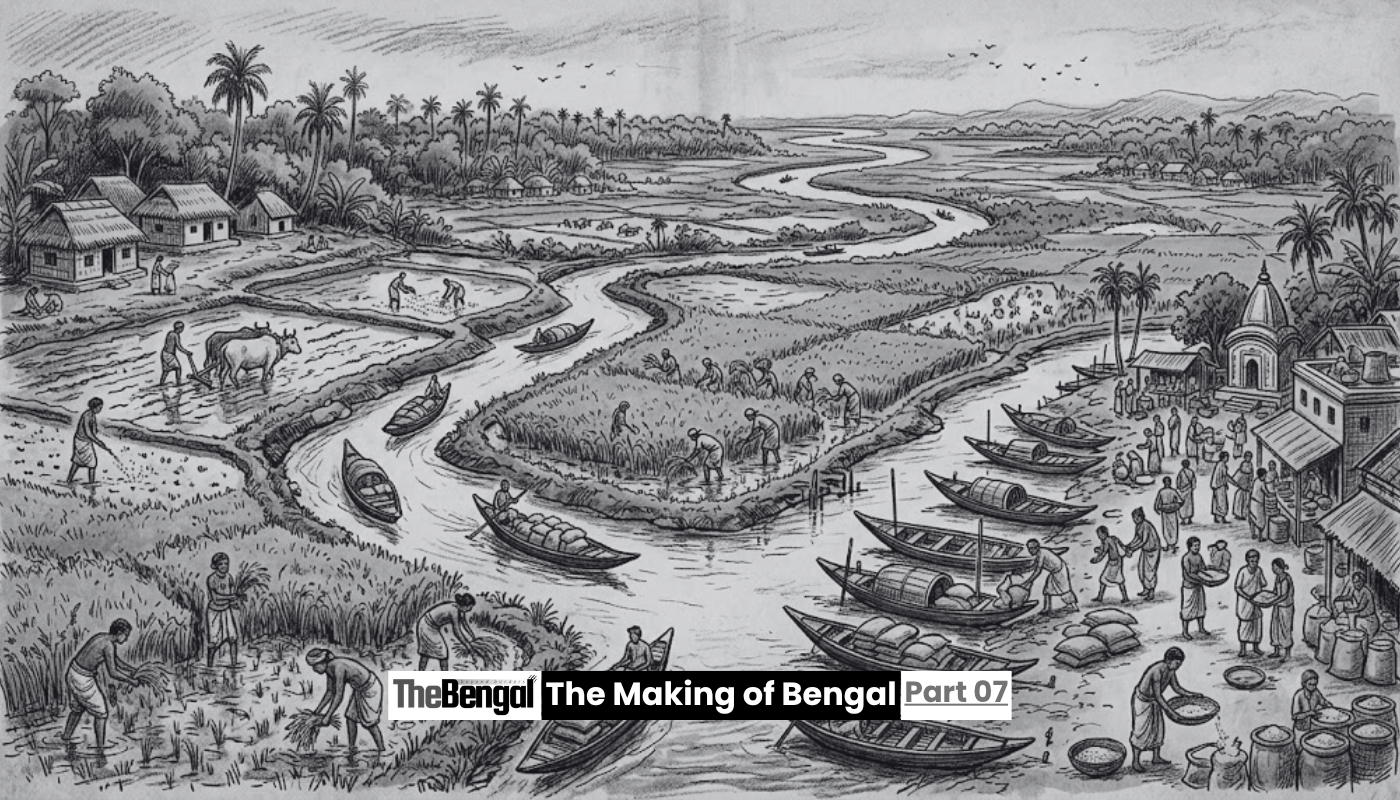
Bengal’s geography made this an unusually demanding task. The delta is criss-crossed by rivers prone to sudden and dramatic flooding, punctuated by drier upland tracts, salt-affected coastal zones near the Sundarbans, and a monsoon calendar that dictated three distinct cropping seasons across the region, Aman rice grown through the winter, Boro through the summer, and Aus through the early autumn. No single rice variety could thrive across all of these conditions. So Bengali farmers did not settle for one. They built thousands.
By the 1940s, researchers estimate that undivided Bengal, spanning what is now Bangladesh and West Bengal, was home to somewhere in the region of fifteen thousand distinct folk landraces of rice, farmer-developed cultivars fine-tuned to local soil, water and climatic conditions. Some varieties, developed for the coastal Sundarbans, could tolerate high soil salinity. Others, suited to deepwater and flood-prone areas, were deep-water or floating rice types capable of elongating their stems as floodwaters rose, keeping their heads above the surface even as the water climbed several metres. This was not simply agricultural experimentation for its own sake. It was survival, worked out grain by grain across a landscape that offered no single, uniform way to grow food.
The Grain That Became a Meal
Nowhere is rice’s importance to Bengal clearer than in language itself. In Bengali culture, the very act of eating rice is treated as synonymous with eating a meal at all. The old Sanskrit word anna and the Bengali word odan both mean rice and meal at once, and to this day, a standard way of asking someone whether they have eaten lunch or dinner is, quite literally, to ask whether they have eaten their rice.
That linguistic fusion reflects something deeper than habit. Rice sat, and in many ways still sits, at the absolute centre of what it means to live a Bengali life, not simply as calories on a plate but as the organising structure around which food culture, ritual and social identity were built.
A Crop Woven Into Every Rite of Passage
Rice’s role in Bengali culture went far beyond nutrition. It was, and in many households remains, deeply embedded in ceremony and ritual across the entire life cycle. Raw rice grains are used to bless a newborn and its mother. A weaned baby’s first solid food, prepared from parboiled, short-grained rice, is marked by a specific ceremony known as Annaprashan. At weddings, a newlywed bride carries rice seeds on a pot atop her head as she is welcomed into her husband’s household, later throwing milled rice grains behind her in a ritual symbolising repayment of a debt to her mother, while guests are treated to fragrant, aromatic rice dishes befitting the occasion. Even funerary rites involve rice, from popped grains scattered along the route to the crematorium to feed birds, to cooked rice offered to guests during mourning ceremonies.
The annual agricultural calendar itself became a cultural calendar. The harvest of winter Aman rice is marked across Bengal by the Nabanna, or new rice, festival, followed by a month-long celebration called Poush Parban during which Bengali women prepare dozens of different rice-based sweets. Different landraces were prized for entirely different purposes: some for their aroma in wedding feasts, some for their stickiness in particular rice cakes, some purely for their unusual and admired appearance, such as one landrace whose kernels bore what farmers described as a distinctive notched belly, prized simply for its resemblance to a tiny embryo. Certain revered varieties, associated with deities such as Lakshmi and Gobinda, were considered essential for particular religious ceremonies to feel complete at all.
Local delicacies grew up around specific landraces in specific districts. The famous rice sweet known as Jaynagarer moa, from South 24 Parganas, depended on the distinctive aroma of a particular aromatic landrace, while Sitabhog, a celebrated sweetmeat of the Bardhaman district, was originally made from a rice variety of the very same name. In both cases, the crop and the dish carried the same identity, a naming pattern repeated across dozens of regional foods throughout Bengal.
An Empire of Diversity Beyond West Bengal
This extraordinary diversity was never confined to one side of a modern border. Genetic studies comparing rice landraces across Bangladesh, Assam and West Bengal have documented considerable complexity in how indica and japonica rice types differentiated across the wider Bengal and northeastern Indian region, underlining that this was a shared agricultural inheritance stretching well beyond any single state or country. In the 1970s, researchers with the Bangladesh Rice Research Institute catalogued a total of 12,479 distinct rice names, including synonyms, cultivated across the newly independent country, while unpublished records from West Bengal’s State Rice Research Station indicated that farmers in that state alone had grown approximately 5,556 landraces until the late 1960s.
Taken together, these figures describe one of the richest single-crop genetic diversity systems documented anywhere on Earth, developed not by any government institution or formal breeding programme, but by generations of ordinary farmers, most of them anonymous, sharing and refining their varieties freely within their communities.
The Cost of Modern Uniformity
That inheritance has not survived the twentieth century intact. With the arrival of the Green Revolution beginning in 1965, a small number of high-yielding modern varieties began steadily replacing the vast range of traditional landraces across both Bangladesh and West Bengal. Researchers estimate that Bengal’s rice diversity has fallen from an estimated 15,000 landraces in the 1940s to roughly 1,250 surviving across the entire region today, a twelve-fold reduction achieved within a few decades.
The consequences of this decline extend well past agronomy. Researchers studying Bengal’s rice culture describe the loss as an erosion of biocultural diversity, one that has weakened the specificity of long-standing rituals, faded the particular flavours of regional sweets now made with substitute grains under old names, and eroded a traditional culture of free seed-sharing between farmers, replaced by dependence on commercial seed suppliers. Traditional thatched roofing, once made from the long, durable straw of traditional rice varieties, has increasingly given way to corrugated tin, since the straw of most modern varieties is too short for the purpose. Some traditional rice varieties, researchers have also found, carried genuine nutritional and medicinal value, including notably high iron content used traditionally to treat anaemia in new mothers, benefits largely absent from the high-yielding varieties that replaced them.
A Crop That Made a Civilization
None of this diminishes what rice achieved in Bengal over four thousand years. It transformed a floodplain into farmland capable of supporting one of the densest populations on Earth. It gave the region a shared vocabulary, in which the word for rice and the word for a meal became one and the same. It shaped courtship, birth, marriage and death, and it drove ordinary farmers, across countless unrecorded generations, to develop an almost unimaginable diversity of locally adapted varieties, each suited to its own patch of Bengal’s endlessly varied soil and water.
In the next chapter of this series, we move from crops to communities, exploring the forgotten civilizations whose remains still lie buried beneath Bengal’s soil, and what they reveal about the deeper roots of the societies that rice itself helped make possible.
Sources: Debal Deb, “Rice Cultures of Bengal,” Gastronomica: The Journal for Food Studies 21, no. 3 (2021); Wikipedia, “History of Rice Cultivation”; PMC/NIH, “The Complex History of the Domestication of Rice”; Frontiers in Ecology and Evolution, “The Fits and Starts of Indian Rice Domestication”; Travis et al., “Assessing the Genetic Diversity of Rice Originating from Bangladesh, Assam and West Bengal,” Rice 8 (2015).