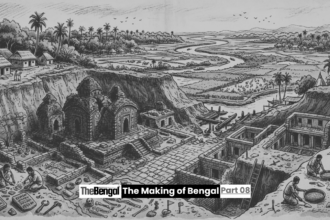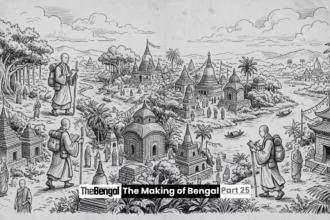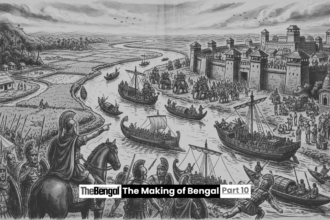


This article is part of The Making of Bengal, a long-form historical series by The Bengal. The previous two chapters traced the collapse of Shashanka’s kingdom into roughly a century of anarchy, and the fragmented, short-lived local dynasties that struggled and failed to restore order across Bengal. This chapter follows what finally brought that century to an end, a moment historians and legend alike have treated as genuinely extraordinary ever since.
A Century That Had to End Somehow
By the middle of the eighth century, Bengal’s exhaustion with matsyanyaya, explored across the previous two chapters of this series, had reached a genuine breaking point. Small dynasties like the Khadgas, examined in the previous chapter, had proven capable of holding limited territory for a generation or two, but none had managed to reunify Bengal the way Shashanka briefly had a century earlier. According to the historical record, sometime around 750 CE, the various independent chieftains who had spent decades fighting each other over fragments of territory finally arrived at a shared conclusion: continuing as they were had become worse for everyone than trying something new.
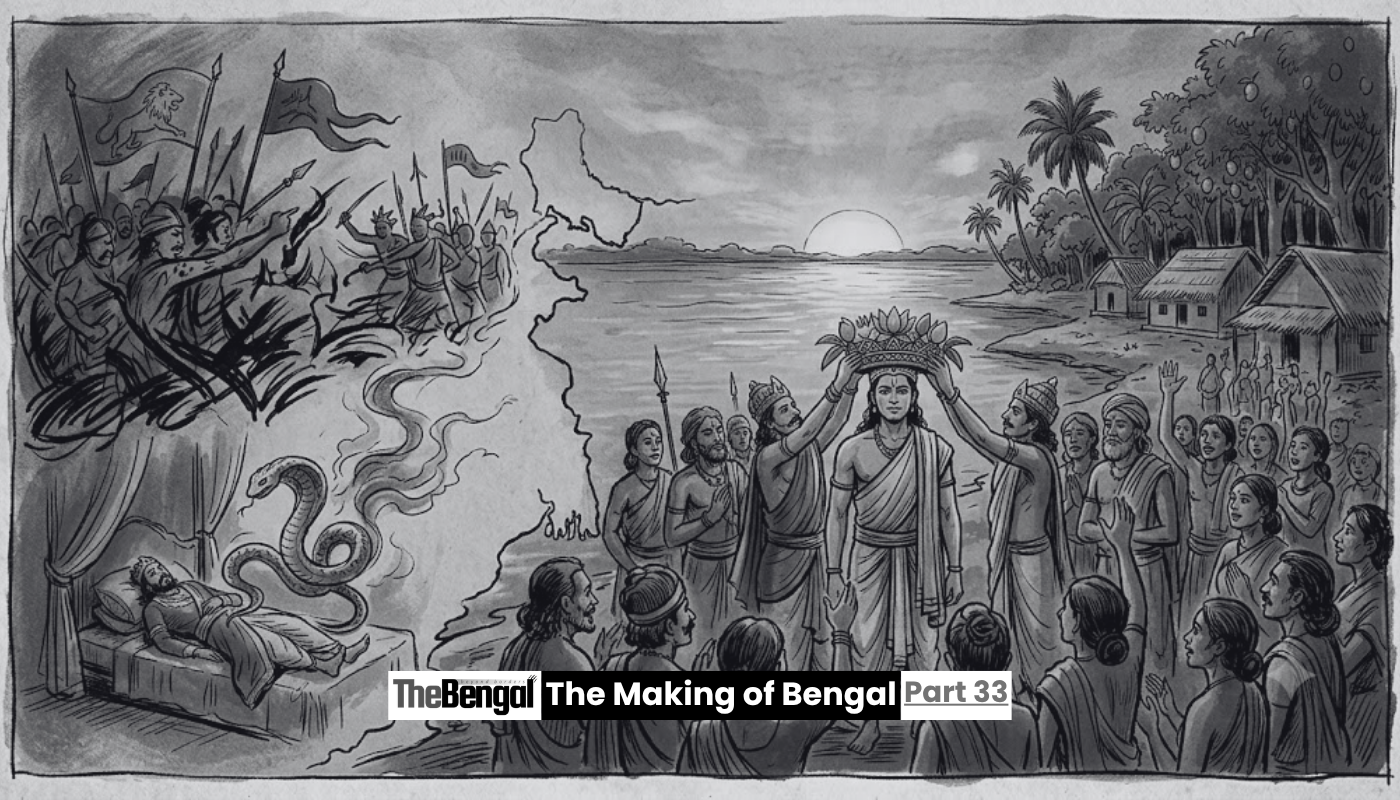
What they did next has become one of the most celebrated moments in Bengal’s ancient history, precisely because of how unusual it was. Rather than waiting for one chieftain to militarily overpower all the others, or inviting an outside dynasty to impose order by force, Bengal’s regional leaders instead convened an assembly and selected a single figure, a man named Gopala, to become their king.
What the Inscriptions Actually Say
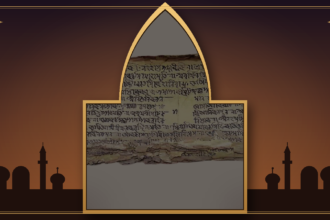
The most important surviving evidence for this event comes not from any account written at the time, but from a later royal inscription with every reason to remember it accurately: the Khalimpur copperplate, issued during the thirty-second regnal year of Dharmapala, Gopala’s own son and successor. In a formal eulogy honouring his father’s rise, the inscription describes how the prakriti, a Sanskrit term generally understood to mean the people or subjects, took action specifically to end the state of matsyanyaya, elevating Gopala, described as the crest jewel among the heads of kings, to symbolically take the hand of Lakshmi, the goddess of royal fortune, a poetic way of describing his elevation to the throne.
Historians treat this passage carefully. The term prakriti almost certainly did not mean anything resembling universal suffrage or a mass popular vote in the modern sense. Given the genuine chaos and fragmentation described in the previous chapters of this series, it is difficult to imagine ordinary common people gathering in any organised, coordinated way during a period when even basic security had broken down. What the inscription more plausibly describes, and what Grokipedia’s summary of modern scholarship on the event confirms, is a mechanism involving mahattaras and prakritis, principal officers, regional chieftains and other figures of local authority, convening as a kind of council or assembly specifically to choose a ruler capable of ending the lawlessness they had all been suffering under. This was not democracy in any modern constitutional sense. It was something narrower but still genuinely unusual for its time and place: a negotiated, consensus-based selection of a king by the region’s existing power brokers, rather than a claim to the throne settled by inheritance or outright conquest.
A Serpent Demoness and a Century of Legend
Alongside this comparatively sober inscriptional evidence survives a considerably more dramatic account, preserved by the Tibetan Buddhist historian Taranatha, writing in his History of Buddhism in India nearly eight centuries after the events it describes. According to Taranatha’s version of the story, Bengal’s chieftains, desperate to end the anarchy, began selecting one king after another, only to find that each new ruler was killed on the very first night of his reign by a monstrous serpent demoness, described as the queen of an earlier, deposed king, who crept into the royal bedchamber and devoured him before morning. Only Gopala, in this telling, managed to survive the encounter, killing the demoness himself and remaining safely on the throne where his predecessors had all perished.
Modern historians are understandably cautious about treating this account as literal history. Wikipedia’s own summary of the episode describes Taranatha’s version plainly as a legend, considered historically unreliable given how many centuries separate its composition from the events it claims to record. Yet, much like the Vijaya legend examined in an earlier chapter of this series concerning Bengal’s maritime connections to Sri Lanka, the story’s persistence and specific shape are themselves worth taking seriously. A folk tradition built around repeated failed kingships, each new ruler destroyed almost immediately before Gopala alone proves capable of holding power, reads as a fairly natural way for oral memory to dramatise exactly the situation the more sober Khalimpur inscription describes in drier administrative language: a century in which, as the Manjusrimulakalpa had already put it in an earlier chapter of this series, no ruler of Gauda could hold the throne for even a year, until one finally did.
A King Without a Crown to Inherit
What makes Gopala’s rise genuinely distinctive, beyond the unusual manner of his selection, is where he came from beforehand. The same Khalimpur inscription that records his election also describes his immediate family background, and it is notably modest by the standards of ancient royal genealogy. His father, Vapyata, is remembered specifically as a skilled military commander, described in the inscription using a term meaning killer of enemies, while his grandfather, Dayita Vishnu, is recalled instead as a learned man, respected for his knowledge rather than any military or political distinction. Some scholars, drawing on later regional histories, have proposed that Vapyata’s family may originally have migrated eastward from northwestern Punjab, though this remains a matter of ongoing historical debate rather than settled fact.
What this genealogy makes clear, regardless of its precise geographic origins, is that Gopala was not a displaced prince from any of the earlier dynasties this series has followed, not a descendant of Shashanka’s line, not connected to the Khadga kings of Samatata, not an heir of the earlier Gauda or Vanga ruling houses. He appears to have risen instead from a locally respected but genuinely non-royal military family, precisely the kind of figure a council of exhausted, competing chieftains might plausibly settle on: capable enough to command real authority, but without the kind of established dynastic claim that might have made rival chieftains suspicious of his ultimate ambitions.
An Ending That Was Also a Beginning
Gopala’s election, whatever its precise mechanics, worked. Where a century of local dynasties, military strongmen and semi-independent feudatories had all failed to restore lasting order across Bengal, Gopala succeeded, beginning a reign that historians generally date from around 750 to 770 CE, and founding a dynasty, the Palas, that would go on to rule Bengal and much of eastern India for close to four centuries, a span of continuous rule this series has not yet encountered from any single ruling house since the story began.
There is a genuine symmetry worth pausing on here. This series opened its account of Bengal’s political history with Gangaridai, a kingdom powerful enough, by reputation, to turn back Alexander the Great, yet one whose internal structure and rulers remain almost entirely unknown. It has since followed Mauryan administrators, a Gupta collapse, Shashanka’s brief and fiercely contested independent kingdom, and a century of anarchy so total that ordinary households became, in effect, sovereign unto themselves. Out of all of that, Bengal’s next great political era began not with a conqueror’s sword, but with an assembly of exhausted local leaders, quite possibly meeting in genuine desperation, choosing a capable military commander’s son to end the chaos they had all grown tired of living through.
In the next chapter of this series, we turn to the man Bengal chose, and the empire, the Pala dynasty, that his election would go on to build.
Sources: Wikipedia, “Gopala I”; Grokipedia, “Gopala I”; Banglapedia and Liquisearch, “Gopala (Pala King): Democratic Election”; Brainly.in, summary of Taranatha’s account; MyIndMakers, “India, Choose Your Leaders Wisely! Lesson to Learn from the Pala Dynasty”; Khalimpur Copperplate Inscription of Dharmapala.