

This article is part of The Making of Bengal, a long-form historical series by The Bengal. The previous section closed with Gopala’s extraordinary election around 750 CE, examined across three chapters covering the mechanics, the aftermath and the wider historical significance of that unusual moment. This chapter opens a new section of the series, one covering the empire that single election eventually produced, and asks directly what made it, by many measures, the most consequential dynasty Bengal has ever known.
A Dynasty Named for What It Promised
There is something worth noticing immediately in how the Palas named themselves. Every ruler from Gopala onward carried the suffix pala, meaning protector, in Sanskrit and Prakrit alike, transforming what began as a single king’s personal name into a dynastic brand built around an explicit promise: protection, specifically, from the kind of anarchy this series traced in exhaustive detail across the previous section’s chapters on matsyanyaya. Given that Gopala himself was chosen by a council of exhausted regional chieftains specifically to end a century of lawlessness, this naming pattern reads less like accident and more like a founding dynasty consciously advertising, generation after generation, exactly what it existed to deliver.
By any reasonable measure, that promise was kept longer than almost any comparable claim in the history this series has followed. The Pala Empire ruled continuously, across eighteen generations of kings, for approximately four centuries, from Gopala’s election around 750 CE to the dynasty’s effective end in the mid-twelfth century, when Vijayasena’s rising Sena dynasty finally displaced the last weakened Pala rulers from Bengal proper, though a reduced Pala line reportedly continued to hold onto territory in southern Bihar for a further forty years afterward.
From Regional Kingdom to Northern Indian Superpower
Gopala’s reign, examined at length in the previous section of this series, had already achieved something significant simply by reunifying Gauda, Pundra and Vanga and extending influence into Magadha. What his son Dharmapala did next transformed that regional achievement into something considerably larger. Dharmapala expanded Pala territory decisively, defeating rivals in what historians call the tripartite struggle, a decades-long three-way contest for control of the prestigious northern Indian city of Kannauj, fought against the Gurjara-Pratiharas of western India and the Rashtrakutas of the Deccan. Though Dharmapala’s own battlefield fortunes in this contest were mixed, he succeeded through a combination of military pressure and diplomacy in placing his own protégé, a ruler named Chakrayudha, on the Kannauj throne, marking, as Banglapedia puts it plainly, Bengal’s first successful involvement in the wider politics of northern India.
His son Devapala, reigning from around 810 to 850 CE, carried this expansion to its absolute peak. Under his rule the empire’s reach extended into Assam, Odisha, parts of central India and toward the Himalayan foothills, with inscriptions such as the Badal pillar recording military campaigns against the Pragjyotisha kings of Assam, connecting this chapter directly to the wider four-region geography this series has followed since its earliest chapters on prehistoric Assam and Tripura. At its zenith, the Pala Empire stood as the dominant power across the northern Indian subcontinent, a genuinely remarkable outcome for a dynasty founded, within living memory of Devapala’s own grandfather, by a council of desperate local chieftains trying simply to end a century of anarchy.
The Last Great Protectors of Buddhism
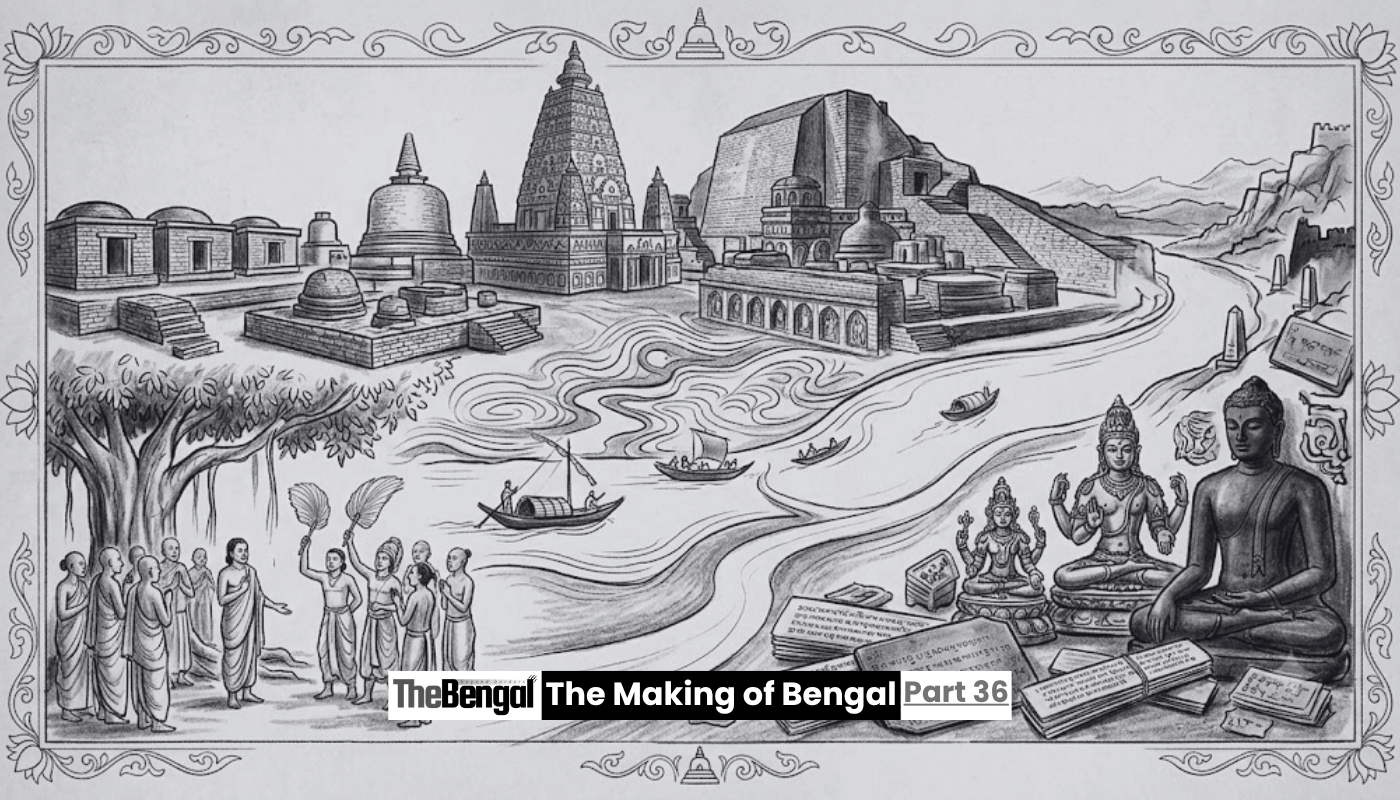
If Pala military and political achievement forms one half of this dynasty’s claim to greatness, its religious and cultural legacy forms the other, and arguably the more enduring one. As the last major imperial power in the Indian subcontinent to actively champion Buddhism at exactly the historical moment the religion was declining almost everywhere else on the subcontinent, the Palas built and sustained an interconnected network of monastic universities without real parallel elsewhere in the medieval Buddhist world.
Gopala had already begun this pattern with Odantapuri, examined in the previous section of this series. Dharmapala went considerably further, founding the Vikramashila Mahavihara around 783 CE, an institution that would go on to rank alongside Nalanda as one of the two most important centres of Buddhist learning anywhere in Asia for the next three centuries, and constructing the Somapura Mahavihara at Paharpur, described in a later Nalanda inscription as pleasing to the eyes of the world, and recognised by architectural historians as having influenced Buddhist temple design as far afield as Myanmar and Indonesia, a connection this series will examine in far greater depth in a dedicated later chapter. Under Devapala, Nalanda itself, already centuries old by this point, entered what many historians consider its own golden age, drawing monks and scholars from Tibet, Nepal, China and Southeast Asia, with Bengali-trained monks in turn carrying Buddhist teaching outward as far as Java and Sumatra, a two-way scholarly traffic this series will follow in detail in its chapters on Bengal’s connections to the wider Buddhist world.
Not a Straight Line, but a Genuinely Resilient One
What separates the Palas most sharply from every dynasty examined earlier in this series is not simply longevity but resilience under genuine strain. Following Devapala’s death, the empire entered what historians studying the period describe as a long phase of stagnation, roughly from 861 to 995 CE, during which weaker successors lost significant territory to rivals including the Rashtrakutas and the Gurjara-Pratiharas, with the latter’s ruler Mahendrapala reportedly penetrating as far as northern Bengal itself. This is precisely the kind of prolonged institutional weakness that had permanently doomed earlier Bengali kingdoms explored in this series, Shashanka’s Gauda collapsing within months of his death, the Khadga dynasty fading into obscurity after barely four generations.
The Palas did not collapse the same way. Mahipala I, reigning from roughly 988 to 1038 CE, achieved what historians frequently describe as a genuine second founding of the dynasty, reclaiming lost territory across Bengal and Bihar and extending Pala influence as far as Varanasi. Even after his death brought renewed weakness, and after a peasant revolt known as the Kaivarta rebellion temporarily overthrew and killed his successor Mahipala II, the dynasty found one further reserve of strength in Ramapala, reigning from around 1077 to 1120 CE, who suppressed the rebellion, restored Pala authority across northern Bengal, and extended influence once more into Assam and Odisha, becoming, in the judgement of most historians, the last genuinely significant Pala ruler.
That capacity for repeated institutional recovery, not once but twice, across more than a century of documented decline, is something this series has not encountered from any earlier Bengali kingdom, and it is arguably the strongest single argument for treating the Palas as Bengal’s most genuinely successful dynasty rather than simply its longest-lived.
A Title Worth Questioning
And yet the question posed in this chapter’s own title deserves to be taken seriously rather than answered with simple celebration. The Pala Empire’s greatest strength, its consistent commitment to Buddhist patronage across four centuries, ultimately became inseparable from one of its greatest vulnerabilities. As Buddhism’s broader position across the Indian subcontinent continued weakening throughout this same period, the Palas’ own fortunes, closely tied to a religion in decline elsewhere, arguably declined in tandem, a connection multiple modern historians draw explicitly when explaining the dynasty’s eventual eclipse. The elective principle that gave Gopala his unusual legitimacy, examined at length in the previous section of this series, also periodically produced succession uncertainty in later generations, precisely the kind of instability a purely hereditary system might have avoided. And for all their military reach into Kannauj, Assam and Odisha, the Palas never converted these campaigns into permanent territorial control outside their Bengal and Bihar heartland, winning battles and placing protégés on distant thrones without ever fully absorbing the northern Indian empire they spent nearly a century contesting.
Whether four centuries of documented resilience, genuine cultural achievement and religious patronage outweighs these real limitations is not a question this series intends to settle in a single opening chapter. What is not in dispute is scale. No dynasty examined anywhere earlier in this series, not Gangaridai, not the Mauryan administration, not Shashanka’s brief but consequential kingdom, ruled longer, reached further, or left a more legible physical and cultural record than the one built from Gopala’s improbable election.
In the next chapter of this series, we look more closely at the son who took his father’s stabilised kingdom and turned it into a genuine contender for the mastery of northern India: Dharmapala, and the empire-building ambition that defined his reign.
Sources: Wikipedia, “Pala Empire”; Grokipedia, “Pala Empire”; Britannica, “Pala Dynasty”; Banglapedia, “Pala Dynasty”; Itihaas, “Pala Empire at Its Height (8th-12th Century CE)”; The Indosphere, “Pala Dynasty & The Golden Age of Buddhism”; Ancient Origins, “The Pala Empire: An Indian Dynasty Ruled by Protectors of Buddhism”; NextIAS, “Palas Dynasty: Rulers, Administration, Religion, Economy”; Studocu, “The Pala Dynasty: A Historical Overview of Bengal’s Glory.”