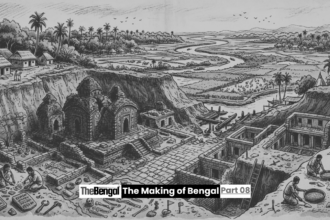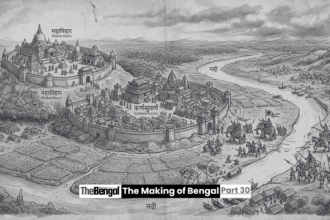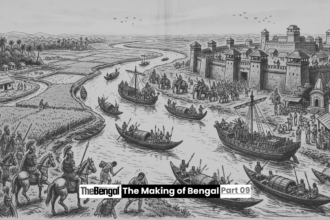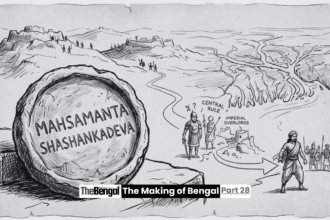


This article is part of The Making of Bengal, a long-form historical series by The Bengal. Previous chapters explored the mythic and epic-era memory of Bengal’s tribal kingdoms, Vanga, Pundra, Suhma and Anga, as recorded centuries later in the Mahabharata and the Puranas. This chapter marks a turning point in the series itself: the moment Bengal stops being known only through later literary memory and starts appearing in a document written at the time, by the administration that actually governed it.
A Labourer’s Discovery
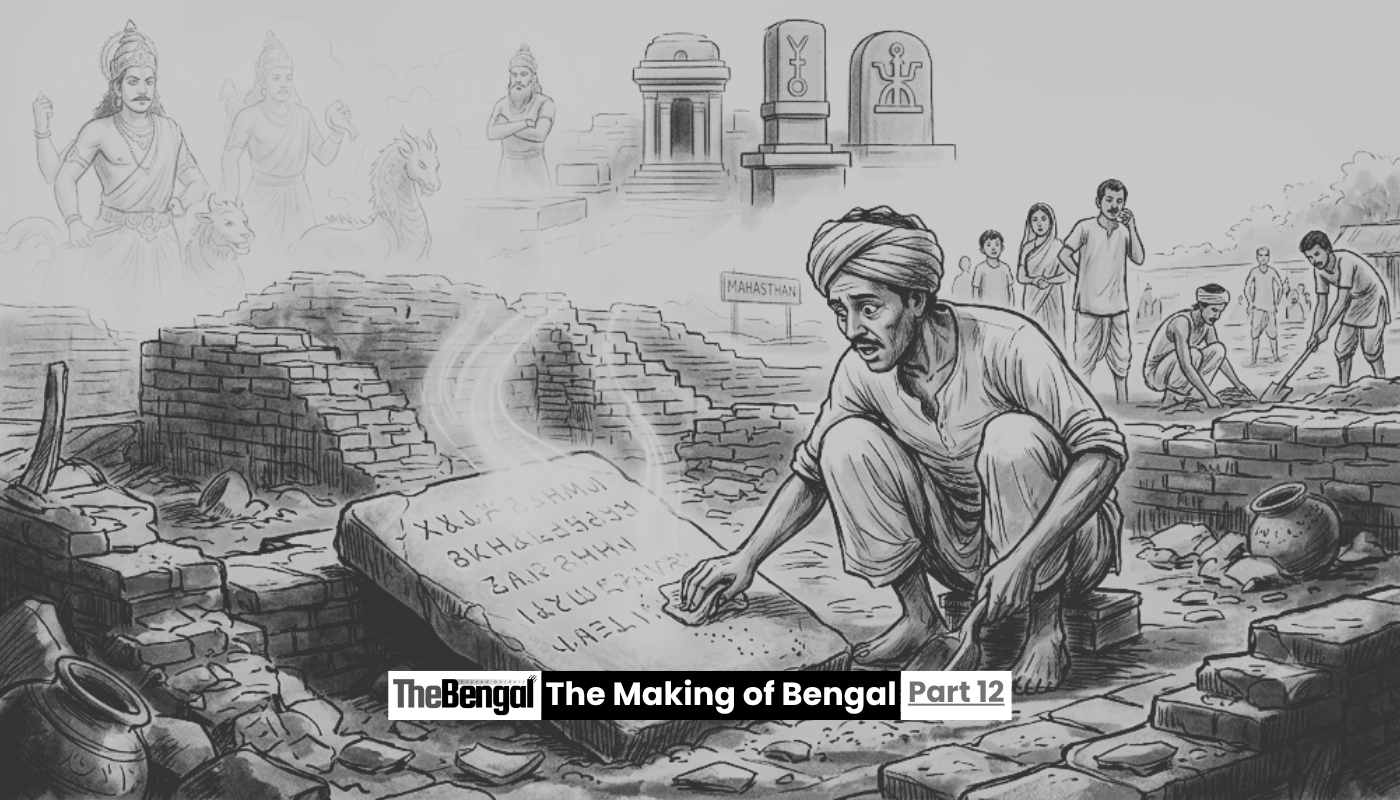
The story of how this inscription came to light is almost as striking as its contents. On 30 November 1931, in the village of Mahasthan in what is now Bogra district, Bangladesh, a day labourer working amid the ruins of an ancient citadel came across a small, damaged limestone slab. What he had found, though nobody could have known it immediately, was the oldest piece of writing ever recovered from the Bengal region, a fragment of administrative correspondence more than two thousand years old.
The stone itself is modest: a circular slab bearing seven lines of text in the Brahmi script, parts of it broken and lost, making a full and confident reading impossible even today. Scholars who have since studied the inscription, including D.R. Bhandarkar and D.C. Sircar, generally agree on its broad meaning even where individual words remain disputed, and palaeographers date its script firmly to the Mauryan period, roughly the third century BCE, placing it in the same general era as the famous edicts of Emperor Ashoka.
An Order From the Centre of an Empire
What makes the Mahasthan inscription remarkable is not its size but its content. This is not a religious dedication, a royal boast, or a funerary record, the kinds of texts that usually survive from the ancient world. It is, in essence, a piece of bureaucratic correspondence: an administrative order, issued by an imperial authority, instructing a local official on how to manage a crisis.
The text is addressed to a mahamatra, a high-ranking administrative and judicial officer in the Mauryan system, stationed at a city the inscription calls Pudanagala, understood by scholars to be a rendering of Pundranagara, the ancient name for the settlement now known as Mahasthangarh. The order instructs this official to relieve distress being suffered by a group referred to as the Samvangiyas, apparently the local inhabitants of the town, by opening a government storehouse, a kosthagara, and releasing its contents.
According to Banglapedia’s summary of the text, the storehouse in question was to be stocked with four essential requisites: oil, grain, unspecified “tree” produce, and coin, specifically two units of shell-based currency known as gandaka and kakanika, each representing a small denomination built from cowrie shells. The order further specifies that this reserve was meant to guard against emergencies caused by flood, fire, or the destruction of crops, in one especially vivid detail, even naming crop damage caused by parrots as a recognised hazard the storehouse needed to cover.
This is, in other words, an ancient famine and disaster relief decree, comparable in spirit to some of Ashoka’s own recorded edicts on relief efforts elsewhere in the empire, though scholars remain divided on whether the Mahasthan inscription should be dated precisely to Ashoka’s own reign or to the broader Mauryan period surrounding it.
The First Proof of Mauryan Authority in Bengal
Beyond its immediate content, the inscription carries enormous significance simply by existing where it does. As Banglapedia puts it, the historical importance of the record lies in the fact that it is the earliest evidence suggesting Mauryan authority over the Pundravardhana region, and it provides the first definite evidence of urbanisation in Bengal.
That is a substantial claim, and it is worth sitting with. Everything discussed in earlier chapters of this series, the tribal kingdoms of Vanga and Pundra remembered in the Mahabharata, the reputation of Gangaridai among Greek and Roman writers, the archaeological finds at Chandraketugarh and Wari-Bateshwar, relies on inference, later literary memory, or physical remains that must be interpreted and dated indirectly. The Mahasthan inscription is different. It is a contemporary document, written by the administration actually governing the region at the time, naming a real official, a real city, and a real population, and describing a real act of governance.
It also confirms something that classical sources could only imply: that by the third century BCE, Bengal, or at least the Pundravardhana region in its north, had been absorbed firmly enough into the Mauryan Empire that its officials were issuing detailed, practical administrative orders there, on the same footing as anywhere else in Mauryan territory. The independent tribal kingdoms remembered in epic literature had, by this point, given way to something new: a province governed from the centre of one of the largest empires the ancient world had yet seen.
The City Behind the Inscription
The inscription is also our clearest window yet onto Pundranagara itself, the city now known by its later name, Mahasthangarh, in Shibganj upazila of Bogra district. Archaeologically, Mahasthangarh is recognised as the earliest confirmed urban site anywhere in present-day Bangladesh, and the fortified core of the city remained in continuous use from the Mauryan period all the way through to the eighth century CE, an extraordinary span of urban continuity by any standard.
The city’s name itself carries layers of later meaning. Mahasthan roughly translates to a place of excellent sanctity, with garh meaning fort, a name first recorded in a thirteenth century Sanskrit text called the Vallalcharita, centuries after the Mauryan inscription was carved. An anonymous text known as the Karatoya Mahatmya, likely composed around the same period, refers to the same location using two additional names, Pundrakshetra, meaning land of the Pundras, and Pundranagara, city of the Pundras, both directly echoing the ancient territorial name discussed in the previous chapter of this series. Later still, a Persian-influenced administrative decree from 1685 referred to the site as Mastangarh, a hybrid Sanskrit-Persian name meaning the fortified place of an auspicious personage, a label that eventually settled into the modern name Mahasthangarh.
This layering of names, Pundranagara under the Mauryas, Pundrakshetra in medieval Sanskrit tradition, Mastangarh under later Persian-influenced administration, traces, in miniature, the same long arc this series has been following: a city and a region continuously renamed and reclaimed by successive political and cultural powers, yet never entirely losing the thread connecting it back to its earliest recorded identity.
A Fragmentary but Priceless Record
It would be a mistake to overstate how much this single inscription actually tells us. Several words remain genuinely uncertain, and later academic analysis, including the detailed epigraphic study published in Epigraphia Indica, shows scholars working carefully through damaged letters, disputed readings and competing reconstructions of individual words. Much of what the inscription communicates survives only in fragments, quite literally, since parts of the stone itself are broken and lost.
And yet, fragmentary as it is, the Mahasthan Brahmi inscription remains the single most important written source available for understanding how Bengal looked and functioned in the third century BCE. It confirms Mauryan administrative presence in the region, documents a functioning monetary system built around cowrie-based currency, records deliberate state planning for famine and disaster relief, and names, however imperfectly, a real city and a real population that history had otherwise left almost entirely to myth and inference.
Bengal’s entry into recorded history, then, did not arrive with a grand declaration or a monument to conquest. It arrived as an emergency food order, carved into limestone by a distant imperial bureaucracy, buried for over two thousand years, and finally uncovered by an unnamed labourer whose own name history never bothered to record at all.
In the next chapter of this series, we look more broadly at Ashoka’s Bengal, examining why the Mauryan Empire needed this distant delta province, and what its incorporation meant for the wider imperial project centred at Pataliputra.
Sources: Wikipedia, “Mahasthan Brahmi Inscription” and “Mahasthangarh”; Banglapedia, “Mahasthan Brahmi Inscription”; Grokipedia, “Pundravardhana”; Epigraphia Indica XXI, D.R. Bhandarkar, “Mauryan Brahmi Inscription of Mahasthan”; IAS Bio and LotusArise, “Ashoka’s Inscriptions for Famine Relief”; Wikipedia, “Early Indian epigraphy.”