

This article is part of The Making of Bengal, a long-form historical series by The Bengal. The previous three chapters traced Shashanka’s rise, his character and contested religious legacy, and the short, turbulent life of the kingdom he built at Karnasuvarna. This chapter closes the story by asking a different kind of question: not what Shashanka did, but why historians still cannot agree on how to judge it.
A Problem Built Into the Sources Themselves
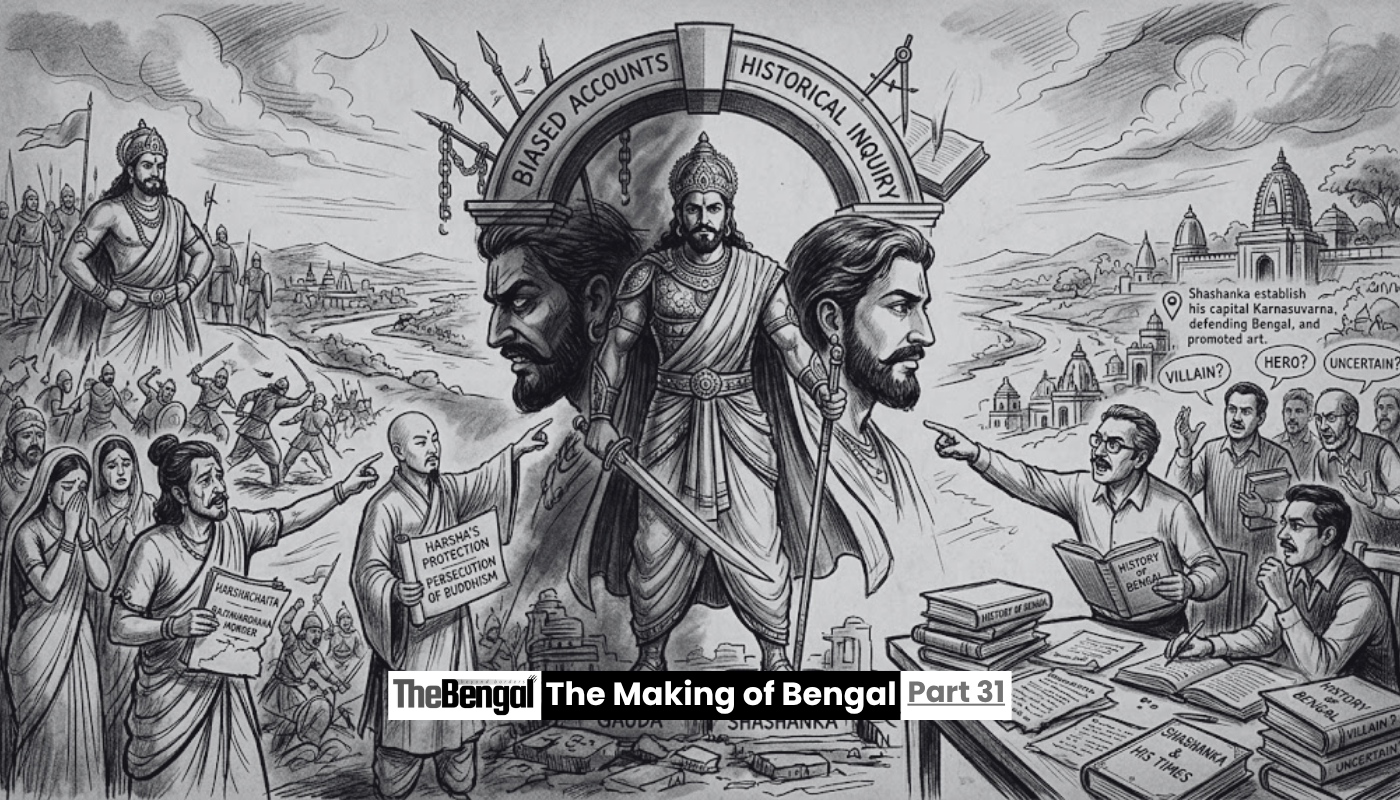
Every historical figure is, to some degree, at the mercy of whoever happened to write about them. Shashanka’s case is unusually stark. As the previous chapter of this series already began to explore, the two most detailed contemporary literary accounts of his reign both come from parties with clear reason for hostility. Banabhatta composed the Harshacharita as court poet to Harshavardhana, whose brother Rajyavardhana had, by most accounts, died as a direct result of Shashanka’s political manoeuvring. Xuanzang, meanwhile, travelled through India and recorded his observations of Shashanka’s alleged persecution of Buddhism while journeying largely under the goodwill and protection of Harsha’s own court, the same Harsha who spent much of his reign at war with Gauda.
This is not a minor methodological footnote. It means that almost everything modern readers know about Shashanka’s personality and conduct passes through the pen of people allied against him. Historians reconstructing his reign are, in effect, working almost entirely from testimony gathered from the losing side’s enemies, a genuinely difficult position for anyone trying to write balanced history, and one that goes a long way toward explaining why serious scholars continue to reach such different conclusions from the same limited body of evidence.
Majumdar’s Skepticism, and the Pushback It Received
The clearest expression of this scholarly divide can be traced through a direct exchange between two respected historians, already introduced in an earlier chapter of this series. Ramesh Chandra Majumdar, the influential Bengali historian who authored the landmark 1943 History of Bengal and went on to edit the eleven-volume History and Culture of the Indian People, examined the twelfth-century Manjushri-Mula-Kalpa’s account of Shashanka’s Bodhi tree destruction and judged it doubtful, arguing it was unsafe to treat statements written roughly five centuries after the fact as reliable history.
Radhagovinda Basak offered a direct counter-argument. There was, Basak maintained, no obvious reason to assume the twelfth-century Buddhist author who recorded this account carried any personal animosity toward a king who had died five hundred years before he was even writing, and the author may simply have been preserving a genuine historical memory of events as they had actually unfolded in the seventh century. Neither position has definitively won out. Modern accounts of Shashanka’s reign, this series’ own earlier chapters included, generally present both views side by side rather than declaring a clear winner, precisely because the underlying evidence genuinely permits either reading.
A King Claimed by Bengali Nationalism
Beyond the narrow evidentiary dispute over religious persecution lies a second, broader layer to this historiographical divide, one rooted less in the seventh century than in the early twentieth. Shashanka’s rediscovery and elevation as a major historical figure coincided closely with a period of intense Bengali intellectual and cultural revival, the same era that produced Rabindranath Tagore’s literary nationalism and a broader movement to recover and celebrate a distinctly Bengali historical identity separate from British colonial narratives.
Within this context, Shashanka’s story carried an obvious symbolic charge. The Bengali antiquarian Akshay Kumar Maitreya, reflecting on Gauda’s legacy, argued that any serious history of Bengal needed to begin with Gaur, precisely because the whole region and even the Bengali language itself had once carried Gauda’s own name. Modern academic surveys of Shashanka’s reign describe him plainly as a symbolic figure in the region’s aspirations for independence and self-rule, a description that reveals as much about how twentieth-century Bengali scholars wanted to read their own history as it does about the seventh-century king himself. A ruler who had broken free from outside imperial control, minted his own currency, and successfully resisted, for decades, the combined pressure of the two most powerful kings of his era offered an unusually apt ancestor figure for a Bengali intelligentsia then living under a very different but equally unwelcome form of outside rule.
This is not to suggest that Shashanka’s genuine historical achievements were invented by nationalist-era historians. The core facts, his break from Later Gupta overlordship, his unification of Gauda, Vanga and Samatata, his decades of successful resistance against Harsha, examined across the previous three chapters of this series, rest on solid inscriptional and numismatic evidence independent of any later ideological framing. What nationalist-era scholarship did was select which parts of that record to emphasise, and how to interpret the genuinely ambiguous parts, in ways that suited the political and cultural mood of their own time.
Even His Bloodline Remains Disputed
The disagreement extends further still, down to the basic question of who Shashanka actually was before he became king. R.D. Banerji, a professor of ancient Indian history whose earlier archaeological work at Chandraketugarh was explored in a much earlier chapter of this series, argued that Shashanka carried genuine royal blood from the Later Gupta line, possibly as a son or nephew of Mahasenagupta himself. The historian Padmanath Bhattacharya reached a similar conclusion, treating Shashanka specifically as Mahasenagupta’s son. Other historians, working from the same limited evidence, including the Rohtasgarh seal identifying him only as a mahasamanta serving an unnamed overlord, have reached rather different conclusions, with historian D.K. Ganguly instead concluding that Shashanka was a native of Magadha with no clearly established royal lineage at all, a self-made regional figure rather than a displaced Gupta prince.
Neither position can currently be proven decisively, and this uncertainty runs directly parallel to the unresolved question, examined in an earlier chapter of this series, of exactly whose feudatory Shashanka had originally been. Even the most basic facts of his early life remain genuinely contested territory, subject to reconstruction rather than confirmed record.
A Figure Too Important to Leave Unclaimed
What makes Shashanka such an unusually persistent subject of historical argument is precisely this combination of genuine importance and genuine evidentiary thinness. He was, by essentially universal scholarly agreement, the first ruler to unify a meaningful portion of Bengal under independent, native rule, a milestone significant enough that no serious history of the region can skip past it. Yet almost everything beyond that basic achievement, his religious conduct, his ancestry, even the precise nature of his original feudatory status, survives only through fragments, hostile testimony, and later texts written centuries after his death.
That combination, undeniable significance paired with deeply contested detail, is exactly the kind of gap into which competing historical interpretations naturally rush. Colonial-era Buddhist sympathisers, twentieth-century Bengali nationalists, careful source-critical scholars like Majumdar, and his own contemporary critics like Basak have all, in their different ways, filled that gap according to their own priorities and assumptions. None of them were working from significantly better raw evidence than any of the others. They were working from the same handful of inscriptions, the same hostile chronicle, the same pilgrim’s account, and reaching, quite legitimately, rather different conclusions.
Fourteen centuries after his death, Shashanka remains exactly what this final chapter’s opening promised: not a settled historical figure, but an argument still being had, one that says as much about the historians conducting it as it does about the king they are all still trying, imperfectly, to understand.
In the next chapter of this series, we leave the fractured, hard-won kingdom of Gauda behind and turn to what followed its collapse, the chaotic, poorly documented period historians often call Bengal’s dark century, and the very different kind of king who would eventually emerge to end it.
Sources: Wikipedia, “Shashanka” and “R. C. Majumdar”; Wikiwand, “Shashanka”; Grokipedia, “R. C. Majumdar”; Studocu, “Shashanka: The First Independent King of Gauda (590-625 CE)”; The Daily Observer, “Remembering the Forgotten King of Bengal”; Wikipedia, “Historiography of India.”