

This article is part of The Making of Bengal, a long-form historical series by The Bengal. In the previous chapter, we followed the story of how Gangaridai’s reputation for military strength reportedly convinced Alexander the Great’s own army to mutiny rather than face it. This chapter turns from that dramatic non-event to something more concrete: what the physical remains buried beneath Bengal’s soil actually tell us about the kingdom itself.
A City Rediscovered in Fragments
Chandraketugarh, the mounded site near Berachampa in North 24 Parganas discussed in an earlier chapter of this series, remains the single strongest physical lead scholars have on Gangaridai. Since intermittent excavations began in 1956, led at various points by the Ashutosh Museum of the University of Calcutta, the Archaeological Survey of India, and the Centre for Archaeological Studies and Training, the site has produced a long, if incomplete, record of occupation. Archaeologists involved in the digs have concluded that the settlement was at its most extensive between roughly 200 BCE and 200 CE, with clear evidence that people had lived there even earlier, in the pre-Mauryan period, and continued through the Sunga, Kushana, Gupta and Pala-Sena eras.
What makes Chandraketugarh compelling as a candidate for a Gangaridai capital is not just its age but its scale and character. The site covers an estimated 80 hectares, encircled by a high rampart wall and moat, structural features consistent with a genuine fortified town rather than a village that simply grew large by accident. Within that enclosure, excavators have recovered an extraordinary range of finds: finely modelled terracotta plaques and figurines, pottery, jewellery, and coins, evidence, taken together, of a wealthy, artistically sophisticated urban population rather than a subsistence farming community.
Coins That Point to the Sea
Among the most telling discoveries at Chandraketugarh are its coins. Archaeologists have recovered numerous silver punch-marked coins, the characteristic currency of the Mauryan and pre-Mauryan economies, alongside a small number of gold coins, including one associated with the later Gupta rulers Chandragupta and Kumaradevi. One coin in particular has drawn special attention from historians: a so-called dolphin-type punch-marked coin, whose imagery is widely read as a signal of seafaring activity, a small but suggestive clue that the people minting and using this currency were engaged in maritime trade rather than purely inland commerce.
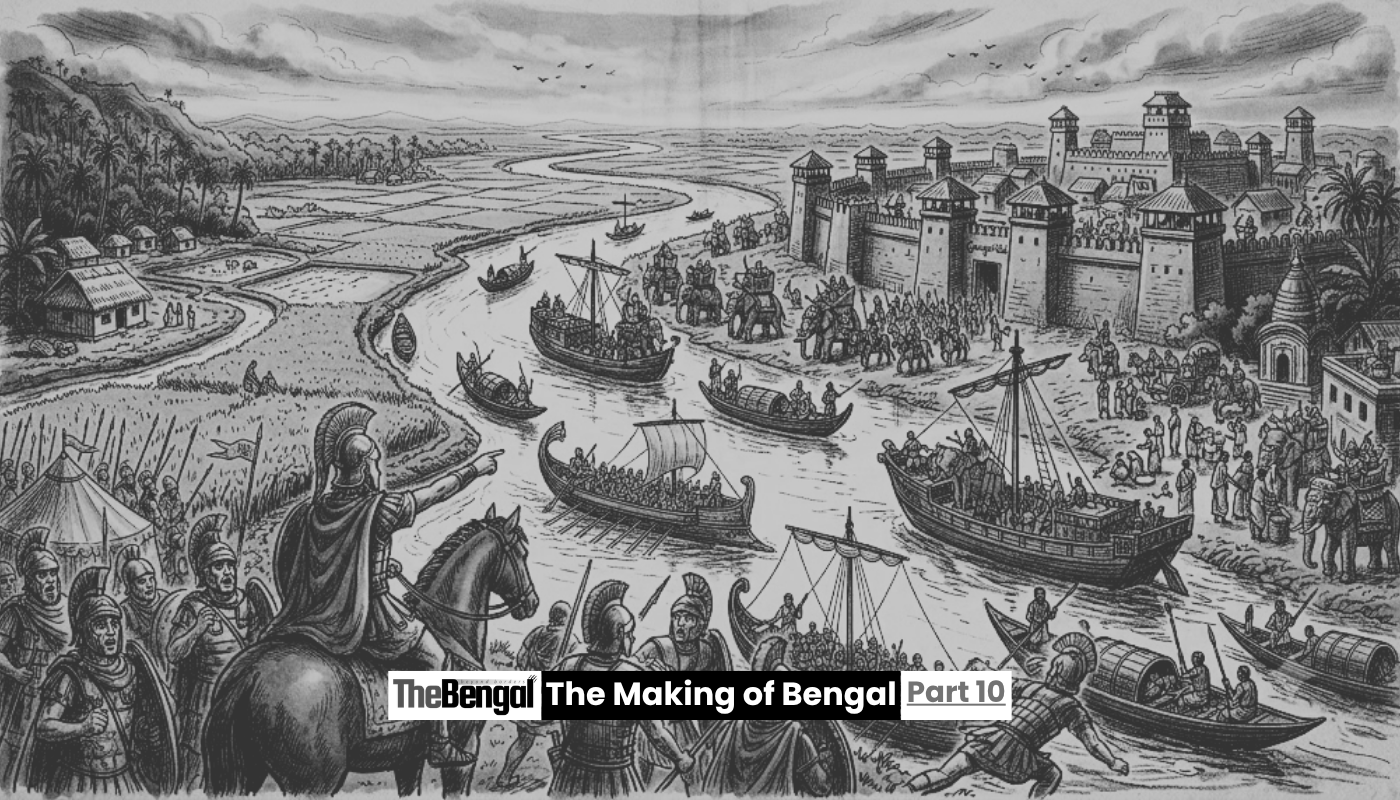
That reading fits neatly with the site’s geography. Chandraketugarh sits beside what is now the largely silted-up Bidyadhari River, but in antiquity this was a far larger and more navigable waterway, one that connected directly to the Bay of Bengal. A settlement positioned at that junction, between an inland river system and open sea access, is exactly the kind of location one would expect for a port city engaged in long-distance exchange, and it lines up closely with the classical description of Gange, the capital city Ptolemy assigned to the Gangaridai in his second-century Geographia, situated at the mouths of the Ganges.
An Echo Across the Delta
Chandraketugarh does not stand alone in offering this profile. As explored in an earlier chapter of this series, the site of Wari-Bateshwar in Narsingdi district, in present-day Bangladesh, presents a strikingly similar archaeological signature: fortification ramparts, a deliberately planned street grid including a road running more than 180 metres, minted silver coins, and imported goods pointing toward trade connections reaching as far as Southeast Asia and the Roman world. Some scholars have proposed that Wari-Bateshwar corresponds to Sounagoura, another emporium named by Ptolemy, distinct from Gange but part of the same broader network of delta trading centres.
Taken together, these two sites, one associated with Gangaridai in the western delta, the other with a separate but comparably wealthy emporium in the east, suggest that whatever political shape Gangaridai actually took, it existed within a delta-wide pattern of fortified, trade-oriented urban centres, rather than as a single isolated capital surrounded by empty countryside. Historians researching Bangladesh’s ancient past have described this pattern plainly: far from being a simple rural hinterland, the delta region functioned as an important and interconnected link in early historic urban and commercial networks stretching across both modern countries.
Guesswork Wearing the Clothes of Certainty
For all that archaeology has added to the picture, it is worth being honest about how much remains genuinely unresolved. No inscription recovered from Chandraketugarh, Wari-Bateshwar, or any other candidate site has yet named a ruler of Gangaridai, confirmed a capital by name, or offered anything close to a native account of the kingdom’s own history. Everything connecting these physical ruins to the Greek and Roman name Gangaridai rests on a chain of inference: geography that roughly matches classical descriptions, material wealth consistent with the kind of power that could field the described armies, and timing that roughly overlaps with when Alexander’s contemporaries were writing.
Some researchers have gone further still, proposing more specific but unproven links. A team from IIT Kharagpur has floated the idea that Chandraketugarh’s legendary founder, the little-known king Chandraketu, may in fact be the same figure the Greek writer Megasthenes referred to as Sandrocottus, a name usually identified with Chandragupta Maurya. If true, that would tie the site directly to one of the most consequential dynasties in Indian history. It remains, however, a contested and unconfirmed theory rather than an established fact, one more layer of speculation on a site that has generated a great deal of it.
Grokipedia’s summary of current scholarship captures the tension well: while classical sources link the Gangaridai’s territory and capital to the region around Pataliputra and describe extensive trade in goods like rice, textiles and pearls through delta ports, archaeological evidence from sites such as Chandraketugarh is generally read as supporting an identification with the indigenous Vanga kingdom of ancient Bengal specifically, rather than confirming any single, tidy narrative connecting Greek report to Bengali ground.
A Museum for a Kingdom That Left No Voice
The West Bengal state government has, in recent years, moved to formalise this uncertain but compelling story, planning a museum intended to showcase what officials describe as Bengal’s forgotten history: its maritime links to ancient Greece and Rome, and the terracotta art and relics recovered from Chandraketugarh itself. It is a fitting, if slightly ironic, way to memorialise Gangaridai. A kingdom known to the ancient world almost entirely through the fear it inspired in someone else’s army is now being reconstructed, piece by fragmentary piece, through the pottery shards, coins and terracotta figures its own people left behind, without a single inscription in which they get to speak for themselves.
What emerges from this evidence is neither a confirmed capital nor a named king, but something more like a silhouette: a delta civilisation wealthy enough to mint its own coinage, connected enough to trade across the Bay of Bengal, and fortified enough to defend itself, all consistent with the kind of power capable of making the son of Philip of Macedon think twice. The details Greek writers never bothered to record, and Bengali sources of the time never managed to preserve, remain buried, quite literally, under the same soil that has already given up Chandraketugarh’s coins and Wari-Bateshwar’s roads.
In the next chapter of this series, we move forward into the era of the Mauryas, tracing how the empire that eventually absorbed much of northern India dealt with Bengal, and whether the delta’s fearsome reputation held up once a new and very different kind of Indian power came calling.
Sources: Wikipedia, “Gangaridai” and “Chandraketugarh”; Grokipedia, “Gangaridai”; Homegrown India, “The Lost Kingdom of Gangaridai: The Bengal Power That Stopped Alexander”; Indrosphere, “The Mighty Gangaridai: Power & Influence in Ancient India”; Harvest Journal, “Chandraketugarh & Khana Mihirer Dhipi”; The Better India, “What Connects Indus Valley Civilisation to Bengal?”; jarniascyril.com, “History of Bangladesh: From Ancient Origins to Independence.”