
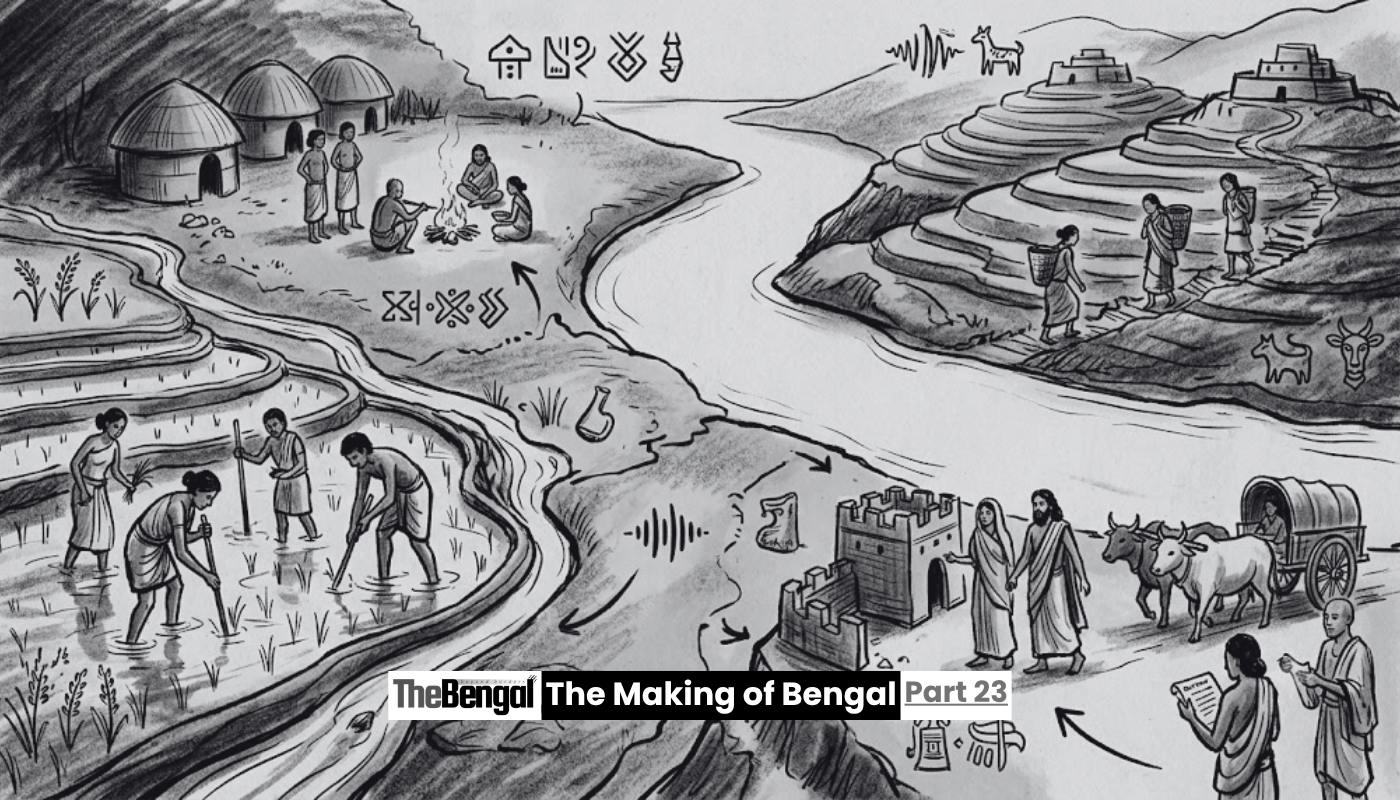

This article is part of The Making of Bengal, a long-form historical series by The Bengal. The previous section closed with a look at family life, fashion and society across the delta’s early historic cities. This chapter turns to something even more fundamental: what language, or languages, the people living in that world actually spoke, long before Bangla itself came into being.
A Delta That Was Never Linguistically Empty
It is tempting to imagine ancient Bengal’s linguistic story beginning with the arrival of Indo-Aryan speakers and their Prakrit dialects. The evidence suggests something considerably older and more layered. Researchers studying the pre-modern linguistic landscape of the wider Bengal region describe a substrate of indigenous Austroasiatic languages spoken by early inhabitants, later overlaid, rather than simply replaced, by Indo-Aryan vernaculars introduced through successive waves of migration.
These Austroasiatic tongues are closely associated with the ancient rice-farming communities that migrated from mainland Southeast Asia through northeast India roughly two to four thousand years ago, precisely the same broad timeframe and migratory logic discussed in an earlier chapter of this series covering how rice itself transformed Bengal. Traces of this older linguistic layer have not vanished entirely. Linguists studying modern Bengali have identified Austroasiatic influence surviving in the language’s phonology and vocabulary, particularly in words describing local flora and fauna, plants, animals and features of the landscape for which the incoming Indo-Aryan speakers apparently had no ready equivalent term of their own, and simply absorbed the existing local word instead.
Alongside this Austroasiatic layer, scholars also point to a documented Tibeto-Burman presence, associated with hill and forest communities likely connected to the wider northeastern region explored in earlier chapters of this series, Assam and Tripura among them, along with a more debated but still noted Dravidian linguistic influence, evidence that Bengal’s pre-Aryan population was never linguistically uniform to begin with.
The Arrival of Prakrit
Indo-Aryan speech reached Bengal gradually rather than all at once, arriving through the Magadhi Prakrit, an eastern Middle Indo-Aryan dialect that became the prevalent spoken language across the wider Gangetic valley from around the third century BCE onward. This is not an abstract linguistic detail. It is directly tied to physical evidence already discussed in this series: the Mahasthan Brahmi inscription, Bengal’s oldest surviving written record, examined in an earlier chapter, was itself composed in Prakrit using the Brahmi script, a direct, dateable example of this eastern Indo-Aryan speech being used for real administrative business in the region during exactly this period.
Crucially, Prakrit functioned as the everyday spoken medium, the language of markets, households and local administration, while Sanskrit and Pali occupied a very different social register, reserved largely for elite literary and religious discourse among priests, scholars and Buddhist teachers. This linguistic division mirrors, in its own way, the social stratification already explored in the previous chapter of this series, where wealthier households used finer pottery than their poorer neighbours. Language, too, appears to have carried its own class markers, with formal Sanskrit and Pali sitting above the everyday Prakrit spoken by most of the population.
Three Sister Languages From One Eastern Prakrit
Bengali did not develop in isolation, and it did not develop alone. According to Banglapedia’s own account of the language’s history, Bangla emerged as a distinct new Indo-Aryan language by roughly 900 to 1000 CE, evolving through two intermediate stages known as Magadhi apabhramsha and abahattha, both descended from the broader Magadhi Prakrit that had been spoken across the region between roughly 600 BCE and 600 CE. Bangla did not emerge alone during this process. Two closely related Indo-Aryan languages, Oriya and Assamese, developed from the very same eastern Prakrit lineage at roughly the same time.
The closeness of this relationship persisted for centuries. Banglapedia notes that until as late as the fourteenth century, there was reportedly little meaningful linguistic difference between Bangla and Assamese, a detail that connects directly back to the wider regional history this series has followed, spanning present-day West Bengal, Bangladesh, Assam and Tripura. Wikipedia’s account of Bengali’s linguistic descent traces this connection even further back structurally, describing the ancestor of modern Bengali as descending through what linguists term the proto-Gauda-Kamarupa line of proto-Magadhan speech, a lineage whose very name, pairing Gauda in Bengal with Kamarupa in Assam, encodes this shared ancestry directly into its scholarly classification.
A Name That May Not Be Indo-Aryan At All
Perhaps the most genuinely surprising thread in this story concerns the very word Bangla itself. The conventional account traces the name back to Vanga, the ancient janapada explored in an earlier chapter of this series, one of the tribal kingdoms remembered in the Mahabharata and the Puranas.
An alternative hypothesis complicates that tidy derivation considerably. According to this competing account, the term Bangalah may not derive directly from the Sanskrit Vanga at all, but instead from vangala, a word belonging to the Boro language, a Tibeto-Burman tongue associated with the northeastern region, where it is said to mean simply wide land. On this reading, the name would have passed from Boro into regional usage as vangala, later rendered as Bangalah under Turko-Persian administrative spelling, before finally settling into the modern form Bangla, and its Anglicised rendering, Bengal.
Whether or not this specific etymology holds up to further scrutiny, and scholars remain divided on the question, its very existence as a serious proposal underlines something important that this whole chapter has been building toward: the name of Bengal itself, and quite possibly the deep linguistic ancestry beneath it, may owe as much to the Tibeto-Burman-speaking communities of the northeast as to the Sanskrit and Prakrit traditions more commonly credited with shaping the region.
Not a Straight Line, But a Collision
Perhaps the most significant recent challenge to how this whole story has traditionally been told comes from linguistic research questioning the standard, tidy narrative of Bengali descending in an unbroken, linear fashion from Magadhi Prakrit over a thousand years. That traditional framework, researchers argue, fails to account for the genuine multilingual complexity of Bengal’s ancient linguistic landscape and glosses over the disappearance of whatever transitional language varieties must have existed along the way.
The alternative model proposed instead treats proto-Bangla’s emergence as a genuine product of sustained language contact, arising from centuries of interaction between incoming Indo-Aryan superstrate languages and the older non-Aryan substrate languages, Austroasiatic, Tibeto-Burman and Dravidian, already spoken across what this research calls the Banglavarta region, beginning as early as the fifth century BCE. On this account, successive waves of political and religious change, Aryanisation, the spread of Buddhism, later Hinduisation and, much later, Islamisation, each created their own distinct multilingual environments, with genuine pidginisation and creolisation processes at work rather than one language simply and smoothly replacing another over the centuries.
This is a more complicated, and arguably more honest, picture than the traditional single-line family tree most language histories present. Bangla, on this reading, was never simply Magadhi Prakrit slowly wearing down into a new shape over a thousand years of quiet, uneventful drift. It was the product of genuine collision and blending, between incoming Indo-Aryan speech and the older rice-farming, forest-dwelling and hill communities already living across the delta and its surrounding uplands, the same layered, mixed population this series has been tracing since its very first chapter on Bengal’s earliest settlers.
A Language Built From Many Tongues
What emerges from all of this is a picture considerably richer than a simple story of Sanskrit slowly turning into Bengali. Ancient Bengal was home to Austroasiatic rice farmers whose words for local plants and animals still survive buried in modern Bengali vocabulary, to Tibeto-Burman-speaking communities in the hills and northeast whose language may have given the region its very name, to a scattered Dravidian linguistic presence, and eventually to Indo-Aryan Prakrit speakers whose everyday eastern dialect, recorded for the first time on the Mahasthan inscription, would slowly, unevenly, and through genuine contact rather than simple replacement, give rise to the language that would eventually become Bangla.
That process took well over a thousand years, and by the time it finished, sometime around the turn of the first millennium CE, Bengal had not lost its older linguistic layers so much as absorbed and folded them into something new, a language, like the delta itself, built up gradually from many different sources meeting in the same low, fertile ground.
In the next chapter of this series, we turn to the gods worshipped across this same layered linguistic landscape, tracing the religious world of ancient Bengal before Buddhism and Brahmanical Hinduism reshaped it in the centuries that followed.
Sources: Grokipedia, “Languages of Bangladesh”; Wikipedia, “Bengali language”; Banglapedia, “Bangla Language”; Online-Bangla, “History of the Bengali Language”; The Daily Star, “Evolution of Bangla”; Talkpal, “What Are the Linguistic Origins of the Bengali Language?”; Academia.edu, “The Origin and Development of the Bengali Language: An Overview”; ResearchGate, “On the Process of Creation of Proto-Bangla (Bengali): The Case of Language Contact.”