

This article is part of The Making of Bengal, a long-form historical series by The Bengal. The previous chapter traced the overland routes linking Bengal to Yunnan, Tibet and Central Asia. This chapter turns to the goods themselves, the specific commodities that made this crossroads position genuinely profitable, and the classical sources that recorded them in unusual detail.
A Merchant’s Guidebook Names Bengal’s Cloth
Some of the clearest ancient testimony about what actually moved through Bengal’s ports comes from an unusually practical source: a merchant’s handbook. The Periplus of the Erythraean Sea, composed by an anonymous Greek-speaking Egyptian trader in the first century CE, was written not for scholars but for other merchants, a working guide to the ports, goods and hazards of the Indian Ocean trade.
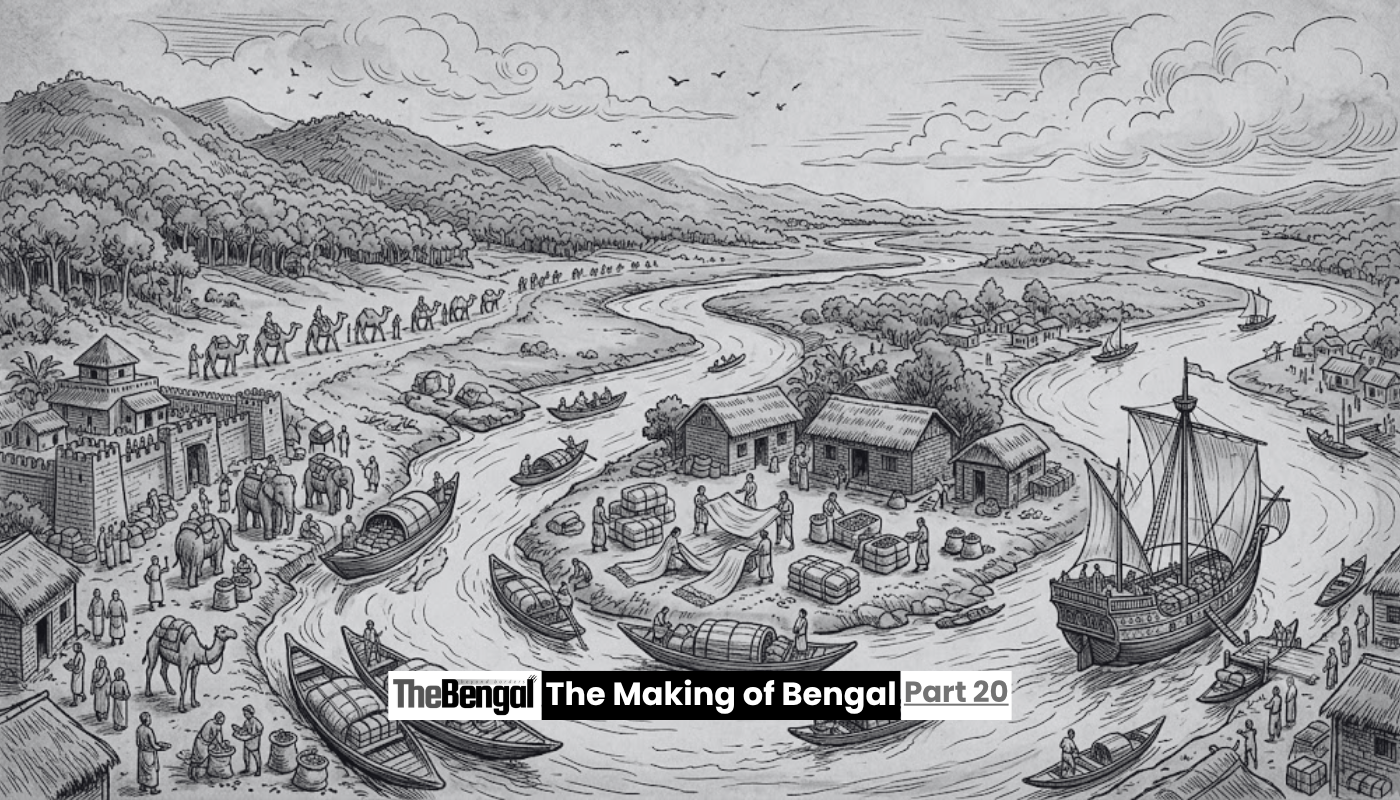
Within it, the Periplus names Gange, the same city discussed in earlier chapters of this series as Ptolemy’s candidate for Gangaridai’s capital, as the source of the very best quality muslin cloth available anywhere along the route, a fabric fine enough to be singled out by name in a text otherwise focused on practical trading logistics. The same text also describes a trade in Chinese silk, referred to as goods from Thinae, arriving as floss, yarn and finished cloth, and passing through the Bengal region on its way south to Limyrike, also called Damirica, the Dravida country of far southern India. Crucially, this Chinese silk was not Bengal’s own product. It represented what modern trade historians call re-export commerce: valuable goods originating elsewhere, in this case China, funnelled through Bengal’s ports and river networks because that was the most efficient path to reach markets further south and, eventually, the Mediterranean.
A Papyrus That Names the Cargo
Literary description is one thing. A surviving customs and loan document is considerably harder evidence, and one has, remarkably, survived from this exact trading world. A loan contract written on papyrus, dated to the middle of the second century CE, records a quantity of Gangetic nard being loaded at the port of Muziris, near modern Cranganore on India’s Malabar coast, for shipment aboard a vessel called the Hermapollon, bound for Alexandria in Egypt.
Nard, along with a related aromatic product called malabathrum, appears repeatedly in classical texts describing goods from the Ganges region, prized in the Mediterranean world for use in perfumes and medicine. Yet neither product actually grew in coastal Bengal itself. Both were plant products native to the hill regions of the northeast, the same broader zone that this series has already connected to Bengal through the Southern Silk Road and the Assam river valleys explored in the previous chapter. Bengal’s role here was not as a producer but as a transit hub: the delta and its coastline gathered these northeastern goods and funnelled them onward, by a coastal route, to Malabar ports like Muziris, where they were loaded onto Mediterranean-bound ships heading toward Alexandria.
This is a genuinely important distinction. It means the value Bengal extracted from this trade was not limited to what its own farmers, weavers and craftsmen produced. The delta profited simply by sitting in the right place, at the point where goods gathered from a much wider hinterland, Assam’s hills, Bengal’s own weaving centres, the wider Gangetic plain, could all be consolidated and shipped onward together.
The Arthashastra’s Map of Silk Country
Kautilya’s Arthashastra, already discussed in an earlier chapter of this series for its precise naming of Bengal’s cotton-producing regions, offers similarly specific detail about silk. The text identifies four distinct named varieties, each tied to a particular producing region: Vangika, from Vanga in southern Bengal, Paundrika, from Pundra in northern Bengal, Suvarnakudyaka, from Suvarnakudya in Kamrupa, corresponding to present-day Assam, and Magadhika, from neighbouring Magadha.
This confirms something worth pausing on: ancient Bengal and Assam were, from at least the Mauryan period, already recognised as distinct and valuable silk-producing zones in their own right, not merely as a transit corridor for goods from elsewhere. Assam’s association with fine silk goes back further still in cultural memory. The Kishkindha Kanda section of the Ramayana describes the eastward route from Magadha passing through Anga and Pundra before reaching what the text calls the country of cocoon rearers, a clear and early reference to the same region’s reputation for silk cultivation. That reputation would eventually attach itself to Assam’s golden muga silk specifically, a wild silk variety unique to the region, though the deeper roots of that industry, as the Arthashastra shows, stretch back to the same Mauryan-era catalogue that also named Bengal’s cotton and Bengal’s own silk varieties by region.
Rivers as the Original Highways
None of this trade, silk moving south from Assam, muslin gathered at Bengal’s ports, nard and malabathrum funnelled toward the Malabar coast, could have functioned without the river systems this series examined in its earliest chapters. The Ganges, Brahmaputra and their many tributaries were never simply the forces that built the delta’s land. They were also its working infrastructure, the channels along which goods, coinage and travellers moved between inland production centres and the coastal ports capable of reaching the wider maritime world.
Banglapedia’s own historical account of Bengal’s trade makes this point directly, describing the region’s geography, stretching from the Himalayas to the sea, as providing regular access both to the Ganges basin in the west and to the wider northeastern part of India, with the delta itself serving as the only outlet through which the entire landlocked Ganges valley could reach the ocean. Put plainly, if you were a trader anywhere in the vast Gangetic hinterland wanting to reach the sea, Bengal was not one option among several. It was, geographically, the only way through.
A Reputation That Outlasted the Ancient World
It is worth noting, briefly, just how durable this reputation for fine textiles proved to be. The same qualities that made Bengal’s muslin famous enough to be singled out by name in a first-century Greek merchant’s handbook would, many centuries later, make it famous again, praised by Arab geographers in the ninth century, described in awe by Marco Polo and Ibn Battuta, and eventually turned into one of the most sought-after luxury fabrics in the world during the Mughal and early colonial periods. That later, better-documented story lies beyond the ancient period this series is currently tracing, but its roots run in an unbroken line straight back to the fine cotton the Arthashastra was already naming by region more than two thousand years ago.
What the Goods Reveal
Taken together, the muslin praised in the Periplus, the Gangetic nard loaded at Muziris, the silk varieties catalogued by Kautilya, and the rivers that carried it all, sketch a Bengal that was neither a passive producer content to sell whatever grew locally, nor merely a corridor goods happened to pass through. It was both at once: a genuine manufacturing centre for cotton and silk textiles renowned as far away as Rome, and an indispensable transit hub gathering products from Assam’s hills and the wider Gangetic plain and delivering them onward to the Mediterranean world.
That dual role, producer and crossroads simultaneously, is precisely what separated Bengal from a simple agricultural hinterland and turned it into one of the genuinely consequential trading regions of the ancient world, a reputation built not on conquest or empire, but on cloth, aromatic wood, silk cocoons, and a river system patient enough to carry all of it to the sea.
In the next chapter of this series, we step away from ports and cargo altogether and turn to something more intimate: what everyday life, food, family and daily routine actually looked like for ordinary people living in ancient Bengal.
Sources: Banglapedia, “Trade and Commerce”; Wikipedia, “Muslin trade in Bengal,” “Muslin” and “Assam silk”; Journal of Historians of Netherlandish Art, “The Filaments of the Textile Trade”; AramcoWorld, “Our Story of Dhaka Muslin”; Periplus of the Erythraean Sea (trans. Wilfred Schoff); Kautilya, Arthashastra.