

This article is part of The Making of Bengal, a long-form historical series by The Bengal. Earlier chapters traced the deep geological processes and river systems that built the delta itself. Before we return to the first farmers and city-builders, this chapter pauses on something rarely discussed: the wild, prehistoric Bengal that existed long before agriculture, long before villages, and long before the very idea of a settled homeland.
It is easy to imagine ancient Bengal as a landscape that sprang into being fully formed, ready for farmers to arrive and till its soil. The fossil record tells a far stranger and more interesting story, one involving lions, hyenas, an ancient species of giraffe, and human ancestors who left behind stone tools carved from petrified wood.
A Landscape of Vanished Animals
Some of the most striking evidence of prehistoric Bengal comes not from human remains at all, but from the animals that once shared the land.
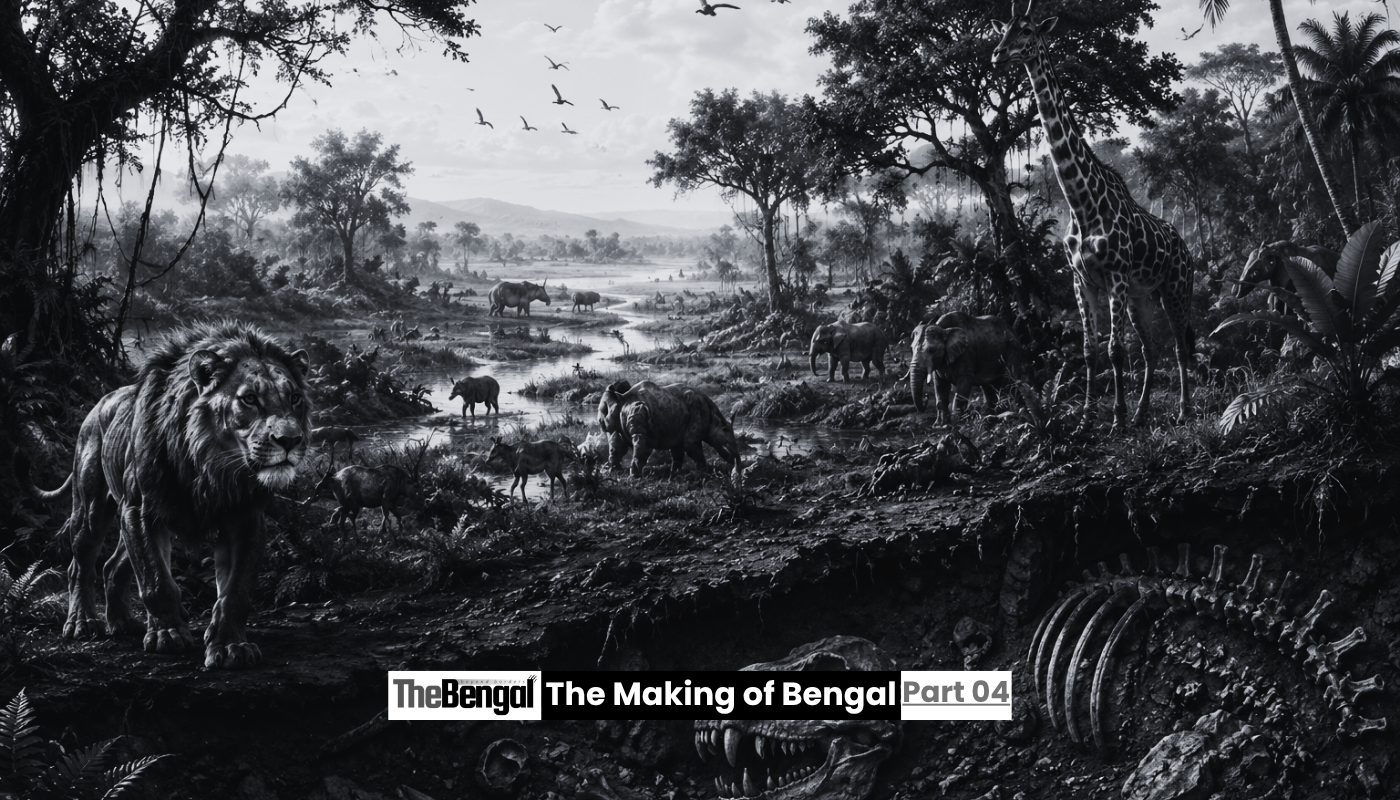
In Bankura district of West Bengal, at a site known as Susunia, palaeontologists have recovered fossil remains identified as belonging to a giraffe species related to the modern Giraffa camelopardalis, a discovery that seems almost impossible to reconcile with the Bengal of today. The same site and surrounding deposits have also produced fossil evidence of lions and spotted hyenas dating to the Pleistocene period, predators that have not roamed this part of South Asia for tens of thousands of years.
These are not isolated curiosities. Vertebrate fossils spanning the middle to upper Pleistocene have been documented across a wider stretch of southern West Bengal and into neighbouring parts of Odisha and Jharkhand, alongside Palaeolithic stone tools recovered from the same sedimentary sequence. Bengal, it turns out, was once part of a much larger East African-style savanna ecosystem, populated by large grazing animals and the predators that hunted them, long before its transformation into the intensively farmed, densely populated delta familiar today.
The People Who Lived Alongside Them
Where there is prehistoric fauna, there are often prehistoric humans, and Bengal is no exception.
At Susunia, researchers have recovered human fossil remains, including a femur and a skull fragment, found in association with large Acheulian stone tools and dated to roughly 250,000 years ago. According to the researchers involved, this mega-mammalian fauna and its accompanying large flake Acheulian artefacts point to the existence of a large, robust hominin population in the region at that time. A separate humerus bone, recovered from a slightly higher and more recent layer, has been linked to an early population of anatomically modern humans, described by researchers as a short and stocky lineage of early Homo sapiens not previously documented elsewhere in South Asia, appearing somewhere between roughly 150,000 and 40,000 years ago.
If these interpretations hold, Susunia offers something remarkable: physical evidence that Bengal was not a late arrival on the human story, but a place where distinct populations of early humans lived, hunted and made tools across an immense stretch of time, long before the earliest farming villages or fortified towns discussed elsewhere in this series.
Bengal sits within what researchers describe as the richest easternmost zone of classic Acheulean hand-axe technology found anywhere in the Old World, a technological tradition associated with early hominins across Africa and much of Asia. Far from being a peripheral or empty region, prehistoric Bengal was connected to some of the broadest and oldest patterns of human toolmaking on the planet.
Toolmakers Without Stone
One of the more unusual aspects of Bengal’s prehistoric record is the material its earliest toolmakers were forced to work with.
Much of the Bengal delta is, geologically speaking, quite young, built from river-borne silt and sand rather than the hard bedrock that early toolmakers elsewhere relied on for shaping stone implements. Suitable rock was often scarce. Instead, prehistoric communities across the region turned to an alternative resource entirely: fossilised wood, ancient tree trunks that had, over millions of years, been gradually replaced by silica and hardened into a stone-like material.
At sites such as the Lalmai hills near Comilla and the Chaklapunji tea estate in Habiganj district, both in present-day Bangladesh, archaeologists have recovered tools crafted from this fossil wood, including hand axes and other cutting implements shaped from material found in the Plio-Pleistocene Dupi Tila rock formation. Even at Wari-Bateshwar, the early urban centre explored earlier in this series, researchers have identified Neolithic tools such as celts and shouldered axes made from sandstone, siltstone and fossilised wood, materials that, notably, do not occur naturally at the site itself and must have been brought in from elsewhere.
This resourcefulness says something important about the people who lived across prehistoric Bengal. Faced with a landscape that lacked the stone resources common elsewhere, they identified, sourced and worked an alternative material with enough skill to produce functional tools, and in some cases transported that material across real distances to reach the communities that needed it.
Scattered Fragments of a Larger World
Unlike Wari-Bateshwar, no single prehistoric site in Bengal offers a complete, continuous picture. Instead, the evidence survives as scattered fragments spread across a wide geography, each contributing a small piece to a much larger and still incomplete picture.
In West Bengal, prehistoric deposits and stone tools have been documented across the Kasai river basin in Midnapur and Bankura districts, associated with a sequence of formations known to geologists as the Lalgarh Formation, itself linked to older Pleistocene boulder conglomerates containing rounded pebbles and cobbles alongside fossil wood. Researchers working in the Rampurhat area of western Bengal have identified what they describe as a distinct Upper Pleistocene surface yielding further prehistoric evidence, and have suggested that continued exploration of the region is likely to reveal considerably more.
Across the border in Bangladesh, prehistoric material has been identified at the Lalmai-Mainamati hills in Comilla, Chaklapunji in Habiganj, Chagalnaiya in Feni district, Sitakunda and Rangamati in the Chittagong region, and Wari-Bateshwar in Narsingdi. According to researchers who have surveyed these locations, each of these regions contains exposed Pleistocene strata alongside raw materials suitable for early stone tool production, making them a linked network of prehistoric activity rather than isolated, unconnected finds.
Taken together, these scattered sites sketch the outline of a prehistoric Bengal that was neither empty nor cut off from the wider currents of early human history. It was, instead, a landscape actively inhabited, hunted across, and worked by tool-using communities for an extraordinarily long period before anything resembling settled village life began to take shape.
Why the Gaps Still Matter
It would be a mistake to overstate how much is known. Much of Bengal’s prehistoric record survives only in fragments, discovered accidentally, excavated unevenly, and complicated by the region’s acidic, waterlogged soils, which tend to dissolve bone and other organic remains far more readily than the drier sediments preserved elsewhere in South Asia. Archaeologists working in Bangladesh have noted that faunal and floral remains from many excavated sites were historically not even collected, simply because their scientific value went unrecognised at the time.
That incompleteness is, in its own way, part of the story. Bengal’s prehistoric world survives today largely by accident: a fossil turned up in a quarry, a stone tool exposed by erosion, a bone preserved by unusually fortunate conditions in a peat deposit. Each new find has a way of reshaping the picture, pushing timelines earlier, filling in gaps, or introducing entirely new questions.
What is already clear is enough to overturn any assumption that Bengal’s story begins with farming, or with the fortified towns and river trade explored elsewhere in this series. Long before any of that, the land was already alive with lions and giraffes, worked by hominins with stone tools in hand, part of a prehistoric world every bit as real, and considerably older, than the civilizations that would eventually rise from the same soil.
In the next chapter of this series, we move from these scattered prehistoric traces toward the first true villages of Bengal, tracing how scattered hunting and toolmaking communities gradually gave way to settled farming life along the delta’s rivers.
Sources: Banglapedia entry on Prehistory; Springer Nature, “Tourism Potentials of Fossil Parks as Geoheritage Sites: A Study in Western and South Western Region of West Bengal, India”; ResearchGate, “Re-looking at Prehistoric Susunia, West Bengal” and “Prehistoric Archaeology in Bangladesh: An Overview”; CenRaPS Journal of Social Sciences, “Prehistory of Bangladesh in the Light of Recent Discovery”; Zoological Survey of India Occasional Paper No. 337, “Animal Remains from South-Western Part of West Bengal.”