

This article is part of The Making of Bengal, a long-form historical series by The Bengal. The previous chapter traced exactly how Shashanka broke free from Gupta and Maukhari overlordship to found Gauda as an independent kingdom. This chapter turns from the mechanics of his rise to the man himself, what he built, what he believed, and the genuinely disputed accusations that have followed his name for fourteen hundred years.
A King Who Left His Own Currency
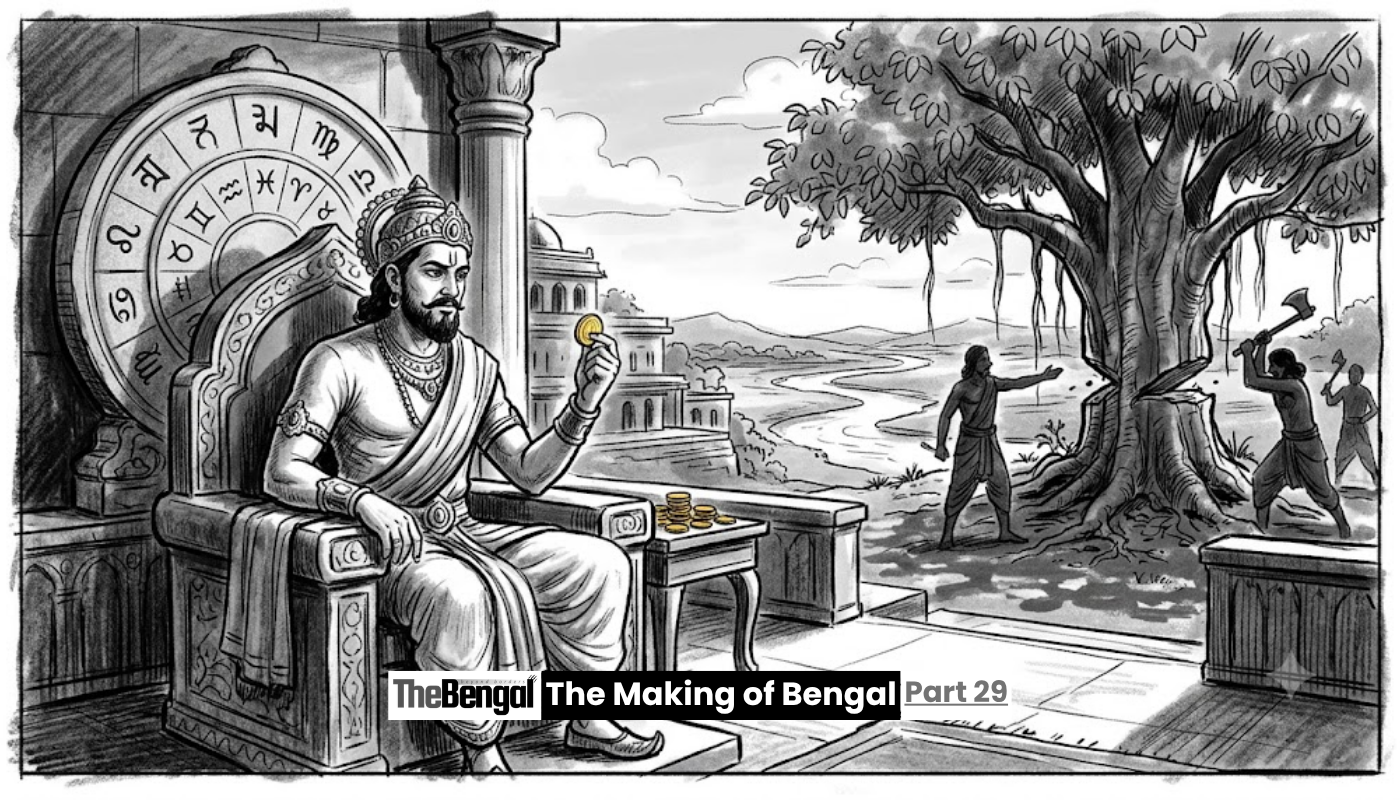
One of the clearest windows into how Shashanka wanted to be seen comes from something he made himself: money. Gold and silver coins known as dinars, issued during his reign, survive as physical, dateable, unmediated evidence of his rule, unfiltered by the biases of any later chronicler. Several of these coins bear images of Shiva and the goddess Lakshmi, a direct visual statement of the religious identity Shashanka wished to project from the very currency circulating through his kingdom.
This detail matters more than it might first appear. A newly independent king, having just broken away from centuries of outside imperial administration explored throughout this series, choosing to stamp his coinage with specific deities rather than more neutral royal symbols, was making a deliberate claim about what kind of kingdom Gauda was going to be. Shashanka was not simply asserting political sovereignty. He was asserting a particular religious character for the state he had built, Shaivite, Brahmanical, and openly devotional, in a region whose religious landscape, as earlier chapters of this series have shown, had spent centuries layering Buddhism, folk goddess worship and emerging Puranic Hinduism on top of one another without any single tradition claiming clear dominance.
A Deliberate Religious Programme
Shashanka’s Shaivite identity was not passive. According to historical accounts of his reign, he vigorously propagated Hinduism, going so far as to invite Sakadvipi Brahmins and Vedic Brahmins into his kingdom, drawn, by most reconstructions, from Kanyakubja and other established centres of Brahmanical learning further west. This was a considered act of cultural policy, importing religious authority and scholarship to help anchor his new kingdom’s identity, not unlike the way earlier rulers explored in this series, from Ashoka to the Gupta emperors, had used religious patronage as a deliberate instrument of statecraft.
Copperplate grants issued during his reign further confirm this pattern, showing a clear favouritism toward Brahmanical institutions aligned with Shaivism, even where direct dedicatory inscriptions to Shiva himself remain comparatively scarce in the surviving record. Taken together with his coinage, this points toward a ruler actively and consistently building a Shaivite Hindu political identity for Gauda, one that stood in reasonably deliberate contrast to the strong Buddhist institutional presence this series documented at length in its chapter on Buddhism’s flourishing across Bengal.
The Calendar Bengal Still Quietly Keeps
Perhaps Shashanka’s most enduring and least contested legacy has nothing to do with warfare, religion or conquest at all. Historians widely credit him with the development of the Bengali calendar, the Bangabda, its starting date falling precisely within the span of his reign. According to one detailed account of his rule, Shashanka established this Bengali era to commemorate his own coronation, following an older Hindu tradition of dating years from a significant royal event, and it has since become, in the words of researchers studying his legacy, a lasting symbol of Bengal’s cultural identity.
There is something quietly remarkable about this. Long after Gauda itself dissolved, long after the political kingdoms explored throughout this series rose and fell, ordinary people across Bengal, whether in West Bengal or Bangladesh, continue to mark Poila Boishakh, the Bengali new year, each spring, tracing their calendar’s origin back, whether they realise it or not, to a seventh-century Shaivite king’s decision to commemorate his own rise to power. Of everything discussed in this chapter, this is the one legacy that has genuinely outlived every controversy attached to Shashanka’s name.
The Accusation That Will Not Go Away
And there is a controversy, a serious one, that has shadowed Shashanka’s reputation since long before modern historians began arguing about it. According to the account of the Chinese Buddhist pilgrim Xuanzang, who travelled through India around 637 CE, roughly a decade or more after Shashanka’s death, and who wrote his account while under the patronage of Harsha, Shashanka’s greatest political rival, the Gauda king ordered the sacred Bodhi tree at Bodh Gaya, the very tree beneath which the Buddha is said to have attained enlightenment, cut down to its roots, the site burned and filled with sand and stone specifically to prevent regrowth, with plans, in some versions of the account, to install a Shiva lingam in its place.
A separate, later text, the Manjushri-Mula-Kalpa, generally dated to around the twelfth century though sometimes placed earlier, goes further still, stating that Shashanka destroyed Buddhist stupas across Bengal and describing him more broadly as an oppressor of Buddhism.
Why Serious Historians Remain Unconvinced
Set against these accusations, however, is a body of scholarly skepticism worth taking seriously. The historian Ramesh Chandra Majumdar, examining the Manjushri-Mula-Kalpa’s account directly, judged it doubtful precisely because it was composed roughly five hundred years after the events it claims to describe, concluding that it would be unsafe to accept its statements as straightforwardly historical.
More striking still is a piece of evidence that argues from silence rather than testimony. Banabhatta’s Harshacharita, the court chronicle composed for Harsha himself, had every conceivable literary and political incentive to blacken Shashanka’s reputation as thoroughly as possible. Its author was, after all, writing for a patron whose own brother, Rajyavardhana, had reportedly been killed through Shashanka’s stratagem, precisely the kind of grievance that invites exaggerated villainy in court literature. And yet the Harshacharita, for all its hostility toward Shashanka on the specific matter of Rajyavardhana’s death, never once mentions religious persecution, never once references the Bodhi tree, and never once accuses him of anti-Buddhist violence. Some researchers examining this gap have suggested a straightforward explanation: perhaps Banabhatta, despite every reason to malign his patron’s enemy, simply did not include these accusations because Shashanka had not, in fact, committed them, and the later Buddhist accounts represent embellishment rather than eyewitness memory.
It is also worth noting that even Xuanzang’s own account, taken at face value, includes a detail that undercuts the tree’s supposed permanent destruction: he reports that the Bodhi tree later regrew, protected and restored under the patronage of a Magadha king said to be Ashoka’s own descendant, growing back, in one telling, to a height of ten feet almost overnight. Whether read as evidence of miraculous religious restoration or simply as evidence that the original damage, whatever it involved, was neither total nor irreversible, this detail complicates any simple picture of Shashanka as a systematic destroyer of Buddhist heritage.
A Man Still Argued Over
What emerges from all of this is not a settled verdict but a genuinely contested one, and that contestation is, in its own way, the most honest thing this chapter can offer. Shashanka was, without real dispute, the founder of Bengal’s first independent kingdom, a Shaivite king who minted his own currency, invited Brahmin scholars into his court, and left Bengal a calendar it still uses. Whether he was also a violent persecutor of Buddhism, as Xuanzang’s account, written for a hostile patron, insists, or a ruler whose reputation was posthumously exaggerated by later, more distant Buddhist chroniclers, as the telling silence of his own contemporary’s chronicle suggests, remains a question modern historians have not resolved and, on the current evidence, may never fully resolve.
In the next chapter of this series, we look more closely at the kingdom Shashanka actually built, its territory, administration and institutions, before turning, in the chapter after that, to a fuller examination of exactly why his legacy continues to divide historians so sharply.
Sources: Wikipedia, “Shashanka”; Grokipedia, “Shashanka” and “Kingdom of Gauda”; Brainly.in, “Give an account of Sasanka’s administration and religious faith”; Scribd, “Shashanka: First King of Gauda”; Buddhist Channel, “Historical Clashes between Hindu Kings and Buddhism”; Rattibha/Buzzchronicles, “Thread about Shashanka and alleged persecution of the Buddhists.”