
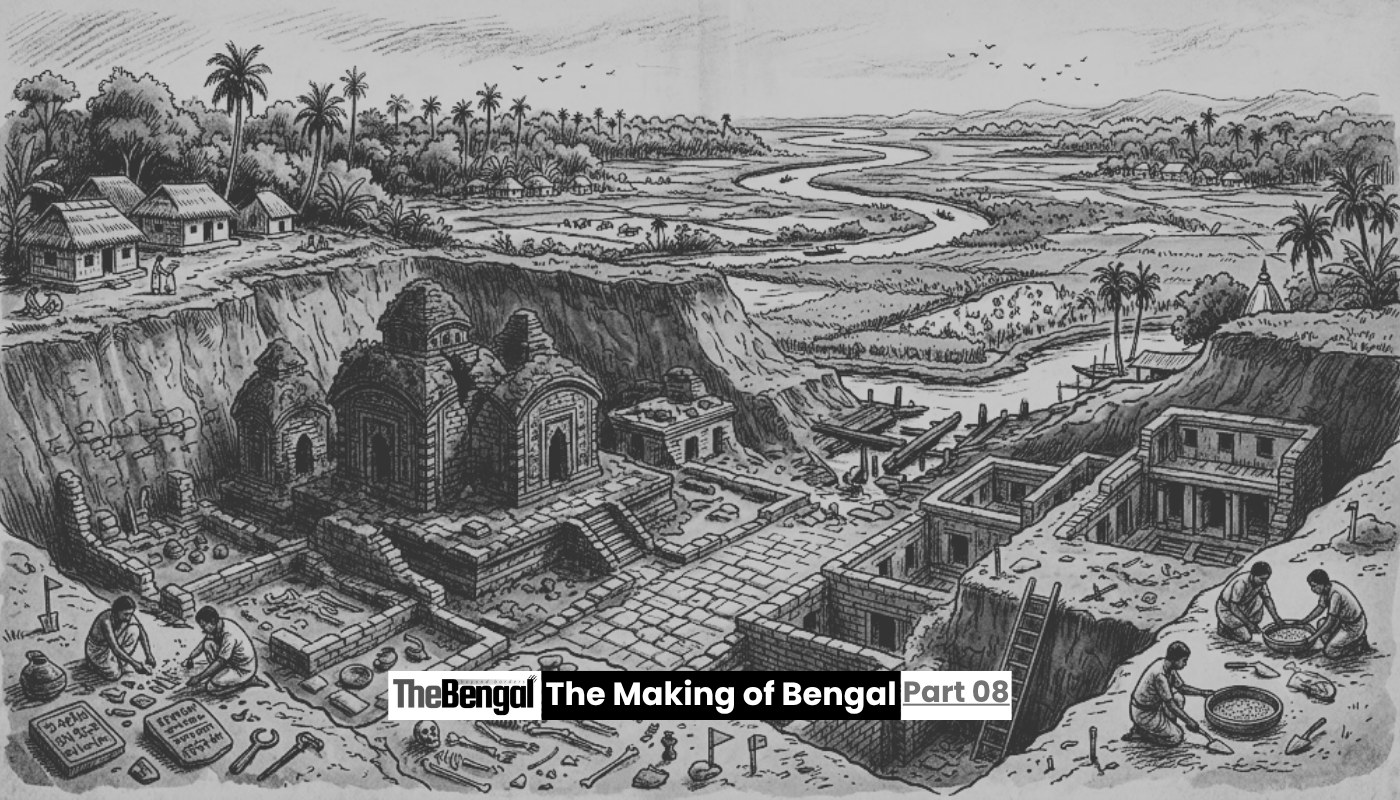

This article is part of The Making of Bengal, a long-form historical series by The Bengal. Earlier chapters followed the deep geological creation of the delta, its first farming villages, and the rise of rice as the region’s defining crop. This chapter turns to something different: the physical remains of entire settlements, and in some cases whole urban cultures, that lay forgotten beneath ordinary fields, riverbanks and city streets across Bangladesh, West Bengal, Assam and Tripura until chance, curiosity or construction work finally brought them back to light.
Bengal’s soil, layered over millennia by shifting rivers and repeated flooding, has an unusual talent for hiding things. Across the wider region, some of the most significant archaeological discoveries were not the product of deliberate searching at all, but accidents: a doctor’s curiosity, a road-building crew, a bank’s foundation dig. What they found, again and again, was that ordinary-looking ground was concealing genuine lost cities.
A Mound Named for a Forgotten King
Around fifty kilometres northeast of Kolkata, near the small village of Berachampa in North 24 Parganas, lies a site that may once have been among the most important trading ports in ancient Asia. Chandraketugarh takes its name from a local ruler about whom almost nothing certain is known, but the site itself has produced evidence of continuous habitation stretching from roughly the fourth century BCE through the Sunga, Kushana, Gupta and Pala-Sena periods.
The site’s rediscovery began, as with so many others in this story, by accident. Around 1905, a local doctor named Taraknath Ghosh noticed broken bricks and pottery scattered across two forested mounds near the Vidyadhari River, then a much larger and more navigable waterway than it is today. He passed word to the Archaeological Survey of India, and a series of scholars, including A.H. Longhurst and the celebrated archaeologist Rakhaldas Bandyopadhyay, inspected the site over the following years. Serious excavation did not begin until 1956, when the Ashutosh Museum of Indian Art carried out a decade-long dig confirming occupation from the fourth century BCE onward.
The stakes here are considerable. Some historians identify Chandraketugarh with the port town the Greek geographer Ptolemy and the author of the Periplus of the Erythraean Sea referred to as Gangaridae, possibly the capital of the ancient kingdom of Vanga, and a hub connected, directly or indirectly, to trade networks reaching toward Rome. The sheer quantity of coins and finely crafted terracotta art recovered from the site supports the idea that this was once a major coastal, cosmopolitan centre.
And yet, despite its significance, Chandraketugarh remains largely unexcavated. Further detailed digging was planned decades ago but never carried out, and the exposed mounds were simply covered back over. Today the site is more often discussed for a darker reason: it sits at the centre of a thriving illegal antiquities trade, its terracotta artefacts turning up at international auction houses even as the ground that produced them lies neglected and unprotected.
The Monastery Beneath a Village
Roughly a hundred and seventy kilometres southwest of Kolkata, near the Odisha border, an even more dramatic act of forgetting took place at Moghalmari, a village in Paschim Medinipur district. For more than a century, a large mound here known locally as Sakhisener Dhibi was simply part of the landscape, occasionally yielding bricks whenever villagers dug into it.
British surveyor H.L. Harrison had noted ruins in the area as far back as 1873, and Bengali historian Nagendranath Basu described the mound in his 1911 survey of the region. But it was not until 1999 that Professor Asok Datta of Calcutta University’s Department of Archaeology, prompted by a local educationist, recognised the site’s true importance and began systematic excavation in 2003.
What emerged over the following decade was extraordinary: the largest and oldest confirmed Buddhist monastery complex in West Bengal, with structural phases dating from the sixth century through to the twelfth. Excavators uncovered massive brick walls decorated with stucco figures of the Buddha, Bodhisattvas and Buddhist deities, terracotta seals inscribed with the names of two distinct monasteries sharing the same compound, a decorated brick gateway, and more than forty bronze artefacts recovered in a single day during a later dig. Some archaeologists believe Moghalmari may be one of the very monasteries mentioned by the Chinese pilgrim Xuanzang, who passed through the nearby port of Tamralipta in the seventh century, though no monastery matching his account has ever been definitively located there. If the identification holds, this quiet West Bengal village may hold the missing piece of one of the most famous travel accounts in Buddhist history.
A City Discovered by a Bank
Far to the northeast, in the heart of modern Guwahati, Assam, an entirely different kind of ancient settlement came to light in 1969, not through scholarly curiosity but through construction. Workers digging the foundation for a Reserve Bank of India building accidentally struck the remains of an ancient site now known as Ambari.
Excavations carried out intermittently from 1970 to 2003 revealed a site with two distinct phases of occupation: an early urban centre dating back to around 200 BCE, and a later medieval phase beginning around 1100 CE. The earlier phase included a brick-built tank, a drainage system, paved pathways and floors, evidence of a functioning urban settlement on the banks of the Brahmaputra centuries before recorded regional history takes clear shape. The later phase told a different story entirely: Ambari functioned as an artisan’s atelier, a production centre where craftsmen carved stone and terracotta sculptures of Vishnu, Surya, Durga and other deities, alongside imported Chinese porcelain that points to trade links reaching well beyond the Brahmaputra valley.
Researchers have since linked pottery finds at nearby locations such as Cotton College and the Mayong area of Morigaon district to the same Ambari cultural tradition, suggesting that the buried city extends considerably further beneath modern Guwahati than any single excavation has yet confirmed. Assam’s own archaeologists have said openly that further digging in neighbourhoods surrounding the original site would likely reveal still more of the city’s forgotten extent, but like Chandraketugarh, Ambari today struggles with neglect, waterlogging and limited government support.
A Region Still Full of Buried Ground
These three sites, one in the Bengal delta’s coastal south, one near its western border, and one deep in the Brahmaputra valley, are not isolated exceptions. They are representative of a much larger pattern across the wider historical region of Bengal. In West Bengal alone, archaeologists have catalogued dozens of mounds and structural remains, from Bangarh in the north to Karnasuvarna and Telkupi, many only partially explored. In Bangladesh, sites such as Mainamati and the Lalmai hills, discussed in earlier chapters of this series, continue to yield new material with every fresh excavation season. In Tripura, prehistoric fossil-wood tool sites sit alongside later Buddhist and Hindu ruins at places like Pilak and Unakoti, themselves incompletely studied. And across Assam, researchers have specifically noted that many ancient towns and cities of the northeast region likely remain entirely undiscovered beneath the modern landscape.
What connects all of these places is not one single lost empire, but a shared pattern of forgetting and rediscovery. Bengal’s history did not vanish because it was unimportant. It vanished because rivers shifted, villages grew over old ruins, colonial administrators had other priorities, and later governments lacked the funding or urgency to dig further. Where curiosity, accident or sheer necessity intervened, whether a doctor noticing broken bricks, a construction crew hitting ancient stone, or a professor following up on a stray tip, entire chapters of the region’s past have come back into view almost overnight.
What Remains to Be Found
It would be a mistake to treat this as a closed chapter. Archaeologists working across West Bengal, Bangladesh, Assam and Tripura consistently describe the same frustration: sites known to be significant remain only partially excavated, hampered by funding shortages, bureaucratic delay, and in some cases active looting. Chandraketugarh, quite possibly one of the most important port cities of ancient India, remains more vulnerable to antiquities thieves than protected by serious ongoing study. Ambari, despite decades of work, is regularly described by Assam’s own archaeological officials as barely scratched. Moghalmari’s excavation proceeded in slow, underfunded stages across nearly a decade before its true scale became clear.
What lies beneath Bengal’s soil, then, is not simply a finished archaeological record waiting to be read. It is an active and unfinished excavation, spread across four modern political territories that once shared, and in many ways still share, a single deep and continuous history. Every mound left undug, every riverside village built over an older one, is a reminder that the story told so far in this series, from prehistoric fossils to rice-growing villages to Buddhist monasteries, is very likely incomplete, waiting on the next accidental discovery to fill in what has been missing all along.
In the next chapter of this series, we leave prehistory and archaeology behind and step into the world of recorded history, examining the era when Bengal first appears by name in the writings of the wider ancient world.
Sources: Sahapedia, “Chandraketugarh: Forgotten Heritage of Bengal” and “Chandraketugarh: Neglected Heritage of Bengal”; Live History India, “Chandraketugarh: An Enigma in Bengal”; The Better India, “What Connects Indus Valley Civilisation to Bengal?”; Wikipedia, “Moghalmari” and “Ambari”; Buddhistdoor Global, “Moghalmari Buddhist Monastery: A Notable Heritage Site in West Bengal”; Chitrolekha International Magazine on Art and Design, “Discovery of a Buddhist Monastery at Moghalmari, Paschim Medinipur”; Government of Assam, Directorate of Archaeology, list of protected sites; Assam Tribune, “From Glory to Dust: Exploring the mysteries behind ancient ruins of Guwahati.”