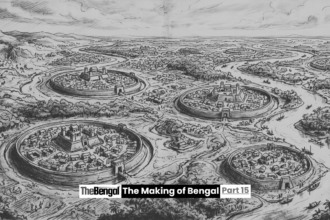

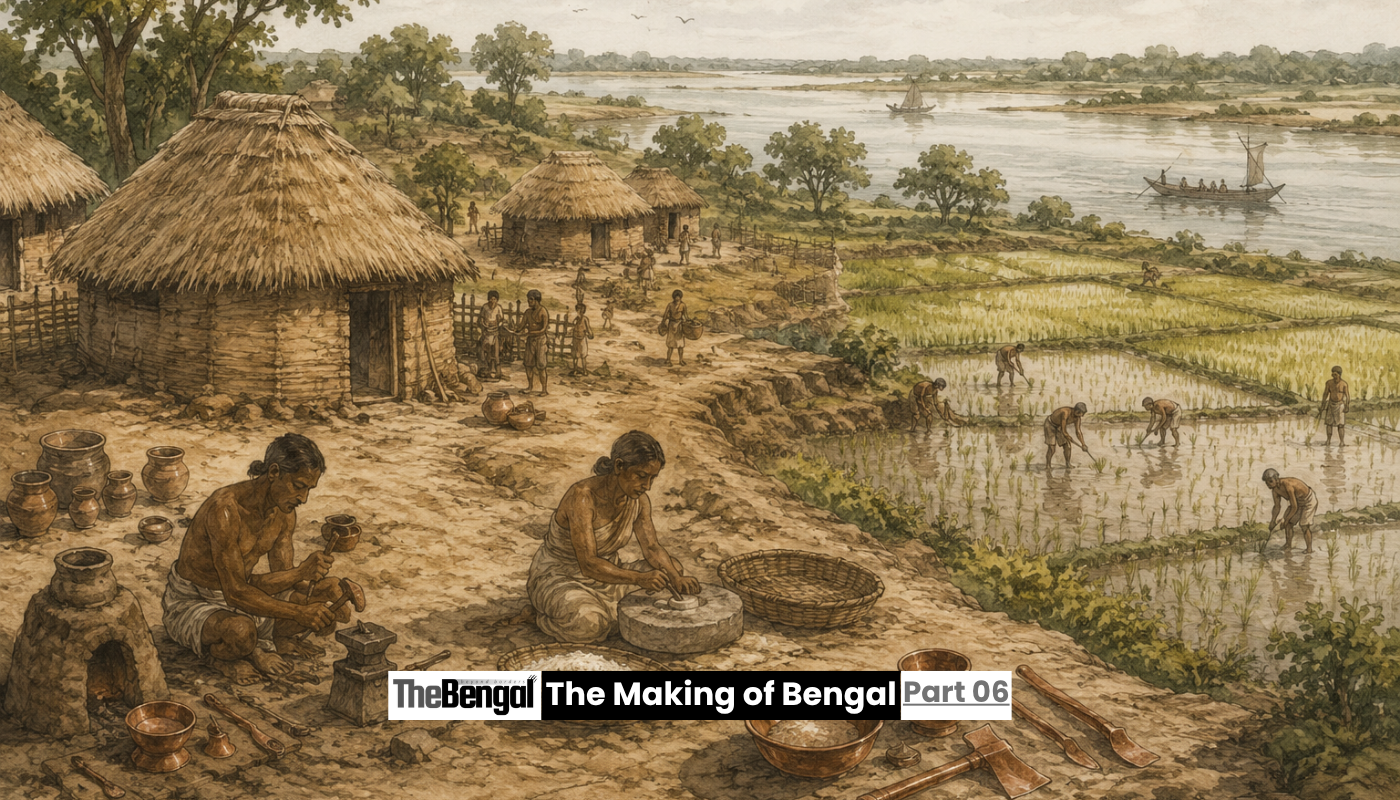

This article is part of The Making of Bengal, a long-form historical series by The Bengal. Earlier chapters followed the deep geological creation of the delta and the earliest human populations who wandered and eventually settled its floodplains. This chapter follows what came next across the wider Bengal region, present-day Bangladesh, West Bengal, and the closely connected areas of Assam and Tripura, as scattered, mobile communities put down roots and built the first proper villages.
For a long time, the story of early village life in eastern India was written almost entirely around sites far to the west, in the Ganga valley, Gujarat and the Deccan. The lands that make up greater Bengal barely featured. That has changed considerably over the past six decades, as archaeologists working across Burdwan, Comilla, Dima Hasao and West Tripura have gradually pieced together a fuller, if still incomplete, picture of the region’s earliest farmers.
A Mound Named After a Mahabharata King
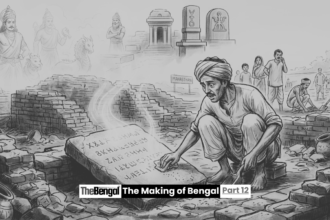
The best-documented part of this story begins on the banks of the Ajay River in Burdwan district, West Bengal. In the early 1960s, archaeologists surveying the valley came across a large mound the local population associated with King Pandu, a figure from the Mahabharata. Two researchers, D.K. Chakrabarti and S.C. Mukherjee, explored the site in 1961 and reported an intriguing mix of finds: microliths, black and red pottery, fragments of lustrous red ware, a spouted bowl, semi-precious beads and other remnants of an older material culture.
Formal excavations followed between 1962 and 1965, and again in 1985, led by archaeologist Paresh Chandra Dasgupta and later teams from the West Bengal Directorate of Archaeology. What they uncovered at Pandu Rajar Dhibi was, for its time, a genuine revelation: clear evidence of a Chalcolithic, or Copper Age, settlement dating back to roughly the second millennium BCE, the first such site ever confirmed in eastern India. The excavators eventually dug fifty three trenches across the mound, revealing six distinct periods of occupation and establishing that the site’s history unfolded in two broad phases, an earlier Chalcolithic period followed by an Iron Age.
The discovery mattered well beyond Bengal itself. Until then, conversations about India’s proto-historic Bronze and Copper Age civilisations had focused almost entirely on the Harappan world far to the west. Pandu Rajar Dhibi placed this part of Bengal firmly on that map, showing that the eastern half of the subcontinent had developed its own, independent Copper Age culture rather than simply lagging behind.
The Villages That Followed in West Bengal
Pandu Rajar Dhibi did not stand alone for long. Once archaeologists knew what to look for, similar settlements began turning up throughout the region, eventually numbering more than seventy sites spread across the districts of Birbhum, Bardhaman, Bankura and Midnapore, threaded along a network of rivers including the Ajay, Damodar, Kunur, Mayurakshi, Dwarakeswar, Shilabati and Rupnarayan.
Among these, a handful of sites have been excavated in real detail: Mahisdal and Bharatpur, both yielding cultural material closely echoing what was found at Pandu Rajar Dhibi, and Mangalkot, which produced similarly distinctive black-and-red pottery alongside copper artefacts. Together, these settlements form what archaeologists now call the Pandu culture, a network of generally small, riverside farming villages that flourished across a broad stretch of southwestern West Bengal, reaching its peak around 1000 BCE.
The clearest evidence of a genuine agricultural transformation comes from Mahisdal, in Birbhum district, where excavators uncovered a pit filled with carbonised rice grains, among the earliest direct physical evidence of rice cultivation found anywhere in eastern India. Rice would go on to become, and remains today, the defining crop of the entire Bengal region, and this humble, blackened pit of ancient grain offers a direct physical link between the deep past and Bengal’s present identity.
Alongside farming, these communities were skilled workers of stone and metal, producing microliths, neolithic celts, bone implements and steatite beads alongside copper bangles, rings, fish hooks and needles. Burial practices uncovered at Pandu Rajar Dhibi, including extended, flexed and secondary burials, have been compared by researchers to customs found at contemporary sites in central India and the Deccan, hinting at cultural connections stretching well beyond the Ajay valley.
Farming Villages East of the Padma
Direct archaeological evidence for this same early village-farming stage in present-day Bangladesh remains comparatively sparse, a gap researchers attribute partly to the delta’s acidic, waterlogged soils, which are far less kind to buried organic material than the drier terraces of West Bengal, and partly to the smaller number of systematic excavations carried out across the country. What is well established, discussed in an earlier chapter of this series, is that early inhabitants of the eastern delta, at sites such as Lalmai and Wari-Bateshwar, relied on fossilised wood alongside sandstone and siltstone to produce Neolithic tools including celts and shouldered axes, materials transported into the region rather than sourced locally. These scattered finds suggest that farming and toolmaking communities were active east of the Padma during broadly the same period as the Pandu culture further west, even if a fully excavated village site comparable to Pandu Rajar Dhibi has yet to be identified there.
Cord-Marked Pottery from the Brahmaputra Valley
Move north and east into the Brahmaputra valley, and the picture changes again. In the North Cachar Hills of Assam, a team led by H.D. Sankalia carried out explorations in the Langthing and Mahur river valleys and, between 1961 and 1963, excavated Daojali Hading, the first stratified Neolithic site discovered anywhere in Northeast India. The dig, led by M.C. Goswami and T.C. Sharma, uncovered polished stone tools, a distinctive ceramic industry, and household items such as corn grinders, stone rubbers and mullers, alongside double-shouldered celts and cord-marked pottery.
That cord-marked pottery matters a great deal to how archaeologists understand the site. It is a technique rare elsewhere in Indian Neolithic cultures but common across China and Southeast Asia, and researchers have pointed to it as evidence that the Brahmaputra valley’s Neolithic communities were connected to a broader East and Southeast Asian cultural world, a pattern echoed at the nearby site of Sarutaru in Kamrup district, which yielded closely related pottery styles. Excavators also recovered jadeite stone at Daojali Hading that must have been carried in from as far away as China, along with grinding equipment suggesting these communities were already growing and storing grain. Dating for the site remains debated, with estimates ranging from around 2500 BCE to as late as the early centuries of the Common Era, a reminder that in Northeast India, Neolithic-style toolmaking and pottery persisted for a very long time and did not everywhere follow the same timeline as farming communities further west.
Fossil Wood Toolmakers of Tripura
Further south, in the hills and valleys of Tripura, prehistoric communities faced the same basic problem encountered by early toolmakers in Bangladesh: a landscape short on usable stone. Their solution was strikingly similar. Geologist N.R. Ramesh, working in the Khowai and Haora valleys, documented more than half a dozen Neolithic sites and recovered as many as seven hundred stone implements from locations including Teliamura, Jirania, Mohanpur, Bishalgarh and Agartala.
What sets Tripura apart is just how thoroughly its toolmakers turned to silicified fossil wood instead of ordinary stone, a locally available material used far more consistently here than anywhere else in the wider region. Researchers have divided the resulting artefact assemblage into an earlier pre-Neolithic phase, lacking polished axes but typologically related to Neolithic tools, and a later Neolithic phase dominated by fully polished axes, with the earlier phase likely dating to sometime after 35,000 years before present and the later phase falling before roughly 3,500 years ago. Scholars have also noted that the overall character of these tools closely resembles Neolithic and Anyathian traditions from the Irrawaddy valley in Burma, positioning prehistoric Tripura as another point of contact between the Bengal region and the wider world of Southeast Asia.
A Patchwork, Not a Single Culture
Taken together, the evidence from these four areas resists any simple, single narrative. West Bengal’s Pandu culture was a rice-growing, copper-using riverine society reaching its peak around 1000 BCE, with clear connections to farming cultures elsewhere in India. Bangladesh’s early communities, though less thoroughly excavated, relied on similar fossil-wood technology to their neighbours across the delta. Assam’s Brahmaputra valley communities produced cord-marked pottery and polished celts that tie them culturally toward China and Southeast Asia rather than the Ganga plain. Tripura’s toolmakers, working almost exclusively in fossil wood, sit somewhere between these worlds, geographically and culturally.
What unites them is not a shared culture but a shared moment: across this entire region, communities were, at broadly overlapping points between the Neolithic and the Chalcolithic, transitioning from mobile foraging toward settled, agricultural or semi-agricultural life, each shaped by the particular rivers, hills and available raw materials of their own corner of Bengal.
An Incomplete but Growing Picture
As with much of the region’s ancient past, the record remains partial almost everywhere. Archaeologists note that only a fraction of West Bengal’s more than seventy known chalcolithic sites have been excavated, that Bangladesh’s prehistoric farming villages remain poorly documented compared to its later urban sites, and that researchers in Assam and Tripura have repeatedly called for more systematic excavation and reliable dating across the wider Northeast.
Even so, the picture that has emerged over the past six decades is a significant one. The first villages of greater Bengal were not a late or marginal footnote to India’s Copper and Stone Age story. They represent several independent, locally adapted farming and toolmaking traditions that took root across the Ajay valley, the eastern delta, the Brahmaputra basin and the hills of Tripura, laying the groundwork, in their own separate ways, for the towns, trade networks and kingdoms that would follow across the whole region.
In the next chapter of this series, we turn to how rice cultivation itself transformed Bengal, examining how this single crop reshaped the region’s economy, its population, and its place within the wider world.
Sources: Banglapedia entries on “Pandu Rajar Dhibi,” “Agricultural Communities, Early Period” and “Prehistory”; Wikipedia entries on “Pandu Rajar Dhibi,” “Pandu culture,” “Early Agricultural Communities in Bengal” and “Daojali Hading”; ThePrint, “India’s proto history not limited to Harappan cities: Bengal’s Pandu Rajar Dhibi tells us more”; West Bengal PCS Exam Notes, “Chalcolithic Cultures in Bengal”; Enroute Indian History, “Daojali Hading in Assam”; Heritage: Journal of Multidisciplinary Studies in Archaeology, “Prehistoric Cultural Traits of Western Tripura.”