
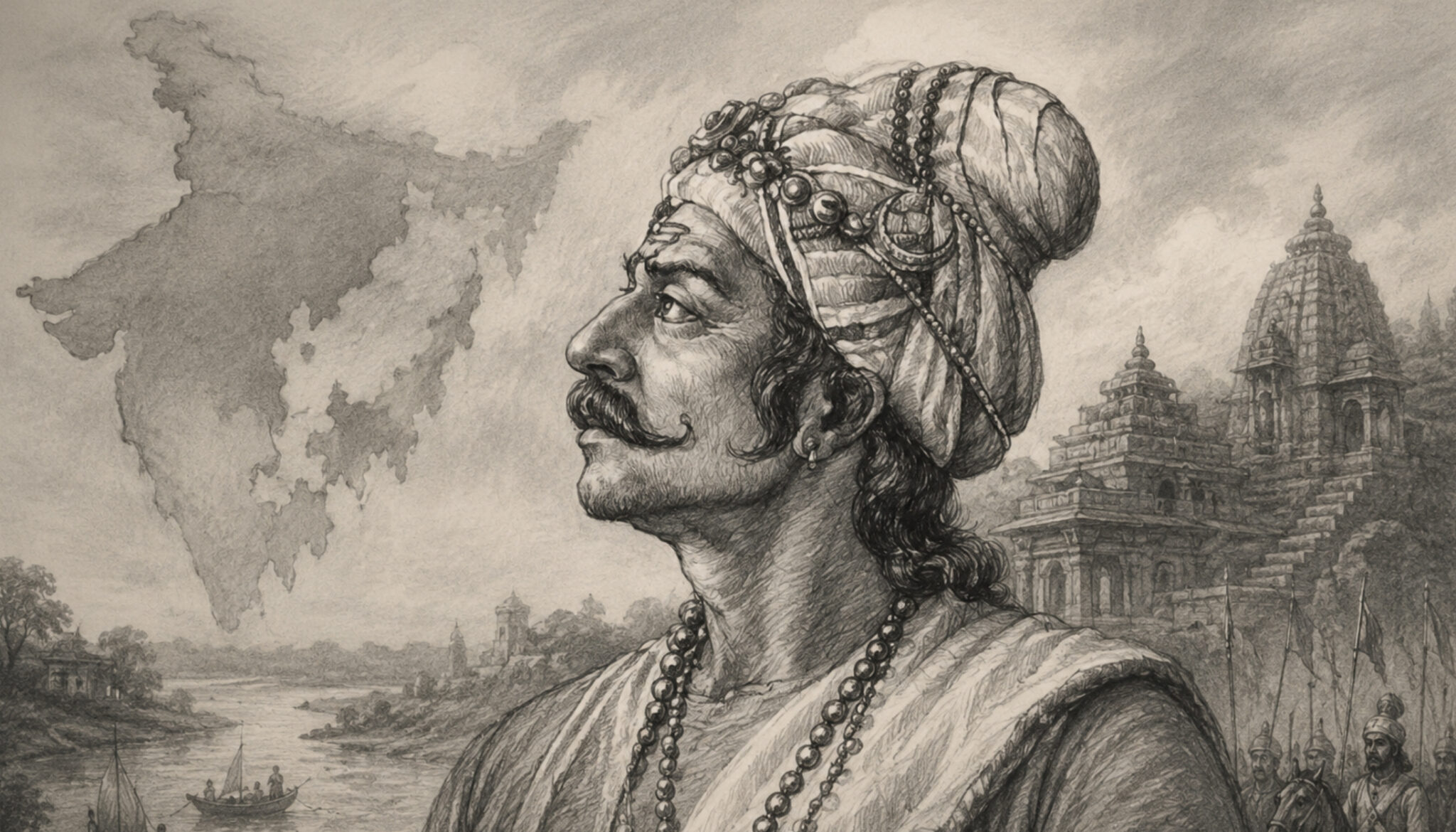

Ask most people to name the first king of Bengal and you will likely hear about Gopala, the soldier turned monarch who founded the Pala dynasty in the eighth century after a hundred years of chaos. It is a good story, and a popular one. But it skips over a man who came before Gopala by more than a century, a man whose brief and violent reign quietly laid the groundwork for the very idea of Bengal as a political entity. His name was Shashanka, and without the chaos he first tamed and then, in dying, unleashed again, there might never have been a throne left for Gopala to inherit.
A Kingdom Born From an Empire’s Collapse
To understand Shashanka, you first need to understand the vacuum he stepped into. The mighty Gupta Empire, once the gold standard of classical Indian civilization, had been crumbling for well over a century. After the death of the emperor Skandagupta around 467 CE, a string of weaker rulers struggled to hold the empire together while waves of Hun invaders pressed in from the northwest. Even after those invasions were driven back, the damage to the imperial treasury and to central authority was already done. By the late sixth century, the last vestiges of Gupta power in eastern India rested with a fading branch known as the Later Guptas, ruled at the time by a king named Mahasenagupta.
Into this slow motion collapse stepped a series of ambitious regional strongmen, each carving out territory from the wreckage. Shashanka was one of them. His earliest known trace is a seal discovered in the hill fort of Rohtasgarh in Magadha, bearing the modest title Mahasamanta Shashankadeva, meaning something close to great feudal chief. Historians still argue over exactly whose vassal he originally was, possibly the Later Guptas, possibly the rival Maukhari dynasty, but the broad picture is clear enough. He began as a subordinate military officer in a crumbling system, and he did not stay subordinate for long.
From Regional Chief to King of Kings
By around 605 CE, following Mahasenagupta’s death, Shashanka had pushed out his former overlords and the other regional nobles competing for the same territory, and established his own kingdom centered on Gauda, with its capital at Karnasuvarna in present day Murshidabad. He minted gold coins to announce his triumph and began styling himself Maharajadhiraja, king of great kings, a title that signaled he considered himself no one’s subordinate anymore.
What followed was a reign defined almost entirely by war. Shashanka’s forces reportedly clashed with the Varman kingdom of Kamarupa in the northeast, defeating its king and capturing two princes, including the future ruler Bhaskaravarman, before releasing them as nominal vassals. He formed a political alliance with Devagupta, the king of Malwa, aimed at counterbalancing the growing power of the linked kingdoms of Kanauj and Thanesar in the north. When the young Thanesar prince Rajyavardhana marched to avenge his murdered brother in law, he ran straight into Shashanka’s army and was killed there, an event later Sanskrit chroniclers describe with just enough ambiguity that historians still debate how directly Shashanka’s own hand was involved.
That killing set off a chain reaction. Rajyavardhana’s younger brother, a prince who would go on to become one of the most celebrated rulers in Indian history, inherited the throne of Thanesar and swore to settle the score. His name was Harsha.
The Long Shadow War With Harsha
Harsha’s rise is one of early medieval India’s great success stories, and Shashanka spent much of the remainder of his reign as the one regional power capable of standing in Harsha’s way. The two fought repeatedly, and while later court poetry naturally favors Harsha’s side of the story, the historical record shows something more complicated than a simple triumph for the northern emperor. Shashanka’s forces are recorded marching on Karnasuvarna and putting one of Harsha’s own generals to flight during a siege, a genuine setback for the supposedly unstoppable Harsha. Through years of intermittent conflict, Shashanka held onto his core territory. He never lost Gauda, and he never fully bent the knee.
By the time his reign reached its peak, Shashanka’s kingdom stretched from Vanga in the east to territory near modern Bhubaneswar in the south, and bordered Kamarupa to the northeast. For the first time, Gauda, Vanga, and Samatata, historically separate and often rival territories within the wider Bengal delta, answered to a single ruler. It is this achievement, not any single battle, that earns Shashanka his real historical importance. He did not merely conquer land. He fused several distinct political traditions into one recognizable polity, the rough outline of what would later be understood as Bengal itself.
A King Who Also Gave Bengal Its Calendar
War was not Shashanka’s only legacy. As king, he kept up several Gupta era administrative habits, including land grants to Brahmins recorded on copperplate inscriptions, three of which survive today from Midnapore and the Egra region. He actively promoted Hinduism, inviting Vedic and Sakadvipiya Brahmin scholars into his court, and his patronage is credited by some historians with helping seed the distinctive literary style that later flourished in Bengal’s royal courts.
His most enduring gift to the region, though, may be one most Bengalis use without a second thought. Many historians trace the origin of the Bengali calendar, the Bangabda, to Shashanka’s coronation, adopted to commemorate his rise to power in the old Hindu tradition of marking a ruler’s ascension with a new era. Centuries later, that calendar would become deeply woven into Bengali cultural identity, celebrated every year at Pohela Boishakh, largely unaware of the seventh century warlord whose crowning may have started the count.
The Darker Reputation
Not every account of Shashanka is flattering, and one accusation in particular has followed him for centuries. Buddhist tradition, recorded in a text written roughly five hundred years after his death, portrays Shashanka as a determined persecutor of Buddhism who destroyed stupas across Bengal and, most dramatically, ordered the felling of the sacred Bodhi tree at Bodh Gaya, the very tree under which the Buddha is said to have reached enlightenment.
It is a striking image, and it has shaped Shashanka’s reputation in popular memory almost as much as his military campaigns have. But serious historians treat the claim with real caution. The eminent scholar R.C. Majumdar pointed out that the source describing this persecution was written centuries after the events it claims to describe, making it, in his assessment, an unsafe foundation for firm historical conclusions. Other historians counter that there is no obvious reason for a twelfth century Buddhist author to have invented ill feeling toward a long dead seventh century king, and that some kernel of real conflict between Shashanka and Bengal’s Buddhist establishment may well lie behind the later legend. The honest answer, as with much of this period, is that the truth probably sits somewhere between devoted persecutor and later scapegoat, and the surviving evidence simply is not strong enough to settle it definitively.
A Legacy That Collapsed Almost Overnight
Perhaps the most telling detail of Shashanka’s story is how quickly it all came apart. When he died around 636 CE, his son Manava inherited the throne, but held it for only about eight months before the kingdom he received began to disintegrate. Harsha and Bhaskaravarman of Kamarupa, the very rivals Shashanka had spent his reign holding at bay, moved in and divided Gauda between them, with Bhaskaravarman eventually seizing Karnasuvarna itself.
What came next is the part of the story most people actually remember, even if they do not connect it back to Shashanka. With no strong central authority left standing, Bengal spiraled into roughly a century of internal fighting and disorder, the period later Pala era inscriptions would immortalize as matsyanyaya, the law of the fish, where the strong devoured the weak simply because no one remained to stop them. It was precisely this disorder, born from the collapse of Shashanka’s unfinished project, that would eventually produce the conditions for a relatively obscure chieftain named Gopala to rise up around 750 CE and found the Pala dynasty.
In other words, Bengal’s two most cited founding stories, the warrior king who first unified the region and the elected king who later rescued it from chaos, are not separate tales at all. They are two chapters of the same story, with the ending of one directly causing the beginning of the next.
Why Shashanka Still Matters
Modern Bengali historians, most notably the pioneering scholar and archaeologist Rakhaldas Bandyopadhyay, who later found international fame for his role in discovering Mohenjo Daro, have long treated Shashanka as more than a footnote. Bandyopadhyay wrote an entire historical novel about him in 1914, drawn to Shashanka as a symbol of Bengal’s forgotten capacity for independent power, at a time when the idea of Bengali self-rule carried very real political weight.
That symbolic importance has only grown with time. Historians researching the roots of Bengali political identity increasingly point to Shashanka’s brief unification of Gauda, Vanga, and Samatata as the true starting point of Bengal as a coherent political idea, not merely a geographic description. He was not a gentle nation builder in any modern sense. He was, by most honest accounts, a military adventurer who fought his way to the top and held on through sheer persistence against one of history’s great empire builders. But in doing so, however briefly and however violently, he gave a scattered set of rival territories their first real taste of being one place, ruled by one crown, answering to one name.
Fourteen centuries later, most of what he built is gone, his capital lost, his dynasty extinguished within a year of his death, his religious legacy still argued over by scholars. What survives is a calendar quietly ticking through its centuries in Bengali homes every spring, and a persistent, half remembered claim that somewhere in the tangled early history of a fractured delta, one king briefly made it whole.
Sources consulted include contemporary and near contemporary records such as the Harshacharita of Banabhatta, the travel accounts of the Chinese monk Xuanzang, surviving copperplate inscriptions of Shashanka and his rivals, and modern historical scholarship including R.C. Majumdar’s History of Ancient Bengal and Sailendra Nath Sen’s Ancient Indian History and Civilization.