
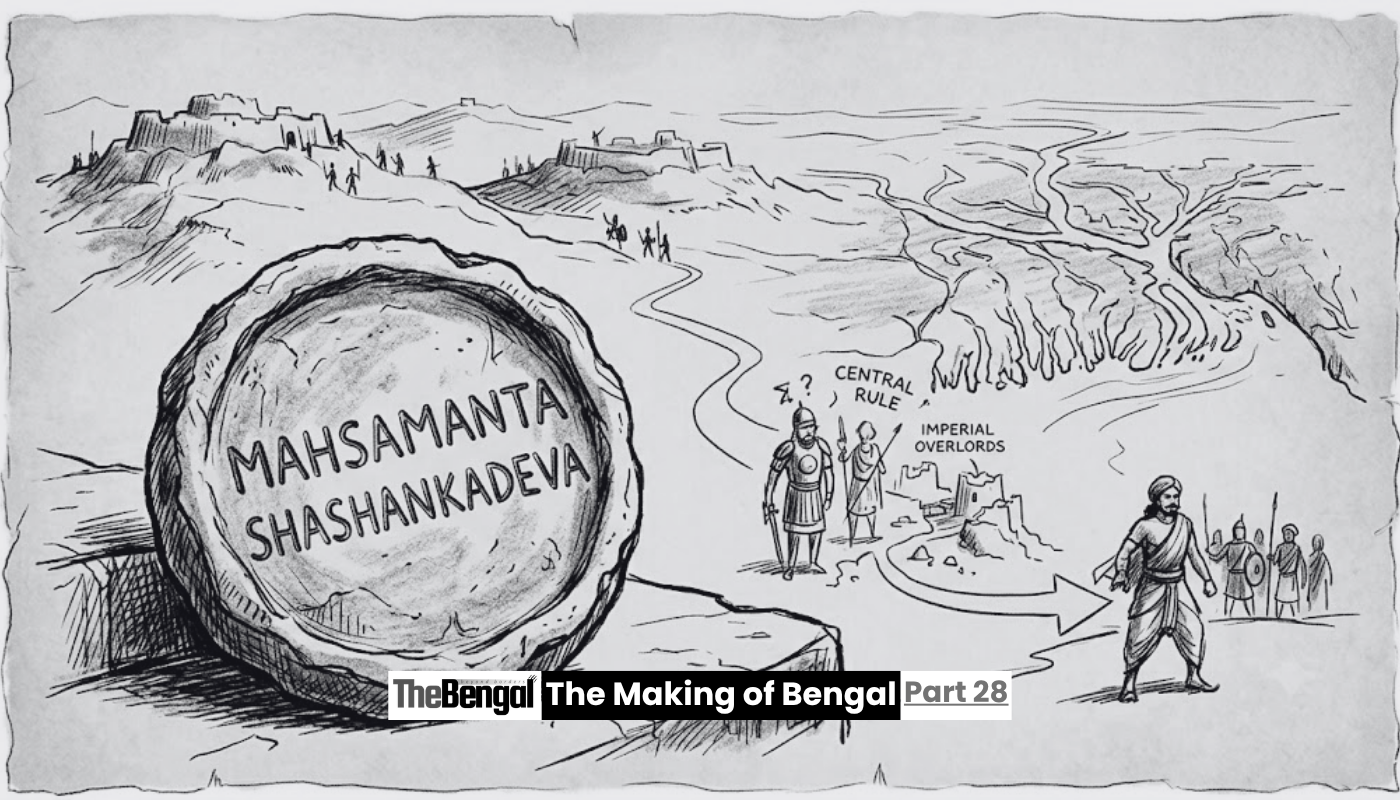

This article is part of The Making of Bengal, a long-form historical series by The Bengal. The previous chapter traced the slow collapse of Gupta authority across Bengal, ending with the last dated Gupta inscription at Kotivarsha in 542 CE. This chapter follows what happened in the vacuum that collapse created, and specifically how one ambitious regional officer turned that vacuum into Bengal’s first independent kingdom.
A Name First Found Far From Home
It is a strange fact of history that the man credited with founding Bengal’s first independent kingdom is first documented nowhere near Bengal at all. The earliest surviving trace of Shashanka comes from a seal recovered at Rohtasgarh, a hill fort in what is now Rohtas district, Bihar, hundreds of kilometres west of Bengal’s core territory. The inscription on that seal is brief to the point of anonymity: Mahasamanta Shashankadeva, identifying him only by name and rank, a mahasamanta, a high-ranking feudatory or subordinate lord, serving some greater authority whose name the seal does not record.
That authority was, by most reconstructions, a Gauda ruler already governing from Karnasuvarna, the city near modern Murshidabad already introduced in the previous chapter of this series. In other words, before Shashanka became Bengal’s first independent king, he appears to have spent time as someone else’s regional deputy, stationed far outside the territory he would eventually rule as sovereign, a detail that fits an oddly common pattern in the history of empire, where the officer entrusted with defending a frontier eventually becomes the one who breaks it away.
A Genuinely Unresolved Question
Historians remain honestly divided over one basic question this chapter cannot fully resolve: whose feudatory was Shashanka actually serving? One long-standing view holds that he began his career under Mahasenagupta of the Later Gupta dynasty, the same weakened successor state discussed in the previous chapter, ruling from a reduced territory in Magadha and Malwa after the collapse of the main Gupta line. On this reading, Shashanka served Mahasenagupta loyally until the older king’s death, after which he drove out the remaining Later Gupta nobles and established his own independent rule from Karnasuvarna.
Other historians find that account difficult to square with the wider political picture. Sailendra Nath Sen has pointed out that Mahasenagupta was, by this point, already under considerable pressure from the rival Maukhari dynasty for failing to adequately defend his own territory, making it genuinely doubtful that such a weakened ruler would have knowingly handed a position of real military importance to an ambitious subordinate like Shashanka. A further alternative, proposed by the historian Middleton, suggests Shashanka instead served as feudatory to an otherwise poorly documented Gauda king, possibly a ruler named Jayanaga, whose own place in this fractured political landscape remains only faintly recorded. As Wikipedia’s own account of the period concludes plainly, whether Shashanka was a feudatory under the Later Guptas or the Maukharis is simply not known with certainty.
This unresolved uncertainty is not a failure of modern scholarship so much as an accurate reflection of how genuinely chaotic Bengal’s political landscape had become by the final decades of the sixth century. Multiple rival powers, the Later Guptas, the Maukharis, assorted local Gauda chieftains, were all competing simultaneously for authority over roughly the same fractured territory, and Shashanka’s own early career sat somewhere within that tangle, visible today only through a handful of seals, inscriptions and one heavily biased later chronicle.
The Moment the Door Opened
What is considerably clearer is the timing of Shashanka’s actual break for independence. Mahasenagupta died around 601 CE, and it was in the years immediately following his death that Shashanka moved decisively, driving out the remaining Later Gupta nobility and other prominent regional figures, and establishing his own sovereign rule from Karnasuvarna. By around 605 CE, following Mahasenagupta’s death, Shashanka had firmly established what would come to be known as the Gauda Kingdom, issuing gold coins to commemorate his triumph and adopting the title Maharajadhiraja, king of great kings, a title that made an unambiguous claim to full sovereignty rather than mere regional lordship.
The political conditions surrounding this moment were, crucially, unusually favourable for exactly this kind of move. As the historian who assembled the World History Encyclopedia’s account of Gauda notes, the broader political landscape of northern and eastern India at the time meant that any ruler with genuine ambition needed first to secure his own position before anything else was possible, and Shashanka clearly understood this. With the Later Guptas weakened, distracted and increasingly consumed by their long-running rivalry with the Maukharis over control of Magadha, and with no single unified power strong enough to contest Bengal directly, Shashanka’s consolidation of Gauda faced remarkably little organised resistance. Grokipedia’s own assessment of this period is blunt about it: his ascent reflected pragmatic opportunism rather than any single decisive military feat, the absence of a cohesive rival power doing as much of the work as Shashanka’s own army.
Independence Through Alliance, Not Isolation
What makes Shashanka’s breakaway particularly interesting is that it did not happen in isolation. Rather than simply declaring independence and waiting to be attacked, Shashanka moved immediately to secure his new position through calculated diplomacy, forming a strategic alliance with Devagupta, who was, in a detail that says a great deal about the fluid, almost improvisational nature of power in this period, Mahasenagupta’s own son. Together, this new Gauda king and the son of the very Later Gupta ruler whose collapse had made his independence possible turned to confront their shared rival: the increasingly powerful Maukhari dynasty of Kannauj.
This alliance would go on to draw Shashanka directly into one of early medieval India’s most famous political dramas, the sequence of events later immortalised, with considerable bias against Shashanka, in the court poet Banabhatta’s Harshacharita, involving the Maukhari king Grahavarman, his death, and the rise of Harshavardhana, whose reign and rivalry with Shashanka the next chapters of this series will explore in detail. For now, what matters is the pattern: Bengal’s break from outside rule was secured not through Shashanka acting as a lone conqueror, but through the same kind of shifting alliances, marriages and calculated partnerships that had characterised the wider fragmented politics of post-Gupta northern India.
From a Feudatory’s Seal to a King’s Title
By around 619 or 620 CE, the transformation this chapter has traced was complete and formally proclaimed. Inscriptions from this period no longer describe Shashanka in the tentative, subordinate language of the Rohtasgarh seal. They name him Maharajadhiraja, ruling over a genuinely expanded territory that had, by this point, absorbed Vanga in the south and extended influence into parts of Magadha, Odisha and eastern Bihar, unifying, for the first time under a single Bengali ruler, a spread of territory that this series has spent many chapters describing as fractured, competing janapadas.
The distance travelled between that first anonymous seal, a mahasamanta serving an unnamed lord, and this later inscription, a maharajadhiraja commanding vast territory in his own name, captures precisely what breaking free actually looked like in practice for Bengal. It was not a single uprising or a single battle. It was a patient, opportunistic, carefully timed sequence of decisions, waiting for the right death, forming the right alliance, claiming the right title at the right moment, that turned one ambitious regional officer into the founder of Bengal’s first independent kingdom.
In the next chapter of this series, we turn to Shashanka the ruler himself, examining the man behind this rise to power and the kingdom he went on to build from Karnasuvarna.
Sources: World History Encyclopedia, “Gauda Kingdom”; Wikipedia, “Shashanka” and “Kingdom of Gauda”; Grokipedia, “Shashanka” and “Kingdom of Gauda”; Edukemy, “Gaudas: Post Gupta Age UPSC Ancient History Notes”; HistoryAtlas, “Gauda, Kingdom of History.”