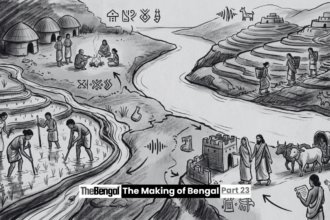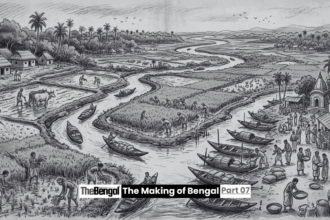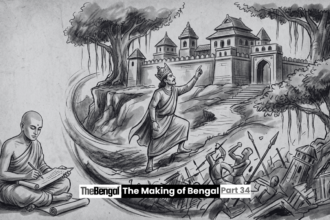

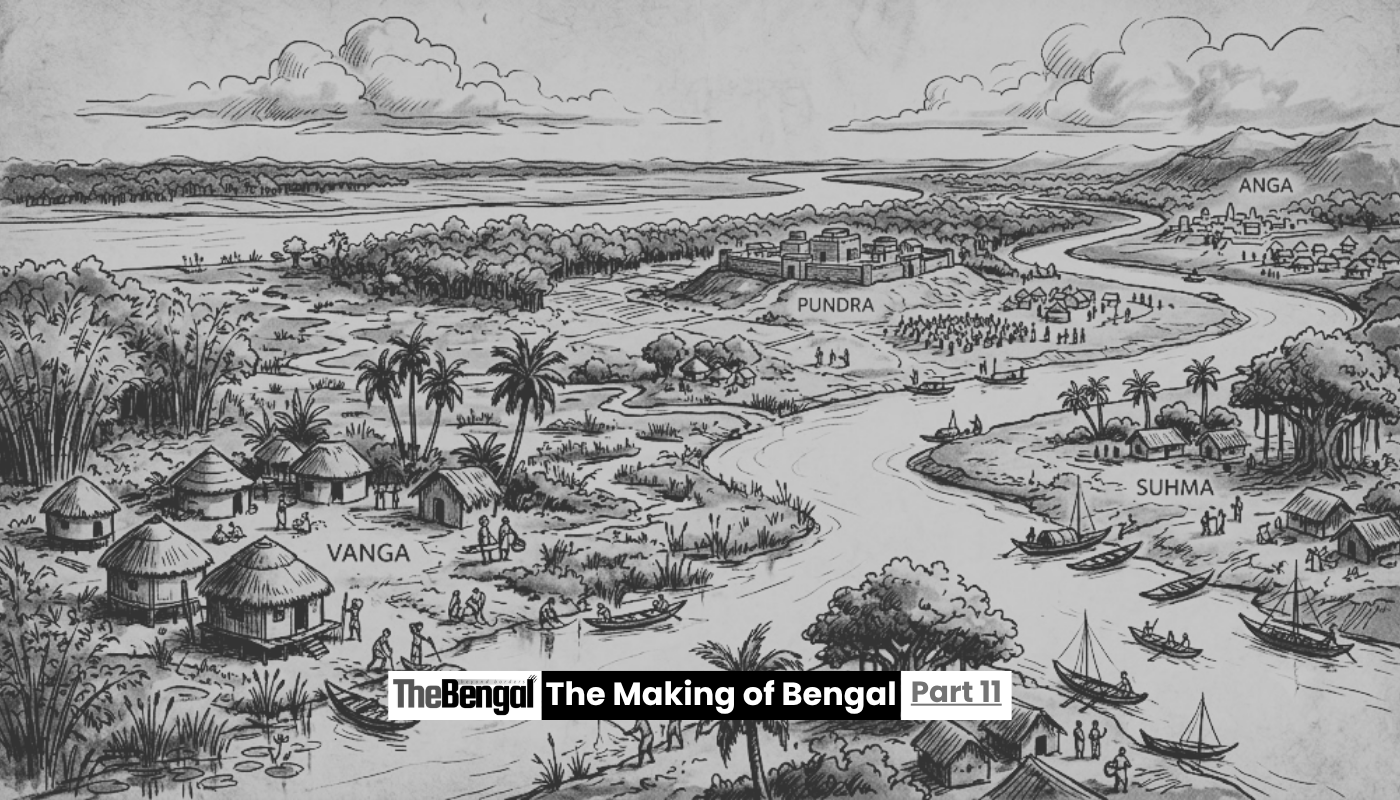

This article is part of The Making of Bengal, a long-form historical series by The Bengal. Earlier chapters followed Gangaridai’s brush with Alexander’s army and the archaeology now being used to locate it on the ground. Before we move forward into the era when the Mauryan Empire absorbed Bengal into its administration, this chapter looks backward, to the older tribal world that existed before any of that: a landscape of distinct, non-Vedic kingdoms that ancient Indian literature remembered long after their independence had faded.
A Region Named Many Times Over
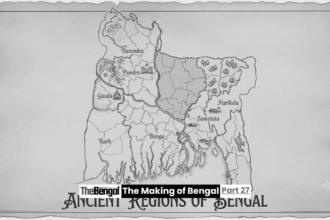
Long before Bengal had a single name, it had several, each attached to a different part of the delta and its surrounding uplands. Ancient Sanskrit and Prakrit sources describe the wider region as a patchwork of janapadas, a term meaning, roughly, the foothold of a tribe or people. Vanga occupied the eastern and southern delta, spanning territory that today straddles southeastern Bangladesh and southwestern West Bengal. Pundra sat to the north, across the alluvial tract of what is now northern Bengal and parts of Bangladesh. Suhma lay to the southwest, between the Bhagirathi and Kansai rivers, encompassing the area around Tamralipta, modern Tamluk. Anga bordered the western edge of this world, overlapping with parts of present-day Bihar. Later sources add still more names to the map: Gauda in the central tract, Rarh to the west of the Bhagirathi, and Samatata or Harikela further east and south.
None of these were understood by ancient writers as parts of a single unified Bengal. They were separate, often rival, political entities, each with its own ruling house, its own reputation, and its own place in the wider imagination of early Indian literature.
Five Brothers, Five Kingdoms
Where did these kingdoms supposedly come from? Ancient Indian tradition offered its own origin story, and it is a strange one even by the standards of Puranic myth.
According to the Mahabharata and texts such as the Brahma Purana, Vayu Purana and Matsya Purana, the five eastern kingdoms of Anga, Vanga, Kalinga, Pundra and Suhma were founded by five brothers born to Queen Sudeshna, conceived through the sage Dirghatamas acting on behalf of the blind king Bali, ruler of a kingdom near Magadha. Each of the five sons went on to found and give his name to one of these territories. It is a legend that binds all five kingdoms together as siblings of a sort, sharing a common mythic ancestry even while functioning, in practice, as entirely separate and sometimes hostile realms.
This shared origin story appears consistently enough across multiple Puranic sources that historians treat it less as literal history and more as a reflection of how classical Indian tradition understood the eastern edge of the subcontinent: as a cluster of related but distinct frontier kingdoms, linked by legend if not always by politics.
Outsiders at the Edge of Aryavarta
What comes through clearly in the earliest textual references to Bengal is a persistent sense of distance, cultural and geographical, between the delta and the Vedic heartland further west. Notably, there is no mention of any Bengal region at all in the earliest Veda samhitas. References only begin to appear in later post-Vedic texts such as the Aitareya Brahmana and Aranyaka, which mention Pundra and the Pundravardhana kingdom, and the Baudhayana Dharmasutra, which explicitly places Bengal outside the boundaries of Aryavarta, the sacred Vedic heartland, going so far as to prescribe purification rituals for anyone who travelled there and returned.
Later Puranic literature is similarly blunt, describing the peoples of Vanga, Pundra and neighbouring Gauda as mleccha, a term generally used for those considered outside proper Vedic society, engaged in trade and seafaring rather than organised around Brahmanical kingship. Whatever the accuracy of that characterisation, it reflects how thoroughly Bengal was regarded, from the perspective of texts composed further west, as a periphery: fertile, wealthy, and populous, but culturally apart.
That did not mean Bengal was ignored. Quite the opposite. The Mahabharata alone mentions the kings of Anga, Vanga and Pundra attending the court of the Pandava king Yudhishthira, and lists the Vangas, Angas, Paundras and other eastern peoples among those bringing tribute to him. Bengal’s rulers were clearly understood as significant enough to be woven into the central political narrative of India’s great epic, even while being described as culturally distinct from it.
A Kingdom Remembered for Its Elephants and Its Ships
Of all these early territories, Vanga receives the most vivid and consistent description, and the details are strikingly familiar to anyone who has read the earlier chapters of this series. Ancient sources portray Vanga as a genuinely formidable military and seafaring power. The Mahabharata’s Digvijaya section recounts how the Pandava prince Bhima, campaigning across the east, killed the king of Modagiri, subdued the ruler of the Pundras, and then turned on the Vangas, subjugating them only after also overcoming the Tamraliptas, Karvatas and Suhmas, before finally reaching the banks of the Lauhitya, the ancient name for the Brahmaputra. A later section of the epic notes that the realm of the Vangas extended all the way to the sea, and elsewhere the text specifically credits the Vanga army with particular skill in handling war elephants.
That detail is difficult to read today without immediately thinking of the elephant corps that Greek and Roman writers, centuries later, credited to Gangaridai, the kingdom explored in an earlier chapter of this series and widely believed by historians to be either identical to, or closely descended from, Vanga itself. Long before any Macedonian army approached the Hyphasis River, Sanskrit epic tradition had already fixed Bengal’s reputation as a land of elephants and river power, difficult to conquer and dangerous to underestimate.
Vanga’s connection to trade and seafaring appears in later texts as well. The Arthashastra of Kautilya, composed around the Mauryan period, mentions Vanga specifically as a source of exceptionally fine cotton fabric, while later Buddhist texts such as the Mahaniddesha and the Milindapanho describe a coastal area of Vanga accessible directly from the sea, reinforcing the same maritime identity that would later make sites like Chandraketugarh and Wari-Bateshwar such important trading centres.
Pundra, Suhma and the Wider Frontier
To the north, Pundra developed its own distinct identity. Ancient sources associate the Pundra people with the warrior Kshatriya tradition, though notably outside standard Vedic religious practice, and credit a legendary ruler named Paundraka Vasudeva with uniting the Pundra, Vanga and Kirata peoples into a single alliance, before entering into a further pact with Jarasandha, the powerful king of Magadha. The mention of the Kirata alongside Pundra and Vanga is a useful reminder that ancient Bengal’s political world did not stop at the edge of the delta. Kirata was a term ancient Indian texts used broadly for various hill and forest peoples, including groups associated with the northeastern frontier stretching toward Assam, suggesting that Pundra’s alliances and rivalries reached beyond Bengal proper and into the wider northeastern region that would later develop its own distinct kingdoms, such as Kamarupa.
Suhma, meanwhile, occupied the southwestern corner of this world, between the Bhagirathi and Kansai rivers, with its own textual pedigree stretching back to the Acharanga Sutra of the Jains, dated to around the sixth century BCE, one of the earliest surviving references to any part of Bengal by name. Suhma appears repeatedly in later grammatical and literary works as well, including the second century BCE grammar of Patanjali, which lists it alongside Vanga and Pundranagara, evidence that the name persisted as a recognisable regional identity for centuries.
The Moment the Old Names Began to Fade
These tribal kingdoms did not last forever in their independent form, and the archaeological record eventually catches up with the literary one to mark the transition. The Mahasthangarh Brahmi inscription, discovered in northern Bangladesh and dated to the third century BCE, is the oldest known inscription from Bengal, and it already shows the region’s Pundra territory being administered in the language and script of the Mauryan imperial state, referring to its inhabitants using the term Samvangaiya. It is a small but significant marker: proof that by this point, the old, independent world of Vanga, Pundra, Suhma and Anga was beginning to be absorbed into something much larger, an empire governed from far outside the delta itself.
That transition, from a patchwork of proud, semi-mythical tribal kingdoms remembered in epic poetry to a province administered under Mauryan bureaucratic control, marks the true end of ancient Bengal’s earliest recorded age. The kingdoms that Bhima supposedly fought, that classical Greek writers may have known indirectly as Gangaridai, and that Sanskrit tradition remembered as descendants of five mythical brothers, were about to become something else entirely: a frontier of empire.
In the next chapter of this series, we follow that transition directly, examining how and when Bengal formally entered the written historical record through its absorption into the Mauryan Empire, and what the Mahasthangarh inscription itself reveals about life in the region under that new imperial order.
Sources: Banglapedia, “Vanga”; Grokipedia, “Vanga kingdom,” “List of rulers of Bengal” and “Names of Bengal”; GlobalSecurity.org, “West Bengal: Ancient History”; Prehistory of India, “Prehistory of Bengal”; Wikipedia, “Pundravardhana”; Bengal Muslim Research Institute, A.K.M. Yaqub Ali, “Vanga: From Janapada to Country”; Ramanisblog, “Bengal Bangladesh Date Back to Prehistoric Times: Ramayana Reference.”