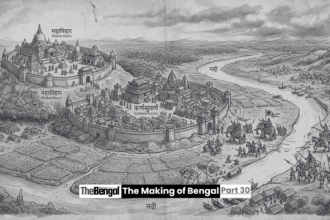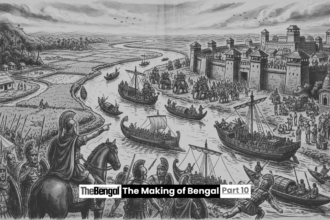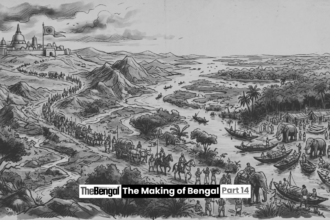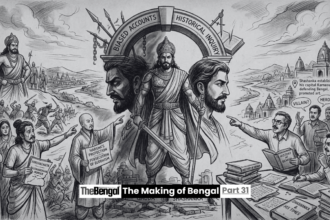

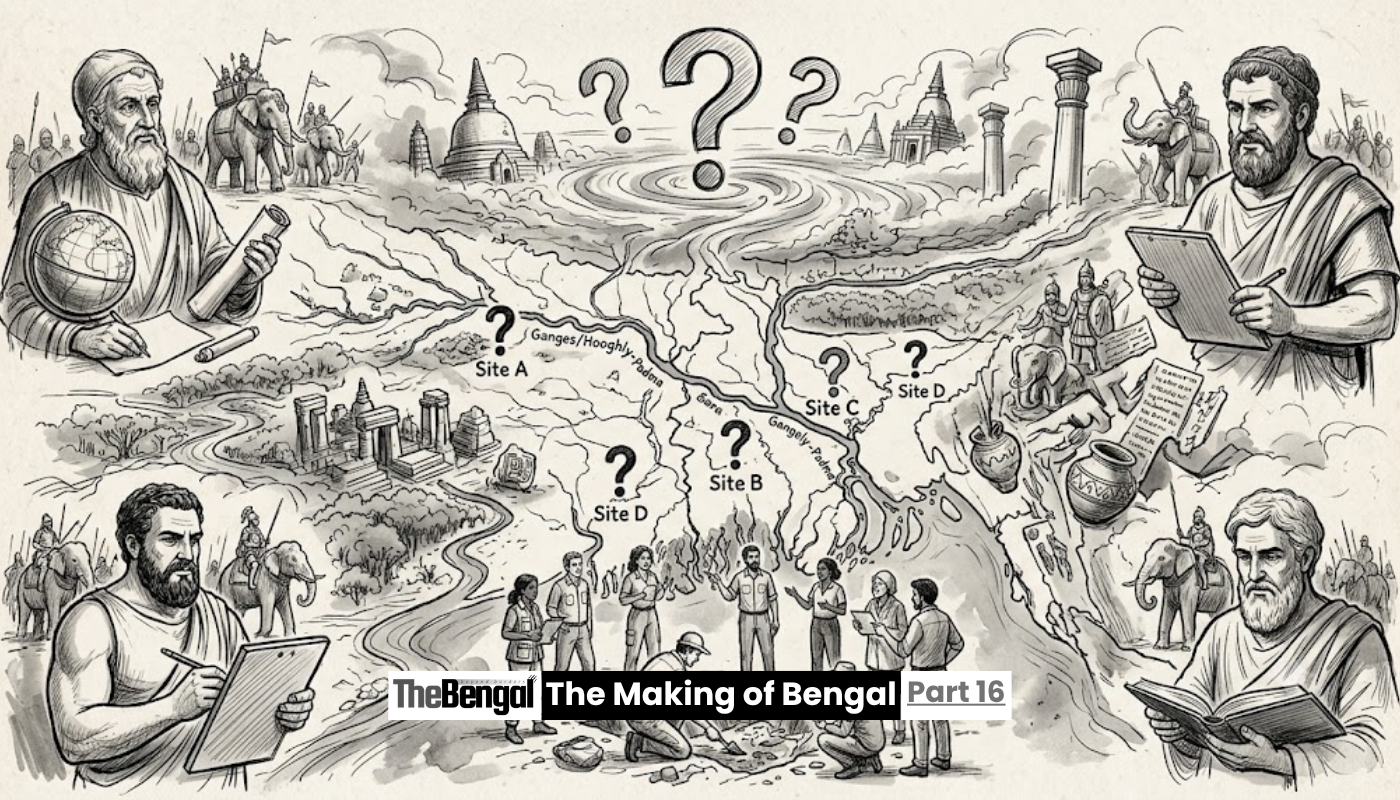

This article is part of The Making of Bengal, a long-form historical series by The Bengal. Across the previous chapters in this section, we have followed Gangaridai’s brush with Alexander’s army, the archaeology being used to trace it, the tribal kingdoms that preceded it in Sanskrit literature, Bengal’s entry into the Mauryan administrative record, and the rise of its first true cities. This chapter closes the section by confronting a question none of that evidence has fully answered: where, exactly, was the capital of it all?
A City Named by a Geographer Who Never Saw It
The clearest starting point is also, frustratingly, the least helpful. In the second century CE, the Alexandrian geographer Claudius Ptolemy compiled his Geographia, a sweeping attempt to map the known world using the reports of merchants, sailors and earlier scholars. In it, he names a city called Gange, describing it as the capital of a kingdom occupied by a people he called the Gangaridai, situated near the mouths of the river from which it apparently took its name.
Ptolemy had never travelled to Bengal himself. His account was built from secondhand information, filtered through the reports of Roman and Greek traders who had, at best, visited the delta’s coastal ports rather than its inland capital. As one modern academic study of ancient Bengal’s maritime geography notes, the search for Ptolemy’s Gange has drawn the attention of scholars for well over a century, with proposals stretching back to the 1840s. The nineteenth century Orientalist Arend Wilhelm Heeren placed it near the village of Dulialpur, southeast of modern Kolkata, while another scholar, Francis Wilford, argued for a site at the confluence of the Ganges. Neither identification has ever been confirmed by excavation, and the ruins of Gange, if Gange is even the correct name for whatever city Ptolemy was actually describing, have never been conclusively located.
Four Rival Candidates, One Unresolved Question
In the absence of a confirmed answer from Ptolemy’s account itself, modern historians and archaeologists have proposed a genuinely wide range of competing candidates for Gangaridai’s political centre, several of which have already appeared elsewhere in this series.
Archaeologist Dilip Kumar Chakrabarti has argued that the core of Gangaridai power sat near the Adi Ganga, a now largely dried-up channel of the Hooghly river, identifying Chandraketugarh as the strongest single candidate, with the nearby site of Mandirtala as a secondary possibility. British civil surgeon James Wise, writing in the nineteenth century, instead proposed Kotalipara, in present-day Bangladesh, as the seat of Gangaridai power. Archaeologist Habibullah Pathan, whose own family’s collecting first drew scholarly attention to Wari-Bateshwar, argued instead that those ruins in Narsingdi district represented genuine Gangaridai territory. A more sceptical strand of scholarship, represented by historian William Woodthorpe Tarn, has gone further still, questioning whether the name Gangaridai as recorded by Diodorus even refers to Bengal at all, proposing instead that Greek writers may have confused it with peoples much further west, near the Beas river in Punjab.
That so many serious researchers, working from broadly the same limited classical sources, have arrived at such different physical locations says a great deal about how thin the surviving evidence actually is. Bengal’s most famous ancient kingdom, well known enough by reputation to be blamed for helping turn back Alexander the Great, still cannot be pinned to a confirmed map coordinate.
The City That May Answer a Different Question
Of the four candidates, Kotalipara deserves particular attention, not because it necessarily solves the Gangaridai puzzle, but because it is, independently, a genuine and well-documented ancient city in its own right. Situated on the Ghagar river roughly 28 kilometres southeast of Gopalganj in Bangladesh, Kotalipara is confirmed by the Ghughrahati copperplate inscription of a ruler named Samacharadeva, and was also known historically as Chandravarmankot.
According to Bengali historical scholarship, while James Wise’s identification of Kotalipara as the capital of Gangaridai remains possible, it is generally considered more reasonable to connect the site instead with the independent kingdom of Vanga, discussed in an earlier chapter of this series, which is understood to have formally emerged as a distinct polity around the sixth century CE, well after the Gangaridai era described by Greek and Roman writers. On this reading, Kotalipara’s true historical significance lies less in solving an eight-hundred-year-old Greek mystery and more in its later role as the confirmed administrative centre of Vanga’s kings following the decline of Gupta authority in the region, a status further discussed in Bengal’s Vanga kingdom sources, which describe Kotalipara emerging as the centre of Vanga administration in the post-Gupta period.
This matters for how we think about the whole search. Vanga is widely believed by historians to have been either identical to, or the direct successor of, whatever political entity Greek writers called Gangaridai. If that connection holds, then Kotalipara’s later importance as a Vanga capital may represent political continuity with an earlier, unnamed seat of power, rather than being the Gangaridai capital itself under a different name.
Perhaps There Was No Single Capital at All
A further possibility, and one worth taking seriously, is that the entire search for a single Gangaridai capital may be looking for something that never quite existed in the way later readers of Ptolemy have assumed. Modern academic treatments of ancient Bengal’s maritime geography note that Gange was described as a distinct port and political centre alongside other important cities of the same era, including Tamralipta, and that classical writers may simply have been describing whichever prominent trading centre their particular informants happened to have visited or heard about, rather than a single, universally recognised capital city functioning the way capitals do in modern states.
Given everything explored elsewhere in this series, the fortified, plan-built settlements at Chandraketugarh, Wari-Bateshwar and Mahasthangarh, the port infrastructure at Tamralipta, the wider network of interconnected towns discussed in the previous chapter, it is entirely plausible that Gangaridai functioned less as a kingdom with one fixed capital and more as a confederation or cultural-economic zone spanning much of the delta, with power and trade distributed across several major fortified centres rather than concentrated in any single city. Ancient Greek and Roman writers, working from fragmentary secondhand reports, may simply have reduced that more complex reality into the familiar shorthand of a single named capital, because that was the political concept their own readers understood best.
A Search That Is Far From Over
What makes this question genuinely open, rather than simply unsolved, is how much of the relevant ground remains unexcavated. Chandraketugarh, as discussed in an earlier chapter of this series, has seen only a fraction of its full extent properly dug, and continues to suffer from looting rather than sustained scholarly study. Wari-Bateshwar’s fifty associated archaeological sites remain, for the most part, unexplored. Kotalipara itself has not been the subject of the kind of large-scale, sustained excavation applied to sites like Mahasthangarh or Bangarh.
Somewhere within that unexcavated ground, or quite possibly nowhere at all in the form later readers have imagined it, lies the answer to where Gangaridai’s political heart truly sat. Until further digging changes the picture, Bengal’s most famous ancient capital remains exactly what it has been for two thousand years: a name recorded confidently by a geographer who never visited it, chased ever since by archaeologists working with evidence that refuses to settle the question either way.
In the next chapter of this series, we turn away from these unresolved mysteries of empire and geography toward Bengal’s own political story, following the collapse of Gupta authority in the region and the rise of the man credited with forging Bengal’s first genuinely independent kingdom: Shashanka.
Sources: Wikipedia, “Gangaridai,” “Vanga kingdom” and “Bengal”; Banglapedia, “Kotalipara”; Homegrown India, “The Lost Kingdom of Gangaridai: The Bengal Power That Stopped Alexander”; Bangladesh.com, “The Historic State of Gangaridai”; Studocu/Jagannath University e-library, “Maritime Ports in Bengal: Gangê”; Teachmint, e-SLM GE-HI-11, History Study Material.