
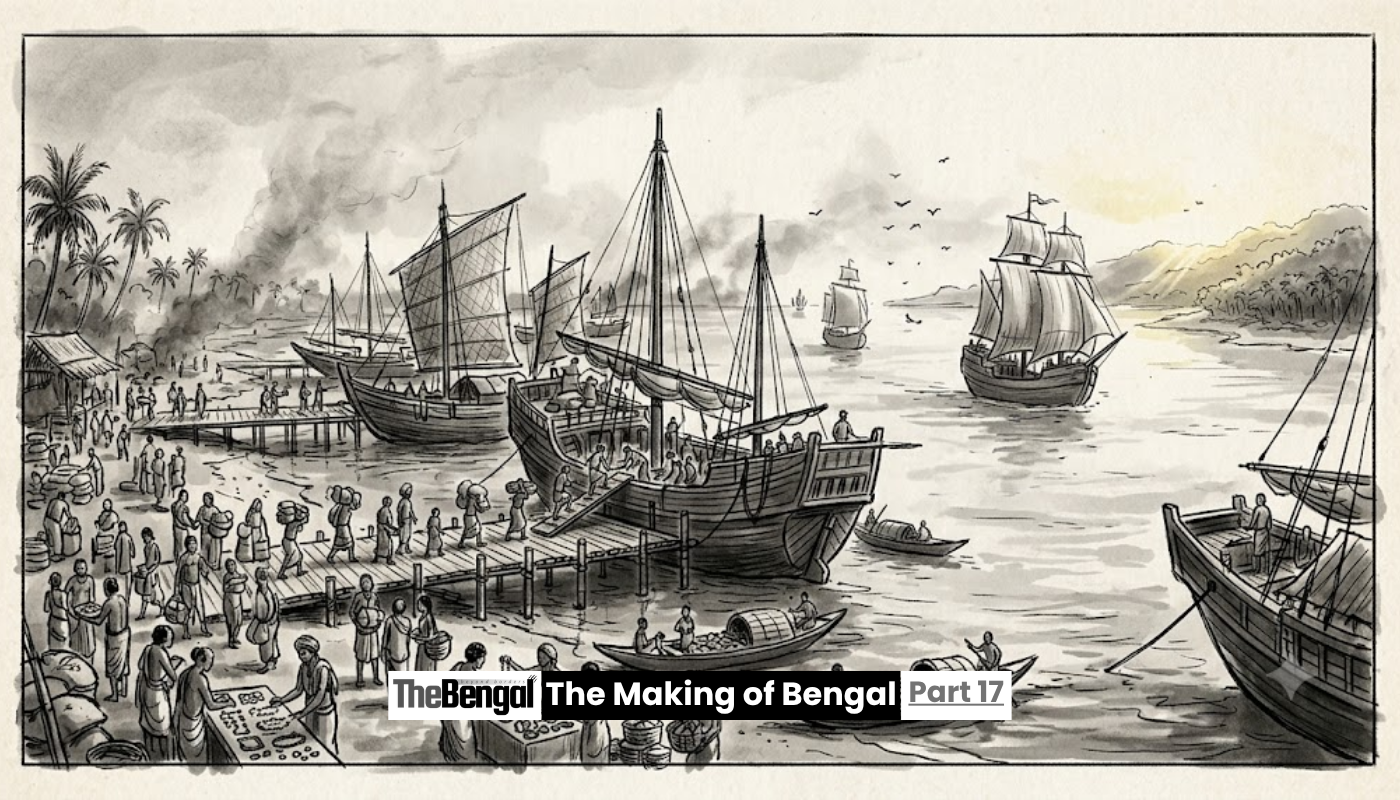

This article is part of The Making of Bengal, a long-form historical series by The Bengal. Having closed the previous section with the unresolved mystery of Gangaridai’s lost capital, this chapter opens a new section of the series, one focused on Bengal’s economy and society in the ancient world, beginning with the sea that made so much of that economy possible.
A Sea Named for the Land Beside It
The Bay of Bengal has, for millennia, functioned as what one recent academic framework calls an interaction sphere, a connected maritime zone linking the eastern coast of the Indian subcontinent with the Indochinese peninsula and the islands of the Malay Archipelago. Long before European ships arrived to chart and eventually dominate these waters, the bay had already served as what researchers describe as an ancient maritime silk route, or spice route, one of the most important sea trading passages connecting India’s eastern seaboard to its Southeast Asian neighbours.
Bengal did not merely sit on the edge of this network. Positioned directly on the eastern coast of India, facing the bay that would eventually carry its name into modern geography, it functioned as one of the principal Indian gateways for voyages heading toward Southeast Asia. Ancient Indian texts had their own name for the destination these ships were sailing toward: Suvarnabhumi, the Land of Gold, referring broadly to mainland Southeast Asia, and Suvarnadvipa, the Island of Gold, referring to the islands of the Malay Archipelago further out. The Buddhist text Milinda-Panha explicitly identifies this region as Suvarnabhumi, one of several ancient Indian sources confirming just how established the idea of a rich, reachable land across the eastern sea had become.
Two Ports, One Trading World
What made Bengal capable of sustaining this role was its network of ports. Historical scholarship on the region identifies Tamralipta and Gange as Bengal’s two major international harbours, discussed in earlier chapters of this series, supplemented by numerous smaller internal ports connected through the delta’s dense web of rivers directly out into the bay.
Tamralipta, in particular, appears repeatedly across ancient literature as the departure point for voyages east. The Sanskrit poet Kalidasa’s Raghuvamsa describes it as a specific type of seaport known as a dronimukha, strategically located near the confluence of the Rupnarayan river and the Bay of Bengal. The Jataka tales, an early Buddhist collection of stories, include an account in the Mahajanaka Jataka of a banished prince who gathers pearls, jewels and diamonds before boarding a ship bound for Suvarnabhumi, a voyage scholars believe most plausibly began at Tamralipta, given its unique access from the eastern seaboard to inland regions such as Mithila. The port’s importance endured for centuries, its last confirmed epigraphic mention appearing in the eighth century Dudhpani Rock inscription, a startlingly long working life for any ancient harbour.
The Physical Proof of a Two-Way Trade
Literary references are one kind of evidence. Physical objects, dug out of the ground on both sides of the bay, are considerably harder to dispute.
Archaeological excavations at Khao Sam Kaeo and Ban Don Ta Phet, two significant ancient entrepots in what archaeologists term Suvarnabhumi, located in present-day Thailand, have recovered semi-precious beads, pottery and cotton thread that researchers trace back to Bengal. This is not a one-way story of Indian goods simply arriving in Southeast Asia, however. At Wari-Bateshwar, the fortified early trading centre in Bangladesh explored in an earlier chapter of this series, excavators recovered a high-tin bronze bowl whose origin traces back to Southeast Asia itself, a find closely comparable to bronze vessels recovered at both Khao Sam Kaeo and Ban Don Ta Phet. Carnelian seals bearing Brahmi script, the same script found on the Mahasthan inscription discussed earlier in this series, have likewise turned up at coastal Southeast Asian sites, indicating regular, sustained contact rather than occasional, isolated voyages.
Some researchers have traced Bengal’s trading reach further still. One scholarly analysis suggests that Bengal may have functioned as the ultimate origin point for the cowrie shells that reached as far as Yunnan in southwestern China, used there as a form of currency, a genuinely remarkable claim if accurate, implying that goods moving through Bengal’s ports could travel not just across the bay but deep into interior China through onward overland networks.
Guilds, Merchants and an Expanding Cargo
This trade did not remain confined to small quantities of prestige goods carried by a handful of adventurous merchants. Research into the organisation of these early sailing networks indicates that, while trade across the bay may have initially centred on high-value prestige items, it expanded over time to include everyday agricultural goods as well, organised through merchant guilds and individual traders operating along the Ganges river valley by the early centuries of the Common Era.
That expansion mattered enormously for Bengal’s own economy. A trade network built solely around luxury goods for elites remains, by nature, limited in scale. One that had grown to include agricultural produce, organised through structured guilds rather than occasional individual ventures, represents something closer to a genuine commercial economy, integrated into the delta’s farming villages and river trade discussed in earlier chapters of this series, rather than a narrow trading operation serving only the wealthy.
More Than Cargo: Carrying a Civilisation Across the Sea
What travelled across the Bay of Bengal was never limited to physical goods. Historians describe the broader process by which Indian religious, political and cultural forms took root across Southeast Asia as Indianization, and Bengal, given its geographical position and its dense network of ports, is understood by researchers to have been a significant contributor to that process, described in one academic study as playing a role in facilitating this assimilation and expansion through its position on the Bay of Bengal.
By the fifth century CE, kingdoms such as Tarumanagara and Kantoli had arisen in the Southeast Asian archipelago, drawing heavily on this same Indian Ocean trading world for both material wealth and cultural influence. Hindu-Buddhist kingdoms across the wider region continued to depend on the Bay of Bengal for both trade and cultural exchange for centuries afterward, a dependence that persisted long after Bengal’s own earliest ports had passed their peak, eventually giving way, by the eleventh century, to a period when the South Indian Chola dynasty came to dominate the same waters so thoroughly that contemporary records describe the Bay of Bengal simply as the Chola’s Lake.
A Sea That Made a Region
It is worth pausing on just how significant this maritime story is to the wider arc this series has been tracing. Bengal’s rivers, examined in earlier chapters, built the delta itself. Its rice, examined in a later chapter, fed a growing population dense enough to sustain real cities. Its fortified towns, from Chandraketugarh to Wari-Bateshwar to Tamralipta, provided the physical infrastructure. But it was the Bay of Bengal, the open water beyond the river mouths, that connected all of that inward-facing development to a much larger world, carrying Bengali cotton and beads to Thai shores, bringing Southeast Asian bronze and camphor back in return, and turning a fertile but geographically peripheral delta into a genuine hinge between South Asia and the wider Indian Ocean world.
Long before Bengal ruled anything on land in the way later empires would, it had already, in a very real commercial and cultural sense, made the bay that bears its name its own.
In the next chapter of this series, we look more closely at ancient Bengal’s maritime empire itself, examining the ships, the sailors and the specific commodities that carried the region’s trade across these waters for the better part of a thousand years.
Sources: ResearchGate, “Tracing Early Maritime Southeast Asia through Archaeological Elements and Bengal’s Contact (400 BCE to 800 CE)”; Scribd, “In Search of Suvarnabhumi: Early Sailing Networks in the Bay of Bengal”; Dhaka University Research Centre Publication, Sharmin, “Exploring Earliest Bengali Diaspora and Cultural Penetration”; Journal of the Indian Ocean Region, “Crossings and Contacts Across the Bay of Bengal: A Connected History of Ports in Early South and Southeast Asia”; Wikipedia, “Countries of the Bay of Bengal”; Observer Research Foundation, “Anchoring the Bay of Bengal in a Free and Open Indo-Pacific”; Sunil Gupta, “The Bay of Bengal Interaction Sphere (1000 BC to AD 500).”