

This article is part of The Making of Bengal, a long-form historical series by The Bengal. The previous chapter followed Atisha and other Bengali-trained scholars carrying their learning outward to Tibet and beyond. This chapter turns the direction of travel around, examining the students and teachers who crossed the length of Asia specifically to study within the network of universities the Pala dynasty built and sustained.
A Coordinated System, Not a Single School
It is easy to think of Nalanda, already introduced in earlier chapters of this series through Xuanzang’s and Yijing’s accounts, as a solitary, singular achievement. The fuller picture, as later scholarship on the period has established, is considerably more interesting. According to Tibetan sources, five great mahaviharas, Vikramashila, Nalanda, Somapura, Odantapuri and Jagaddala, functioned together as an interconnected network under direct state supervision, with scholars moving freely between them rather than remaining confined to a single institution for their entire education. This amounted, in effect, to a coordinated higher education system spanning the whole of eastern India, one this series has already traced piece by piece: Odantapuri founded under Gopala, Vikramashila under Dharmapala, Somapura begun under Dharmapala and completed under Devapala, and Nalanda itself revived and expanded through direct Pala patronage across three successive reigns.
Three of these five, Vikramashila, Odantapuri and Jagaddala, sat within the Pala heartland of Bihar and Bengal proper, while Somapura stood in what is now Bangladesh, and Nalanda, though technically founded earlier under the Gupta emperor Kumaragupta I in the fifth century CE, had by the Pala period become thoroughly bound into this same integrated network through sustained royal funding and shared scholarly traffic. Understood this way, the achievement this chapter describes was never really about any single famous campus. It was about an entire regional system, built and maintained across four Pala generations, functioning as a unified destination for serious scholars from across the Buddhist world.
The Examination at the Gate
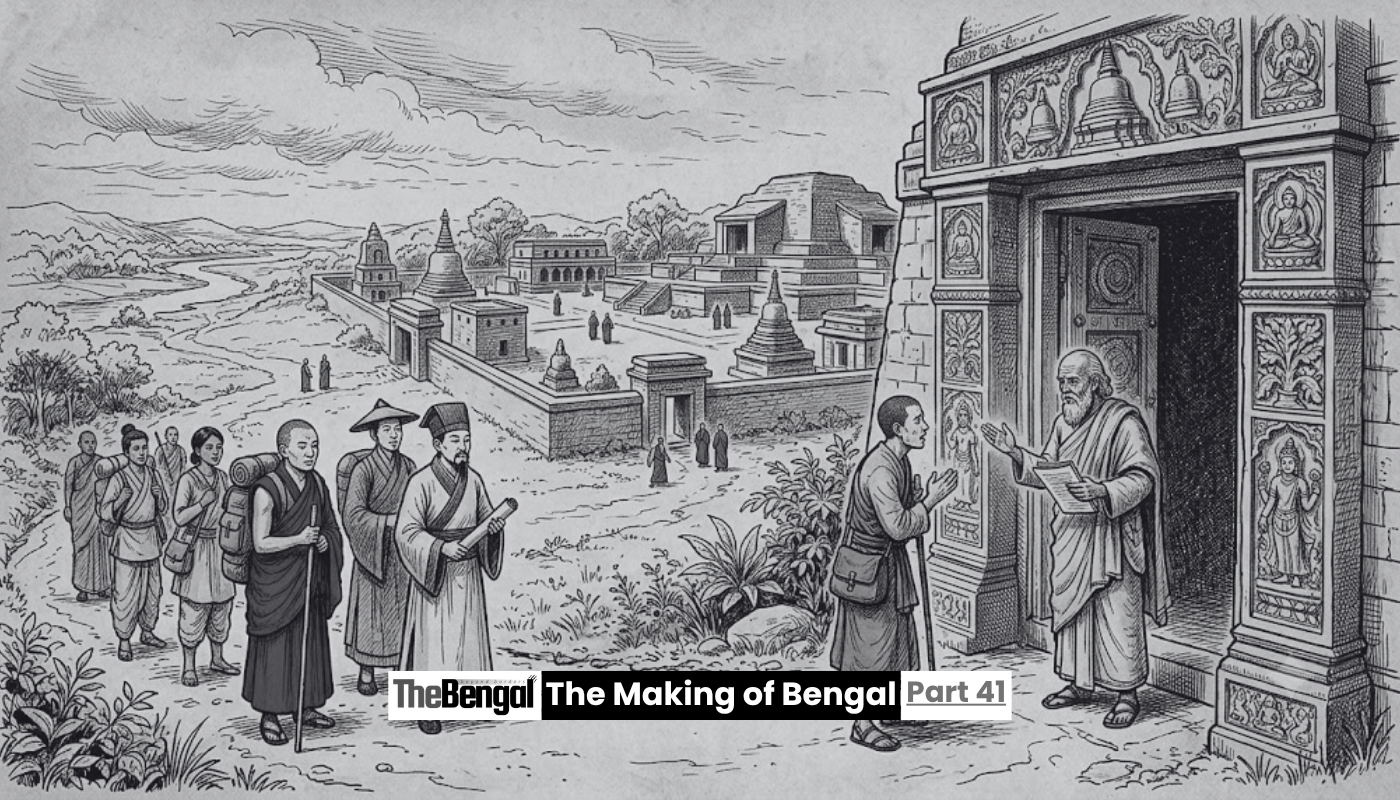
Getting into this system was never simple. At Vikramashila, the university Dharmapala founded and examined in an earlier chapter of this series as a deliberate response to concerns about declining scholastic rigour elsewhere, admission followed a formal and demanding process. Tibetan chronicles describe six dvarapanditas, gatekeeper-scholars, stationed specifically to examine prospective entrants before they were permitted to join the university at all, a structured screening system indicating an institution operating with a level of administrative maturity comparable to Nalanda’s own well-documented practices.
At Nalanda itself, the standards appear to have been comparably uncompromising. Later research into the university’s operation describes admission examinations so rigorous that only around a fifth of applicants were accepted, with successful candidates then receiving their entire education free of charge, funded through the substantial royal land grants this series has already traced across multiple Pala reigns, beginning with Dharmapala’s own grant of two hundred villages examined in an earlier chapter. This combination, genuinely selective admission paired with fully funded education for those who succeeded, meant that a place within this network represented something earned through real intellectual achievement rather than simply purchased through wealth or family connection.
A Student Body Drawn From Half of Asia
What makes this network genuinely remarkable, judged even by modern standards, is the sheer geographic reach of the students it attracted. Nalanda alone is recorded as having drawn scholars from China, Korea, Japan, Tibet, Mongolia, Sri Lanka and across Southeast Asia, a student population that, at its documented peak, numbered over ten thousand students taught by roughly two thousand instructors. This series has already followed one especially well-documented thread of this international traffic in an earlier chapter: Balaputradeva, the Sailendra king of Java and Sumatra, formally petitioning Devapala for land at Nalanda specifically to house monks travelling from his own kingdom, a diplomatic request that only makes sense in the context of exactly this kind of established, ongoing international enrolment.
Among the most consequential of these travelling scholars were the two Chinese pilgrims this series has relied on repeatedly for eyewitness testimony throughout its earlier chapters on Bengal’s Buddhist history: Xuanzang, who both studied and later taught at Nalanda during the seventh century, and Yijing, who followed a comparable path a few decades afterward. Both men left behind detailed travelogues describing the institution’s library complex, its rigorous academic culture and its vibrant daily intellectual life, sources this series has already drawn on directly for descriptions of Tamralipti, Samatata and Karnasuvarna in earlier chapters. Their accounts function as something close to firsthand journalism from within the very system this chapter describes, written by men who were, at various points, both visitors and genuine participants in its academic life.
More Than Religion Alone
It would be a mistake to imagine this network as offering religious instruction exclusively. According to research into Nalanda’s own curriculum, the education on offer there ranged well beyond core Buddhist philosophy to encompass logic, grammar, medicine, mathematics, astronomy and the fine arts, an interdisciplinary breadth genuinely unusual for a monastic institution and one that helps explain why students travelled such enormous distances specifically to study there rather than seeking Buddhist instruction closer to home.
Vikramashila, meanwhile, developed its own particular specialisation, placing especially strong emphasis on Tantric, or Vajrayana, Buddhist teaching, subjects that were, as this series’ previous chapter established through Atisha’s own training there, becoming increasingly influential across the wider Buddhist world during this exact period, particularly in the Himalayan regions and Tibet that Pala-trained scholars would go on to shape directly. This institutional specialisation, distinct curricula at different universities within the same connected network, meant that a serious scholar might genuinely benefit from studying across several of these institutions in sequence, exactly the kind of free movement between mahaviharas the Tibetan sources describe.
A System That Outlasted Any Single King
What ties this chapter back most directly to the broader arc this series has followed through the Pala Age is how deliberately sustained this achievement actually was. No single Pala king built this entire network alone. Gopala began it with Odantapuri, examined in an earlier chapter as his most significant surviving legacy despite the near-total absence of direct inscriptional evidence from his own reign. Dharmapala expanded it dramatically with Vikramashila and the beginnings of Somapura, alongside his substantial funding of Nalanda’s own revival. Devapala carried the network to its recognised peak, completing Somapura and receiving Balaputradeva’s formal international embassy as living proof of just how far the system’s reputation had already travelled.
Across three generations and well over a century of sustained investment, the Palas built something considerably more durable than any single military campaign or territorial claim examined elsewhere in this section of this series. They built an educational infrastructure substantial and prestigious enough that ambitious young scholars across half of Asia organised years of their own lives, and sometimes genuinely dangerous journeys across mountains and open sea, around the specific goal of studying within it.
In the next chapter of this series, we look closely at the single most physically ambitious achievement of this entire network, Somapura Mahavihara at Paharpur, the vast monastic complex whose architectural influence would eventually reach as far as the temples of Myanmar and Java.
Sources: Teachers Institute, “Ancient Indian Universities: The Glorious Legacy of Nalanda, Takshashila, and Vikramashila”; Fabrizio Musacchio, “Buddhist Universities: Innovation and Transmission in Monastic Education”; StoryVibe, “The Rise and Fall of Nalanda University: A Historical Insight”; Careerera, “Nalanda University Courses, Admission 2026”; Nalanda University, “International Students”; International Journal (LBP World), “Nalanda and Takshashila.”