


Every nation likes to have an origin story it can be proud of. Bengal’s favorite one goes something like this: after a hundred years of chaos, the ordinary people of the land came together, set aside their rivalries, and chose an ordinary man named Gopala to be their king. It is the kind of story that makes its way into school textbooks and government speeches, a distant ancestor of democracy peeking out from the eighth century. It is also, on closer inspection, a story built on far less solid ground than most people assume.
A Land Devoured by Its Own Chaos
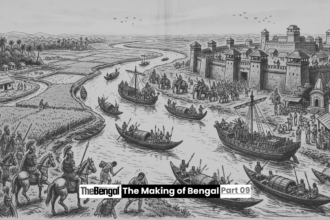
To understand why Bengal needed a Gopala at all, you have to picture what came before him. After the death of the powerful Gauda ruler Shashanka in the early seventh century, the region slid into roughly a hundred years without any stable central authority. Chieftains fought chieftains. Petty lords carved out fiefdoms and lost them just as quickly. Contemporary and near contemporary sources describe this era using a vivid Sanskrit phrase, matsyanyaya, the “logic of the fish,” a world where bigger fish simply swallow smaller ones because there is no magistrate left to stop them.
It is worth pausing on how old this metaphor really is. The idea appears in the ancient Arthashastra, where the total absence of law and punishment is compared directly to fish eating fish in the wild. By the time Bengal’s chroniclers borrowed the phrase for their own century of misery, it already carried the weight of a well understood warning: this is what a society looks like when nobody is in charge.
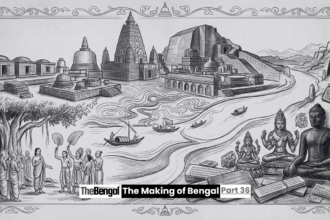
Out of that wreckage, sometime around 750 CE, a man named Gopala took the throne in the Gaur region and began stitching the territory back together. His son and eventual successor, Dharmapala, built on that foundation to turn the Palas into one of the great imperial powers of early medieval India, a dynasty that endured for close to four hundred years and left behind some of the era’s most important centers of Buddhist learning.
The Poor Family Metaphor: Why Nations Behave Like Households
There is a useful way to think about what a state actually is, beyond flags and borders. At its core, a state is simply a social organization, a structure people build so they can live well together and find some genuine satisfaction in life, not just material comfort but real contentment. A single ruler alone on an island, however powerful, will never find that contentment. It only comes through a shared structure where everyone gives a little and gains a little, and where that balance is protected by legitimate authority.
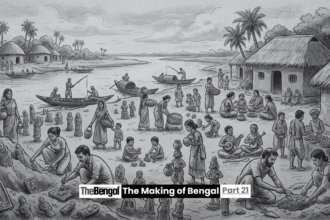
Seen this way, a state under strain behaves remarkably like a poor family. A struggling household often makes decisions in fits and starts. It buys bricks and sand for a home renovation long before it can afford to finish the job, so the materials sit gathering dust and moss while the front path stays unpaved for years. It borrows money for a lavish wedding it cannot really afford, and ends up sitting with its head in its hands afterward. It patches the veranda one year and the roof the next, never quite managing to do everything at once, living permanently surrounded by dust, rubble, and unfinished work because it lacks the resources to fix everything in a single push.
Bengal in the mid eighth century was very much this kind of household, except the crisis was political rather than financial. There was no shortage of ambition among its many petty rulers. What was missing was the single, sustained authority capable of finishing the job, of actually restoring order rather than patching one corner of the kingdom while another corner collapsed. That is the vacuum Gopala stepped into.
Two Very Different Accounts of How He Got There
Here is where the story gets genuinely interesting, and genuinely uncertain. There are essentially two sources historians lean on to explain how Gopala became king, and they could hardly be more different in tone.
The first is a folk tale, recorded not in Bengal and not anywhere near Gopala’s own lifetime, but in Tibet in 1608 CE by the Buddhist historian Lama Taranatha, nearly nine centuries after the events it claims to describe. In this version, Bengal’s leading men had already tried electing several kings in succession, only to watch each one murdered in his bed every single night by a monstrous serpent demoness. Eventually a devotee of the goddess Chunda arrived at a household whose turn it was to offer up a son for the doomed throne, and volunteered to take the young man’s place. That night he fought off the demoness with a sacred staff blessed by the goddess, survived, and kept surviving for seven nights running. Impressed by this uncanny resilience, the people made him their permanent ruler and gave him the name Gopala.
It is, frankly, a fairy tale, complete with monsters and divine weapons, and no serious historian treats it as literal fact. Its real value lies elsewhere: it preserves a folk memory that Gopala’s rise involved some kind of collective decision by the “people,” even if the details are pure legend.
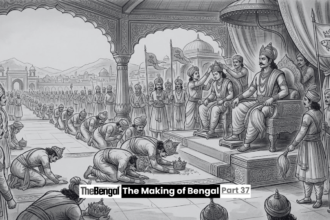
The second source is far more sober but far more ambiguous. It is a single verse inscribed on the Khalimpur copper plate, issued during the reign of Gopala’s own son Dharmapala. Translated roughly, the verse says that to put an end to the fish eat fish disorder, the prakriti took hold of the glorious Gopala’s hand and made him king, the crest jewel among rulers. Later Bengali translations rendered this poetically as ordinary subjects setting aside self interest and lifting up a worthy man to end their suffering.
The entire modern legend of a “democratically elected” king hangs almost entirely on how you translate one word in that verse: prakriti.
The Word That Launched a Thousand Textbooks
Prakriti is a slippery term. In some contexts it can plausibly mean “the people” or “the subjects” in a general sense. In other classical texts, including the Rajatarangini chronicle of Kashmir, the same word is used to mean something much narrower: the senior ministers or chief officials of a court. In that chronicle, a figure named Jalauka is said to have been installed as king by exactly seven such officials, not by any broad popular vote.
This is not a trivial distinction. If prakriti means “the general population,” then Gopala’s story really does describe something like an early election. If it means “a handful of powerful ministers or chieftains,” the story describes something closer to an elite political deal, a small circle of the already powerful choosing one of their own to restore order. Given that eighth century Bengal had, by definition, no functioning central government during this period of anarchy, it is genuinely hard to imagine any mechanism by which ordinary people across a fragmented territory could have coordinated a real, region wide election. There was no administrative machinery left to organize such a thing, let alone enforce its result.
And yet the “people’s election” version of the story took hold with remarkable force among some of Bengal’s most respected historians.
When Historians Fall in Love With a Story
Ramaprasad Chanda and Rakhaldas Bandyopadhyay, two towering figures in the study of Bengal’s ancient past, both endorsed the idea that Gopala was chosen by the people. Even more strikingly, the eminent historian R.C. Majumdar embraced the theory with real emotional force, at one point comparing Gopala’s elevation to the throne to Japan’s Meiji Restoration of 1868, framing it as a moment of extraordinary collective wisdom and self sacrifice by the Bengali people, a moment he suggested Bengali history had never quite matched again.
The remarkable thing is that Majumdar himself, in the very same discussion, acknowledged the case for skepticism. He noted that if prakriti simply meant a few chief ministers, then no central administration existed in that chaotic era capable of empowering officials to select a king on behalf of an entire, fractured country, nor could such officials have expected the wider population to simply accept their choice. In other words, one of the theory’s own leading champions laid out, in his own words, most of the argument against it.
There is a broader pattern worth naming here. Historians, like anyone else, can become attached to a version of the past that flatters the present. A story about ancient Bengal inventing a form of popular sovereignty over a thousand years before European democratic movements is an appealing one, especially to scholars writing during the twentieth century’s own struggles over self rule and national identity. But appeal is not evidence, and a genuinely disciplined reading of history has to be willing to set aside the version it would prefer to be true.
There is also a telling silence in the record. If Gopala’s rise really had involved something as unprecedented and glorious as a popular election, later Pala era inscriptions, which loved to heap praise on the dynasty’s founders, would almost certainly have made a much bigger deal of it. Instead, the surviving eulogies are vague on this exact point, which itself is a quiet argument against the grander version of the story.
So What Probably Happened?
Strip away the folklore and the wishful translation, and a more grounded picture emerges. The Pala family is generally associated with a Kshatriya, or warrior, background. Gopala’s father, Vapyata, is described in the Khalimpur inscription as a destroyer of enemies, language that fits a military lineage rather than a peaceful civic one. Other verses from Pala era copper plates describe Gopala crushing the power of men who had been acting purely on their own selfish will, and establishing lasting peace, phrasing that reads far more like the aftermath of a military campaign than the aftermath of a ballot.
Put together, the likeliest explanation is that Gopala was an accomplished military leader, possibly already a respected general, who used a combination of allies, strategic marriages of convenience among rival factions, and outright force to defeat competing warlords and impose a single authority over Gauda, Vanga, and Varendra, the core regions later sources agree he brought under control. The prakriti in the Khalimpur verse were most plausibly a circle of chieftains or officials who backed him, whether out of genuine hope for stability or simple political calculation, rather than a nation of ordinary villagers casting votes.
None of this makes Gopala a less significant figure. If anything, it makes him a more historically believable one. Restoring order across a shattered, leaderless region through military skill and shrewd alliance building was an extraordinary achievement in its own right, one that gave his son Dharmapala a stable enough foundation to expand the Pala state into a genuine imperial power, patron of great Buddhist institutions, and one of the dominant forces in early medieval South Asia.
Why the Argument Still Matters
This is not merely an academic quibble over a dead language. How a society remembers its founding moments shapes how it understands itself. Treating Gopala’s rise as history’s first democratic election, however inspiring the idea, asks a set of eighth century sources to say something they almost certainly cannot support. Good history is not a ledger of comforting stories; it is a discipline of following the evidence even when the evidence refuses to hand you the ending you were hoping for.
The honest version of Gopala’s story is, in its own way, still remarkable. A capable outsider rose out of a century of anarchy, out of a land as exhausted and improvised as a poor household patching its roof year after year, and built something durable enough to last four centuries. He did not need a fairy tale about serpent demons or a generous mistranslation of a single Sanskrit word to earn his place in history. The reality, warrior turned king turned dynasty founder, is dramatic enough on its own.
Sources consulted include the Khalimpur copper plate inscription of Dharmapala, Lama Taranatha’s sixteenth century History of Buddhism in India, R.C. Majumdar’s The History of Bengal, and modern scholarly summaries of Pala period historiography.