

This article is part of The Making of Bengal, a long-form historical series by The Bengal. The previous chapter followed Dharmapala’s military and diplomatic campaign to install his own nominee on the throne of Kannauj. This chapter steps back from the battlefield to ask a different question: what kind of empire was Dharmapala actually trying to build, and how did his choice of titles, alliances and religious patronage reveal an ambition that went considerably further than territorial conquest alone?
A Title That Announced Its Own Ambition
Words mattered enormously in early medieval Indian kingship, and the specific title Dharmapala eventually adopted, Parameshvara Paramabhattaraka Maharajadhiraja, supreme lord, supreme sovereign, king of great kings, was not a modest one. It represented, by the standards of the period, essentially the highest formal rank a monarch could claim, language reserved for rulers asserting genuine paramountcy over other kings rather than mere regional authority.
What makes this worth examining on its own terms, rather than simply as a footnote to the military campaign traced in the previous chapter, is the gap between title and reality that this series has already learned to read carefully in earlier chapters. Just as Shashanka’s own claim to the title Maharajadhiraja, examined in an earlier section of this series, represented an assertion of sovereignty considerably grander than his kingdom’s actual administrative reach, Dharmapala’s adoption of an even more elevated title was itself a political act, a deliberate statement of how he wanted his reign understood, both by his contemporaries and by history. A dynasty founded, within living memory, by a council of desperate chieftains ending a century of anarchy was now claiming, in its very second generation, the loftiest title available in the entire Sanskrit political vocabulary. That leap, from elected stabiliser’s son to supreme sovereign, tells its own story about how quickly Dharmapala understood his own ambitions had grown.
Marrying the Enemy
One of the more revealing details of Dharmapala’s reign, easy to overlook amid the drama of battles and coronations traced in the previous chapter, is who he chose to marry. His queen, Rannadevi, was a Rashtrakuta princess, drawn from precisely the same royal house whose intervention, twice, had rescued Dharmapala’s Kannauj ambitions from Pratihara defeat. This was no accident of romance. It was calculated statecraft, the same instinct for strategic alliance-building this series has already traced in Shashanka’s earlier partnership with Devagupta against the Maukharis, converting a relationship of mutual battlefield convenience into something considerably more durable: a dynastic bond that would directly shape the ambitions of the next generation, since Dharmapala’s own son and successor, Devapala, would inherit not only his father’s throne but this Rashtrakuta bloodline as well.
This marriage reveals something important about how Dharmapala actually understood empire-building. Military victory alone, as the previous chapter showed in detail, had proven maddeningly unstable, dependent on the unpredictable comings and goings of Rashtrakuta armies he could not control. A marriage alliance offered something battles could not: a standing relationship with the very power capable of deciding, almost accidentally, who controlled Kannauj. Dharmapala’s dream of empire, in other words, was never purely a dream of conquest. It was, from early on, a dream of durable alliance and legitimacy built to outlast any single military campaign.
Fifty Institutions, One Vision
If Dharmapala’s marriage reveals his diplomatic instincts, his religious patronage reveals something closer to a genuine ideological programme. According to the Tibetan historian Taranatha, writing centuries later but drawing on Tibetan Buddhist tradition that had preserved considerable detail about the Pala court’s religious life, Dharmapala founded fifty separate religious institutions across his kingdom. That figure deserves to be sat with. This series has already examined, in detail, two of Dharmapala’s most famous individual foundations, Vikramashila and the revival of Nalanda, but fifty institutions implies something far beyond a pair of flagship monuments. It implies a systematic, kingdom-wide policy of religious infrastructure building, monastery by monastery, region by region, on a scale this series has not encountered from any earlier Bengali ruler, including Shashanka’s own deliberate programme of Brahmanical patronage examined in an earlier section.
Central to this programme was Dharmapala’s relationship with the Buddhist philosopher Haribhadra, whom he took as his personal spiritual preceptor. This was not a ceremonial appointment. Haribhadra was a serious and influential Buddhist scholar, and his direct presence at Dharmapala’s court embedded genuine philosophical and doctrinal engagement into the practical machinery of Pala kingship, rather than treating religious patronage as separate from, or merely decorative to, the business of ruling. A king who kept a working philosopher as his spiritual advisor, and who funded fifty religious institutions as a matter of policy, was building something considerably more ambitious than a treasury of pious donations. He was constructing an entire intellectual and religious infrastructure meant to outlast his own reign, one his son Devapala would inherit fully formed and ready to expand.
A Monastery Built to Outlive Its Founder
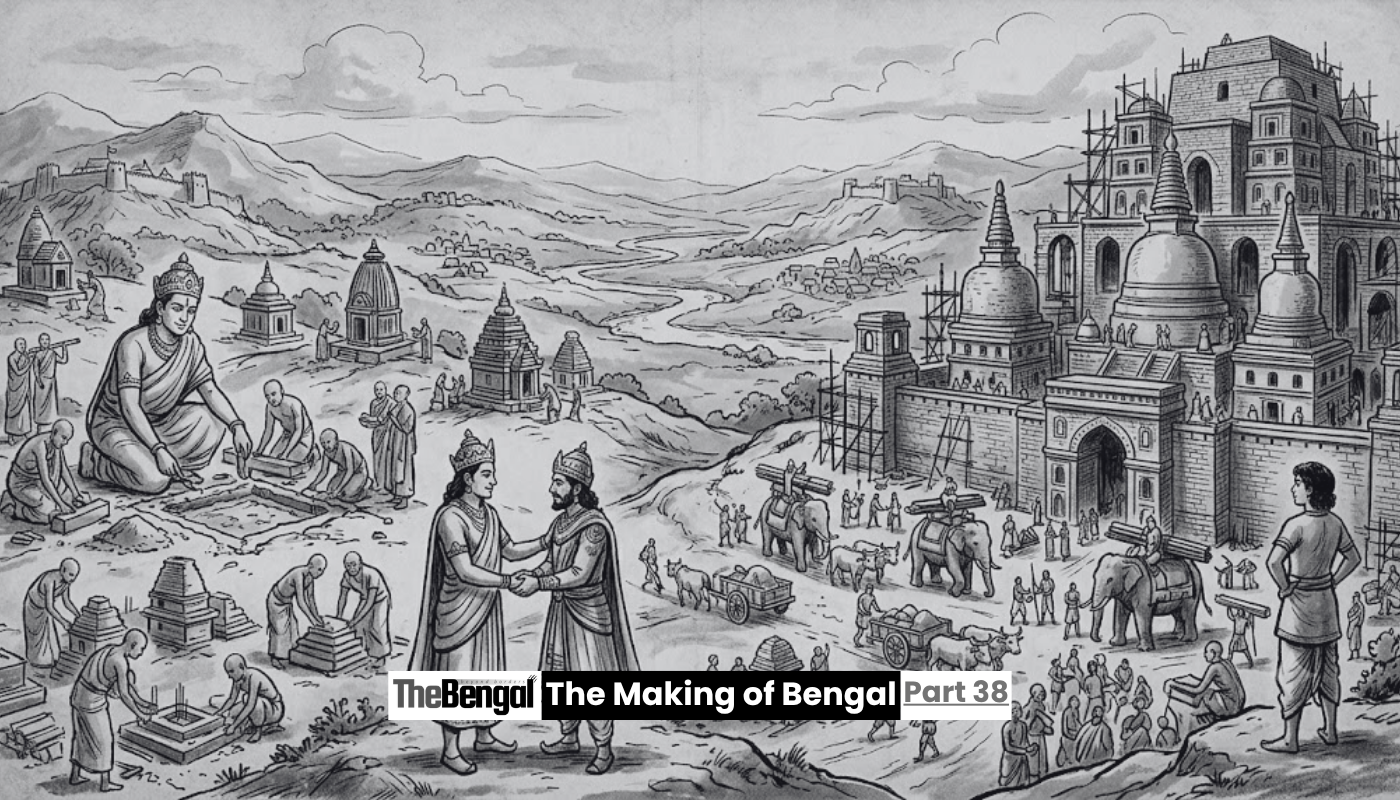
Nowhere is the scale of Dharmapala’s ambition more physically evident than at Somapura, the enormous monastic complex he began constructing at Paharpur, in what is now Naogaon District, Bangladesh. This series will return to Somapura in far greater detail in a later dedicated chapter, but it is worth noting here, in the context of Dharmapala’s broader vision, just how audacious the project actually was. Somapura would eventually become the largest Buddhist vihara anywhere in the Indian subcontinent, its architectural plan influential enough, according to later scholarship, to shape temple design as far away as Myanmar and Java. Yet construction on a project of this scale could not possibly have been completed within a single reign, however long. Dharmapala began it. His son Devapala would restore, enlarge and complete much of what his father had started, adding decorative elements drawing on themes from the Ramayana and Mahabharata to the finished structure.
This detail matters for understanding what kind of empire Dharmapala was actually dreaming of. He was not building monuments sized to his own lifetime. He was laying foundations, quite literally, for projects and institutions he expected his successors to carry forward, a form of dynastic thinking that assumed continuity rather than personal glory, and that, as the previous chapter of this series established, the Pala dynasty would in fact deliver, ruling continuously for eighteen generations after him.
Two Empires, Built Together
What emerges from this closer look at Dharmapala’s reign is a ruler pursuing two parallel and mutually reinforcing visions of empire simultaneously. One was the conventional, military and diplomatic empire traced in the previous chapter, armies, battles, installed vassals, a marriage alliance with the very rivals who had twice defeated him in the field. The other was a religious and intellectual empire, fifty institutions, a philosopher-advisor embedded at court, a monastery so vast it would take two reigns to complete, an investment in Buddhist scholarship substantial enough to eventually produce Atisha, the scholar whose later mission would carry Pala-trained Buddhism all the way to Tibet.
Neither empire, on its own, would have secured Dharmapala’s lasting reputation as the greatest of the Pala kings. Together, they represented something genuinely distinctive: a ruler who understood that lasting power required both the sword and the sanctuary, both a throne installed at Kannauj and a monastery built to outlast his own lifetime. That dual vision, inherited fully formed by his son, is precisely what allowed Devapala to inherit not merely a kingdom but a genuine imperial project already well underway.
In the next chapter of this series, we turn to that son directly: Devapala, who took his father’s twin foundations of military reach and religious patronage and carried the Pala Empire to the absolute peak of its territorial extent, ushering in what many historians consider the true golden age of Bengal.
Sources: Wikipedia, “Dharmapala of Bengal” and “Pala Empire”; GKToday, “Paramesvara Paramabhattaraka Maharajadhiraja was the title of–”; Prepp.in, “Dharmapala (770-810 CE): Important Ruler of Pala Dynasty”; Vajiram & Ravi, “All About Pala Dynasty”; Testbook, “Pala Dynasty: History, Rulers, Administration, Architecture, Literature and Decline.”