

This article is part of The Making of Bengal, a long-form historical series by The Bengal. The previous chapter introduced the Pala Empire as a whole, its four-century span, its Buddhist patronage, and its unusual resilience through repeated cycles of decline and revival. This chapter looks closely at the reign that made all of that possible in the first place: Dharmapala, son of Gopala, and the two remarkable decades in which Bengal briefly became the most powerful state in northern India.
Inheriting a Kingdom, Building an Empire
Dharmapala succeeded his father Gopala around 770 CE, inheriting the stabilised, reunified kingdom examined in the previous section of this series, Gauda, Pundra and Vanga brought together after a century of anarchy, with growing influence already reaching into Magadha. What remains genuinely uncertain, as Wikipedia’s own account of his reign notes, is how much of Dharmapala’s later territory represented outright inheritance from his father versus his own conquest, since the precise extent of Gopala’s kingdom was itself never fully documented. What is not in doubt is what Dharmapala did with whatever base he inherited: he spent much of the next forty years turning it into the dominant power north India had seen since the fall of Harsha’s empire, examined in an earlier section of this series.
The Prize Everyone Wanted
By the late eighth century, the throne of Kannauj had become the single most symbolically loaded piece of political real estate in northern India. Following the collapse of Harsha’s own empire, examined in this series’ section on Bengal’s dark century, no single power had managed to reassert the kind of unified authority he had once held. Kannauj, sitting at the heart of the old imperial heartland, became understood across the subcontinent as the city whose throne conferred genuine claim to supremacy over what Sanskrit sources called madhyadesha, the middle country, and whoever controlled it could plausibly call himself Uttarapathasvamin, lord of the northern road.
Three rising powers wanted that claim simultaneously. Dharmapala’s Palas, expanding westward from their Bengal and Bihar base. The Gurjara-Pratiharas, expanding eastward under an ambitious ruler named Vatsaraja from their base in Rajasthan and Malwa. And the Rashtrakutas, the dominant power of the Deccan under King Dhruva, who periodically marched north from their own capital purely to humble whichever of the other two seemed to be winning, before returning south again without any intention of holding the territory themselves. Historians have since given this decades-long, three-cornered contest a name: the Tripartite Struggle, sometimes called the Kannauj Triangle Wars, fought in overlapping phases roughly between 785 and 816 CE.
Defeated Twice, and Winning Anyway
What makes Dharmapala’s eventual triumph genuinely remarkable is how little it resembled a straightforward string of victories. The Pala records themselves, as Banglapedia notes with a certain dry honesty, are understandably silent about the struggle’s opening phase, for good reason. Around 790 CE, Vatsaraja’s forces met Dharmapala’s near Prayaga and defeated him decisively, with Vatsaraja’s own vassal, the king of Sambhar, reportedly pursuing the retreating Gauda forces and looting the royal treasury on the way home.
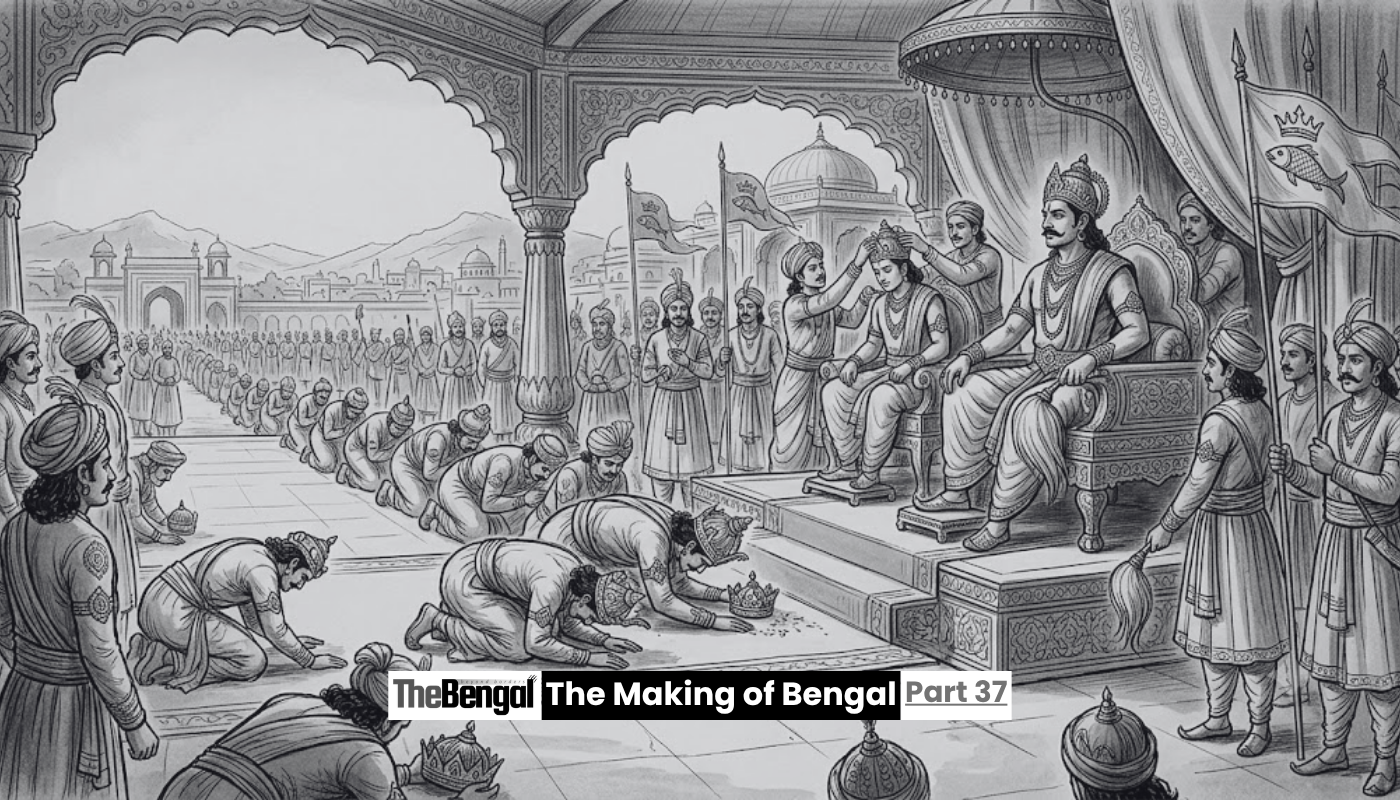
That should, by any conventional logic, have ended Dharmapala’s northern ambitions. Instead, the same Rashtrakuta king Dhruva who had been raiding northern India purely for prestige turned on Vatsaraja next, defeating him in turn before, characteristically, withdrawing south again without staying to consolidate the win. Dharmapala, watching his own conqueror get conquered, seized the resulting vacuum, moved into Kannauj around 791 CE, defeated the weak local ruler Indrayudha, and installed his own chosen nominee, Chakrayudha, on the throne, holding a formal imperial court to mark the occasion. The pattern would repeat almost exactly a second time: years later, Nagabhata II, Vatsaraja’s son, invaded again, drove Chakrayudha into Dharmapala’s protection, and defeated Dharmapala himself near Munger. Once again, a Rashtrakuta ruler, this time Dhruva’s son Govinda III, marched north, defeated Nagabhata II, accepted Dharmapala and Chakrayudha’s voluntary submission, and then, once again, simply returned to the Deccan, leaving the field open for Dharmapala to reassert his position essentially unchallenged.
Twice defeated in open battle, and twice left standing as the last man in the room once his more dangerous rival had been removed by someone else entirely. Dharmapala’s genius, if the surviving record is read fairly, lay less in battlefield brilliance than in a kind of patient opportunism this series has already recognised in an earlier ruler: the same pragmatic, timing-driven approach to seizing power that Shashanka had once used to break free from Later Gupta and Maukhari overlordship generations earlier.
A Court Where Kings Bowed
Whatever the precise mechanics behind it, the outcome by the 790s was extraordinary. The Khalimpur copperplate, already examined in an earlier chapter of this series for its account of Gopala’s own election, records that Chakrayudha’s formal installation on the Kannauj throne was attended and accepted by the rulers of Bhoja, Matsya, Madra, Kuru, Yadu, Yavana, Avanti, Gandhara and Kira, a genuinely sweeping list of territories spanning from the Punjab and Haryana-Delhi region through eastern Rajasthan, central India and the Kangra valley in the Himalayan foothills. The inscription’s own eulogistic language describes these assembled kings bowing respectfully, their diadems trembling, as Chakrayudha took the throne under Dharmapala’s sponsorship.
Historians remain properly cautious about taking this language entirely at face value, Pala court inscriptions had every reason to exaggerate their own king’s triumphs, much as earlier chapters of this series have already had to weigh similarly self-interested claims from other dynasties. But even discounting for royal eulogy, the underlying reality is not seriously disputed: for a period of some years around the turn of the ninth century, rulers across a huge swathe of northern India accepted, formally or practically, that Bengal’s king held the decisive say over who sat on the most prestigious throne in the subcontinent. As the Monghyr copperplate further records, Dharmapala’s position as sovereign, though a considerably looser arrangement than the direct administrative control once exercised by the Mauryas or Guptas examined earlier in this series, was accepted broadly enough that he could travel and offer prayers at distant sites like Kedar and Gokarna without apparent hindrance, a mark of genuinely wide-ranging influence rather than mere symbolic bluster.
Beyond the Battlefield
Dharmapala’s reign was never only about Kannauj. Alongside his military and diplomatic achievements, he undertook precisely the kind of institutional building this series’ previous chapter identified as the Palas’ most enduring legacy. He granted two hundred villages to fund the revival of Nalanda, already centuries old by this point and now entering a new phase of expansion under direct Pala patronage. More significantly still, he founded the Vikramashila Mahavihara around 783 CE in what is now the Bhagalpur district of Bihar, an institution that would grow to house roughly a hundred professors under a governing council of six, and would go on to produce the most celebrated scholar in the whole of the Pala Buddhist tradition: Atisha, whose later mission to Tibet, examined in a future chapter of this series, would permanently reshape the course of Tibetan Buddhism.
There is a genuine symmetry in this dual legacy. The same ruler capable of marching an army into the heart of northern India and installing his own nominee on its most prestigious throne was, in the very same decades, funding monastic scholarship destined to influence religious thought as far away as the Tibetan plateau, precisely the kind of combined military and cultural reach this series’ opening chapter on the Pala Empire identified as the dynasty’s defining, if imperfect, claim to greatness.
A Superpower With an Expiry Date
Dharmapala’s dominance, real as it was, did not prove permanent. The wider Tripartite Struggle would continue for years after his own death around 810 CE, eventually resolving in the Pratiharas’ favour under Nagabhata II by 816. Dharmapala himself never held Kannauj continuously or without contest, and his authority over the distant vassal territories listed in the Khalimpur inscription almost certainly loosened considerably whenever his own attention or military strength wavered.
Yet for the purposes of this series, what matters most is not how long Dharmapala’s dominance lasted, but that it happened at all. A kingdom founded barely a generation earlier by a council of desperate chieftains trying simply to end a century of anarchy had, within one reign, become powerful enough to crown and depose kings across a third of the Indian subcontinent, and wealthy and stable enough, simultaneously, to fund the two most important Buddhist universities in Asia. Bengal, for the first time in the long history this series has followed since Gangaridai’s brush with Alexander, had become a superpower in its own right, not merely a wealthy delta worth fighting over, but a kingdom capable of projecting power outward across the subcontinent on its own terms.
In the next chapter of this series, we turn to Dharmapala’s son and successor, Devapala, who inherited this hard-won dominance and, rather than merely defending it, carried the Pala Empire to the absolute peak of its territorial reach.
Sources: Wikipedia, “Dharmapala of Bengal” and “Tripartite Struggle”; Banglapedia, “Dharmapala”; Britannica, “Dharmapala”; Edukemy, “Age of Three Empires: Palas, Pratiharas, Rashtrakutas”; Vajiram & Ravi, “Tripartite Struggle, History, Causes, Phases”; ClearIAS, “Medieval India: Palas and Gurjara Pratiharas”; Prepp.in, “Dharmapala (770-810 CE): Important Ruler of Pala Dynasty”; International Journal of Integrated Studies and Research, Saksham Jain, “The Pala Empire: An Imperial Dynasty.”