

This article is part of The Making of Bengal, a long-form historical series by The Bengal. In the previous chapter, we examined the Mahasthan Brahmi inscription, the earliest written record from Bengal, an administrative decree confirming that the region had been absorbed into Mauryan imperial rule by the third century BCE. This chapter widens the lens, asking a broader question: what did it actually mean for Bengal to sit at the eastern edge of one of the ancient world’s largest empires, under the rule of its most famous emperor?
An Empire Reaching Its Furthest Edge
The Mauryan Empire was founded in 321 BCE by Chandragupta Maurya, who overthrew the Nanda dynasty with the guidance of his advisor Chanakya, also known as Kautilya, whose treatise the Arthashastra laid much of the intellectual groundwork for Mauryan statecraft. Chandragupta expanded Mauryan control across much of northern India, and his grandson Ashoka, who came to power around 268 BCE after a violent succession struggle, inherited an empire already vast in scope.
By Ashoka’s reign, that empire stretched from the Hindu Kush in the west all the way to present-day Bangladesh in the east, governed from the capital at Pataliputra. Bengal sat at the very furthest edge of this reach, a frontier province rather than a core territory, but a frontier the Mauryas clearly considered worth holding, administering, and, as the Mahasthan inscription shows, actively managing during moments of local crisis.
Blood, Regret and a New Kind of Conquest
To understand why Ashoka’s Bengal looked the way it did, it helps to understand what had just happened elsewhere in his empire. Early in his reign, Ashoka pursued the same kind of military expansion his father and grandfather had, culminating in the conquest of Kalinga, on India’s east coast in present-day Odisha, around 261 BCE. The war was catastrophic. Ashoka’s own inscriptions record casualties and captives numbering more than 200,000, a toll he later described with open remorse.
That war marked a genuine turning point. According to his own edicts, Ashoka renounced further military conquest in favour of what he called conquest by dharma, a policy of moral and religious governance rather than the sword. He converted to Buddhism, and from that point on directed much of his considerable imperial energy toward building stupas and monasteries, patronising Buddhist institutions, and sending out what are usually described as dhamma missions, groups tasked with spreading Buddhist ethical teaching across the empire and, in some cases, well beyond its borders.
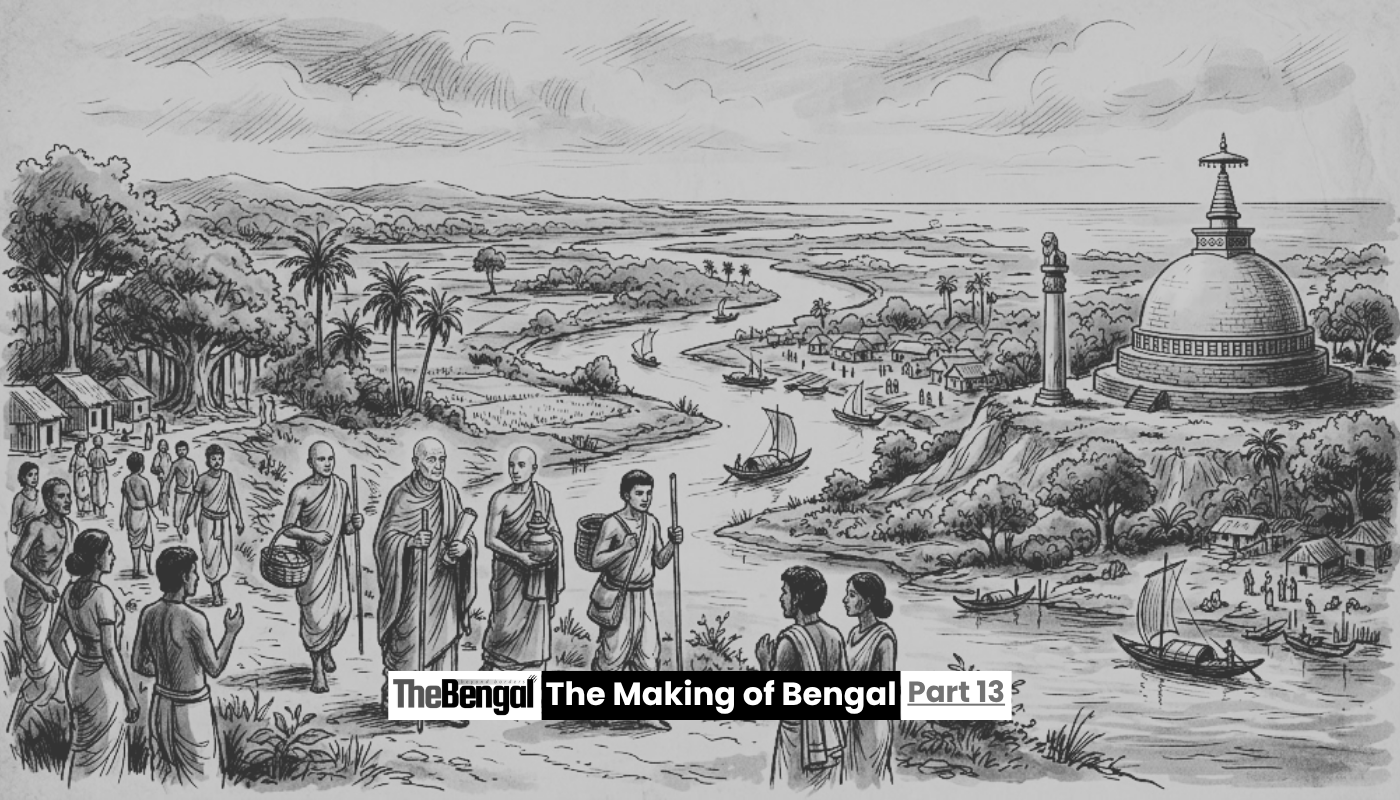
Bengal, sitting at the empire’s eastern frontier, became one of the destinations for this new religious and administrative energy, not through further war, but through missionaries, monastery construction, and imperial patronage.
The Port That Connected an Empire
Nowhere is Bengal’s practical importance to the Mauryan state clearer than at Tamralipta, a port on the southwestern coast of the delta, in what is now the Midnapore region of West Bengal. During Ashoka’s time, Tamralipta functioned as the chief port of the Mauryan Empire, maintaining maritime communication between the imperial heartland at Magadha and the island of Ceylon, present-day Sri Lanka.
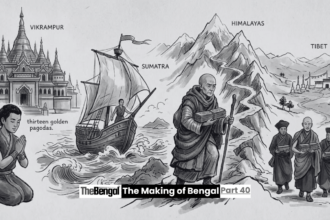
That connection was not merely commercial. According to the Ceylonese chronicle known as the Mahavamsa, Ashoka is recorded as having visited Tamralipta himself, at least on one occasion, and the port is specifically associated with one of the most significant religious missions of his reign: the journey of Mahendra and Sanghamitta, understood in tradition to be Ashoka’s own son and daughter, who embarked from Tamralipta carrying a sacred branch of the Bodhi tree to Sri Lanka, a mission credited with formally establishing Buddhism on the island. Bengal, in other words, was not simply a distant province receiving instructions from the capital. It was the literal departure point for one of the most consequential religious missions of the Mauryan age.
Monasteries Across the Delta
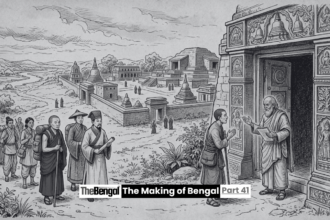
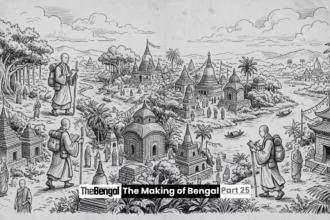
The religious transformation Ashoka set in motion left a physical footprint across Bengal that would still be visible centuries later. According to later Bengali historical sources, a large number of monasteries were established in different parts of the region, in Samatata, Pundravardhana and Tamralipta among them, during Ashoka’s time. This is known largely thanks to the Chinese Buddhist pilgrim Xuanzang, who travelled through the Indian subcontinent in the seventh century CE and personally recorded seeing these institutions when he passed through Bengal.
Xuanzang’s account goes further still, describing stupas he attributed directly to Ashoka in multiple distinct locations across the delta: in Tamralipta and Karnasuvarna in West Bengal, in Samatata in East Bengal, and in Pundravardhana in North Bengal, the same territory named in the Mahasthan inscription discussed in the previous chapter of this series. That such structures were still standing, and still specifically remembered as Ashokan, nearly a thousand years after his reign, is a strong indication of just how extensive Mauryan religious building in Bengal must originally have been, and how deeply Ashoka’s legacy had embedded itself in local memory across the delta.
Buddhist tradition also credits Pundravardhana with a much older, semi-legendary connection to the faith, with some later Chinese pilgrim records claiming the Buddha himself once resided there for three months during his own lifetime, centuries before Ashoka. Whether or not that particular tradition reflects genuine historical memory, it illustrates how thoroughly Bengal, and Pundravardhana especially, came to be woven into the wider narrative geography of early Buddhism, a process that Ashoka’s own patronage appears to have accelerated dramatically.
Not Everyone Welcomed the New Faith
It would be a mistake to imagine Ashoka’s Bengal as a uniformly receptive, harmonious extension of imperial Buddhist policy. The Ashokavadana, an early Buddhist text recounting legends of the emperor’s life, preserves a striking episode of religious friction set specifically in Pundravardhana. According to this account, a non-Buddhist resident of the region drew a provocative image showing the Buddha bowing at the feet of Jnatiputra, the leader of a rival ascetic order known as the Nirgranthas, a term originally associated with a pre-Jain ascetic tradition and later applied to Jain monks generally.
The episode, whatever its precise historical accuracy, indicates that Pundravardhana was home to a genuinely plural religious landscape at this time, with Buddhist, Jain and other ascetic traditions coexisting, competing, and occasionally provoking each other publicly enough that the incident was thought worth recording in Buddhist literature centuries later. Bengal under Ashoka, in other words, was not a passive recipient of one uniform imperial religion, but an active, contested religious frontier in its own right.
What Empire Left Behind
Taken together, the evidence from Tamralipta’s maritime role, the Mahasthan inscription’s administrative order, Xuanzang’s later account of Ashokan monasteries, and the Ashokavadana’s record of religious tension in Pundravardhana, sketches a Bengal that was neither a forgotten backwater nor a passive imperial outpost. It was a working, connected, at times contested part of the Mauryan world: a source of maritime trade and diplomatic missions, a target of significant religious investment, and a place where competing philosophies of the age were openly debated and occasionally clashed.
When the Mauryan Empire itself eventually fragmented in the second century BCE, giving way once again to smaller regional kingdoms, Bengal did not simply return to isolation. The monasteries Ashoka’s patronage had helped establish endured for centuries, the trade routes through Tamralipta continued to function, and the region’s association with Buddhism, sown during this period, would go on to shape much of its subsequent religious and cultural history, developments the following chapters of this series will continue to trace.
In the next chapter, we look more closely at the first cities that emerged across Bengal during this broader early historic period, examining how Mauryan-era administrative integration accelerated urban growth at Pundranagara, Tamralipta, Chandraketugarh and beyond.
Sources: Wikipedia, “Ashoka” and “History of Bengal”; Grokipedia, “Buddhism in Bangladesh”; Britannica, “Ashoka”; Facts and Details, “Ashoka (304-236 B.C.): His Rule, Kalinga and Empire”; The Archaeologist, “The Mauryan Empire: Ashoka’s Role in Spreading Buddhism”; The Indosphere, “Ashoka The Great: The Mauryan Empire and the Spread of Buddhism.”