

This article is part of The Making of Bengal, a long-form historical series by The Bengal. The previous three chapters followed Dharmapala, his vision of empire, and his son Devapala’s reign at the peak of Pala power, including the striking episode of a Javanese king petitioning Bengal for land to build a monastery at Nalanda. This chapter closes the section by following where the influence Devapala’s reign generated actually travelled, and how far Bengal’s reach ultimately extended once its scholars, rather than its armies, became the primary export.
A Prince Who Chose a Different Kind of Conquest
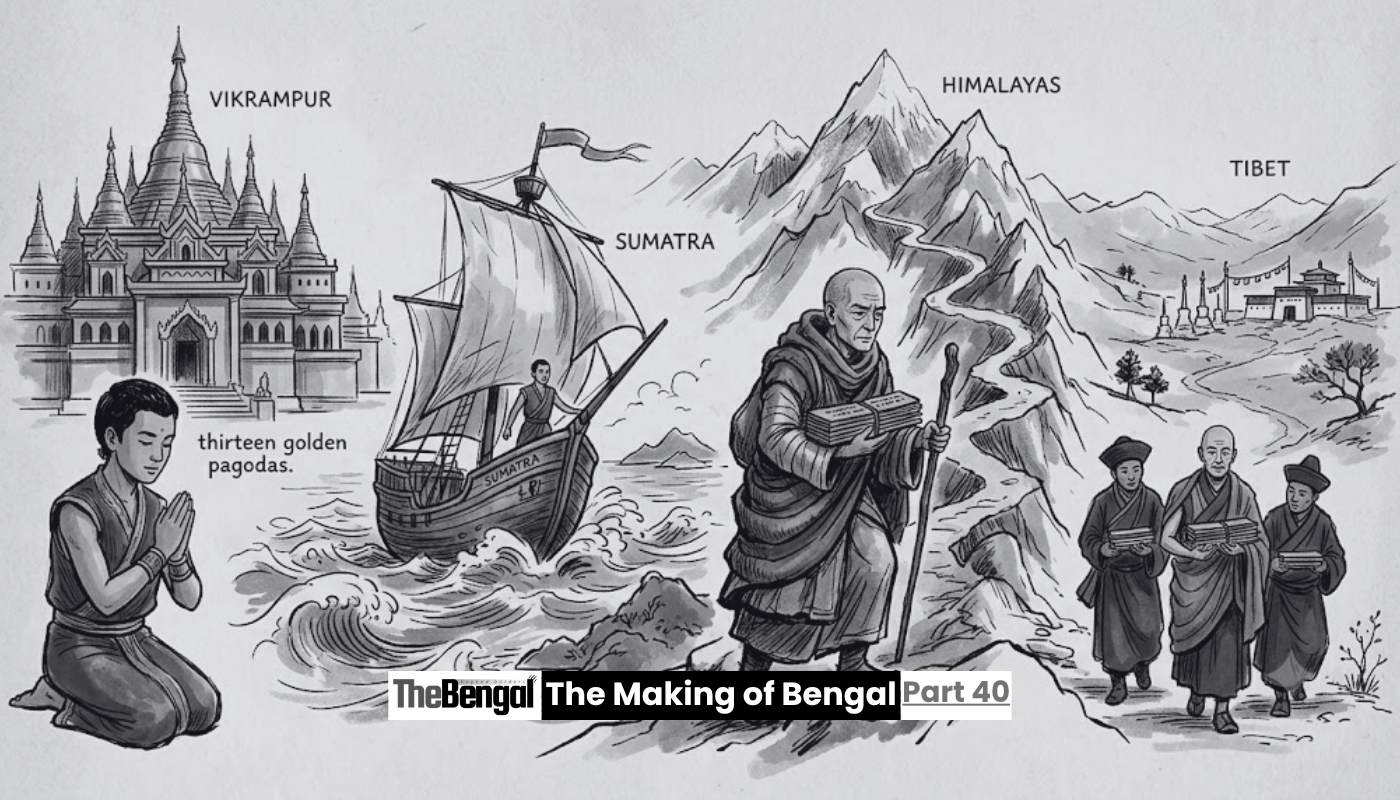
Atisha Dipankara Shrijnana was born, by most accounts, around 980 or 982 CE, in the village of Vajrayogini in the Vikrampur region of Bengal, in what is now Munshiganj district, Bangladesh, into genuine royal privilege. Tibetan biographical tradition describes his childhood home as a palace with thirteen golden pagodas, twenty-five thousand golden victory banners, and twenty-five thousand ornamental pools, the kind of description that reads as much like devotional embellishment as literal record, but which nonetheless signals just how elevated his family’s position was. His birth, striking for this series’ purposes, coincided almost exactly with a major shift in Bengali politics, the resurgent Pala dynasty reclaiming control of the region from the incumbent Kamboja rulers, the very revival under Mahipala I previewed in this section’s opening chapter.
Named Chandragarbha at birth, the young prince showed what Tibetan sources describe as an unusually early and persistent aspiration toward spiritual practice rather than the royal succession his parents had hoped for. He studied under more than a hundred teachers over the course of his education, eventually travelling to Suvarnadvipa, present-day Sumatra, the very Island of Gold this series named in its earlier chapter on Bengal’s ancient maritime trade with Southeast Asia, where he spent twelve years studying under a teacher known in Tibetan tradition as Serlingpa. Only after this extended period abroad did he return to India and take up his place as abbot of Vikramashila, the university Dharmapala had founded generations earlier and examined at length in this series’ chapter on his imperial vision.
The Journey That Reshaped Tibetan Buddhism
What brought Atisha to Tibet was crisis, not conquest. Buddhism there had been badly damaged by the earlier persecution of King Langdarma in the ninth century, leaving, according to Tibetan accounts, considerable confusion among practitioners about how sutra and tantra ought to be properly understood and practised together. King Jangchub Ö of western Tibet, whose own royal lineage traced back to the period of Langdarma’s suppression, undertook what Tibetan sources describe as considerable hardship specifically to secure Atisha’s agreement to travel there.
Atisha accepted, making the crossing over the Himalayas at what was, for the period, an advanced age, and spending the remainder of his life in Tibet reviving and reorganising Buddhist practice there. Tibetan Buddhist tradition itself offers about as strong an endorsement as any historical source in this series has recorded: no Indian visitor to Tibet in the preceding thousand years is judged to have had a greater or more lasting impact on Buddhism there than Atisha did. Alongside his chief disciple Dromtön, he founded the Kadam school, one of the so-called New Translation traditions of Tibetan Buddhism, a lineage whose teachings and monasteries were, by the fourteenth century, absorbed into the Gelug tradition, the school that would eventually produce the line of Dalai Lamas still recognised today.
It is worth pausing on the scale of that legacy. A prince from Vikrampur, trained at a monastery Dharmapala had founded and Devapala had continued to fund, examined across the previous three chapters of this series, ended up shaping the doctrinal foundations of the single most internationally recognisable branch of Tibetan Buddhism that exists in the modern world.
Not the First, and Not the Last
Atisha’s mission was the most famous export of Pala-era Buddhism, but it was neither the first nor the only one. As early as the eighth century, during the reign of the earliest Pala kings this series has followed, the Buddhist mystic Padmasambhava travelled to Tibet at the invitation of King Trisong Detsen, with Pala royal patronage reportedly arranging and supporting the journey. Padmasambhava remains, to this day, one of the most venerated figures in Tibetan Buddhism, credited by tradition with helping to establish the religion there in its earliest institutional form.
A further Pala-era scholar, Santarakshita, already mentioned briefly in this series’ chapter on Dharmapala’s religious vision as the philosopher who served that king’s own spiritual guidance, played a comparably foundational role in transmitting Indian Buddhist philosophy to Tibet. Taken together with Atisha’s later mission, this represents a genuinely sustained pattern rather than a single isolated episode: across roughly three centuries of Pala rule, Bengal functioned as a consistent source of the teachers, texts and doctrinal authority that shaped Tibetan Buddhism at more than one critical juncture in its own development.
An Architecture That Travelled Too
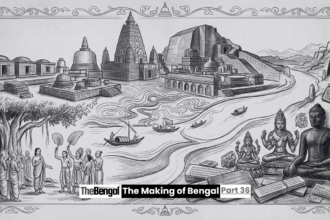
Bengal’s export under the Palas was never limited to individual scholars carrying ideas in their own memory. It extended to the physical form its religious institutions took. The Somapura Mahavihara, begun under Dharmapala and examined in far greater detail in the next chapter of this series, developed an architectural plan distinctive enough, and successful enough, that it went on to directly influence Buddhist temple design as far away as Myanmar and Java, the very Southeast Asian world already connected to this series through Balaputradeva’s embassy to Devapala’s court and Atisha’s own years of study in Sumatra. Vikramashila and Odantapuri, alongside Somapura, together formed what modern scholarship increasingly recognises as a shared architectural blueprint, later monastic complexes across Tibet and Southeast Asia drawing directly on models first developed on Bengali soil.
This is worth setting against everything else this series has traced about Bengal’s outward reach. Earlier chapters followed Bengali cotton and beads reaching Thai shores, cowrie shells travelling from the Maldives through Bengal to Yunnan, and silk moving south along overland routes toward the Bay of Bengal. Under the Palas, that same delta added something considerably harder to quantify but arguably more consequential: doctrine, monastic organisation and architectural form, exported not through merchant ships and caravan routes alone, but through the deliberate, sustained investment in scholarship that Dharmapala had begun and his successors had continued for generations.
An Empire Measured in Influence, Not Just Territory
This chapter closes the section of this series devoted to the Pala Age by returning to the question its opening chapter posed directly: was this genuinely Bengal’s greatest dynasty? Measured purely in territory held continuously, the honest answer, as that opening chapter acknowledged, comes with real qualifications, campaigns won and then not fully consolidated, vassal states that acknowledged Pala supremacy without ever being administratively absorbed. But measured by influence that outlasted the empire’s own political boundaries entirely, the Pala record looks considerably more secure. A dynasty that began with a council of desperate chieftains electing an obscure military commander’s son to end a century of anarchy ended, four centuries later, having produced a teacher whose doctrinal legacy still shapes Tibetan Buddhist practice today, and having built monastic architecture whose influence reached temples in Myanmar and Java.
Bengal, under the Palas, did not simply survive its own turbulent history, traced across every earlier section of this series, from Gangaridai’s brush with Alexander through Shashanka’s contested kingdom and a century of matsyanyaya. It became, for a genuine stretch of centuries, a place the wider world came to for something it could not easily get elsewhere: teachers, texts and a particular, distinctively Bengali synthesis of Buddhist scholarship, carried outward by monks willing to cross oceans and mountains to share it.
In the next chapter of this series, we look closely at the physical institution most responsible for making all of this possible: Somapura Mahavihara, the vast monastic university at Paharpur that Dharmapala began and generations of his successors continued to build.
Sources: Wikipedia, “Atiśa”; New World Encyclopedia, “Atisha”; Tibetan Buddhist Encyclopedia, “Atisha Dipankara Srijnana”; Indo-Buddhist Heritage Forum, “Atisha Dipankara Srijnana: The Reformer of Buddhism in Tibet”; GetBengal, “Ancient Bengal’s Phenomenal Role in Spreading Buddhism in Tibet”; Tsem Rinpoche, “Atisha Dipamkara Shrijñana: The Reviver of Buddhism in Tibet”; ResearchGate, “The Enduring Legacy of the Pala Empire: A Renaissance of Culture, Knowledge, and Heritage”; HD Jain College, “Vikramshila: Archaeology and History.”