
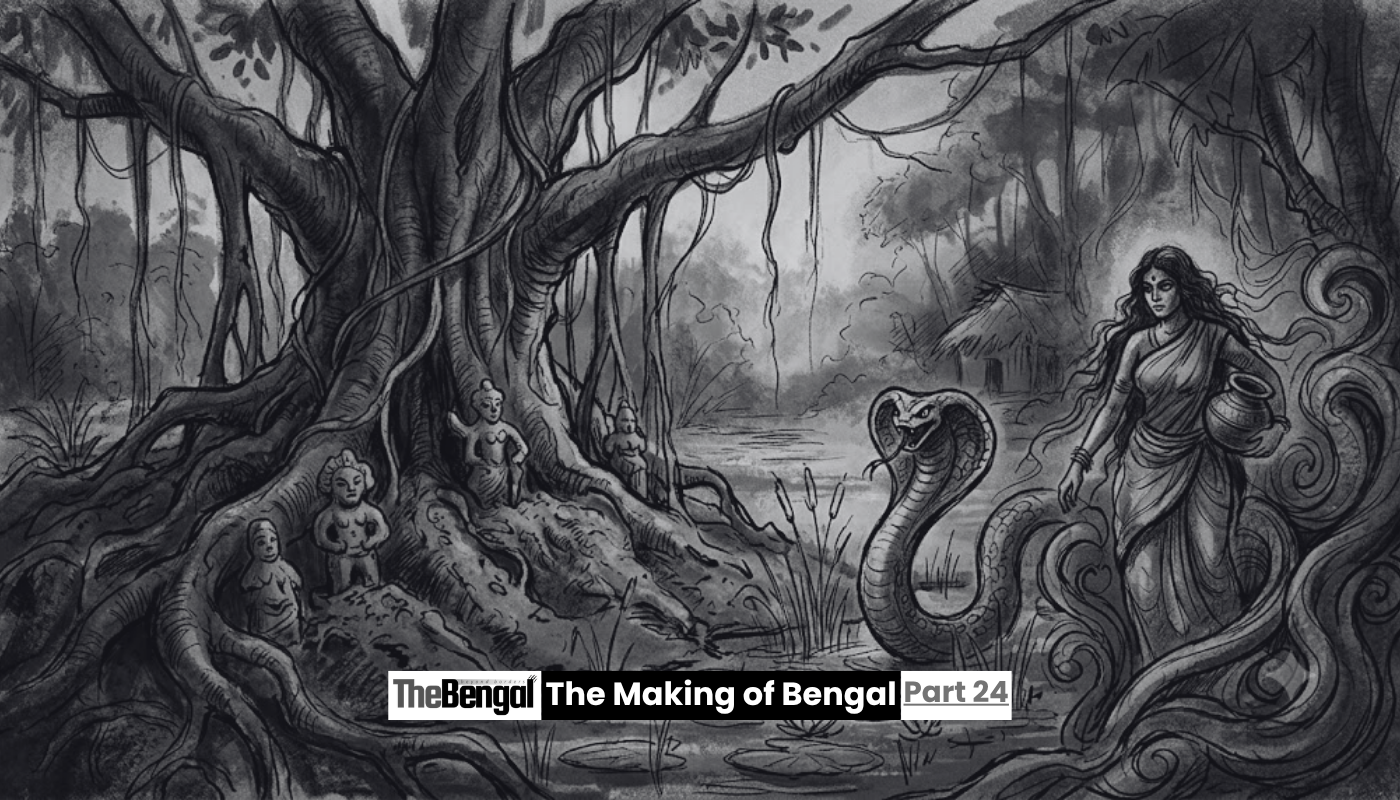

This article is part of The Making of Bengal, a long-form historical series by The Bengal. The previous chapter traced the languages spoken across ancient Bengal before Bangla itself emerged, a story of layered substrates and slow blending rather than clean replacement. This chapter follows the same pattern into religion, asking what gods the people of the delta actually worshipped before organised Buddhism and Brahmanical Hinduism arrived to reshape the picture.
Spirits in the Trees
Return, for a moment, to the terracotta record explored in an earlier chapter of this series covering daily life and family in ancient Bengal. Among the figures recovered from Chandraketugarh are repeated depictions of Yakshas and Yakshis, male and female nature spirits associated with trees, fertility, wealth and protection, rendered in clay with striking care and detail. One such figure, discussed in the previous chapter on food, fashion and family, shows a Yakshi standing beside a blossoming honeysuckle tree, her hand resting on her waist, wearing an elaborately decorated headdress.
These were not marginal or decorative figures. Researchers studying Chandraketugarh’s terracotta output have identified the Yakshi cult as a genuinely significant devotional tradition at the site, one connected not only to worship but potentially also to decoration and even education, a divine figure woven thoroughly into the texture of everyday religious life in the delta’s early cities. Long before organised temple Hinduism reached Bengal in any developed form, its people appear to have already been venerating spirits rooted quite literally in the landscape itself, in trees, groves and the natural fertility of the land that this entire series has traced back to the delta’s rivers and soil.
A Goddess Tradition Older Than the Aryans
Beyond individual nature spirits, Bengal’s religious landscape carried a deeper and more structural inheritance: the concept of Shakti, divine feminine power. According to research into Bengal’s goddess traditions, the assignment of power specifically to female deities was already well established in pre-Aryan times, an era researchers describe as having a strong matriarchal cultural undercurrent. Even after the arrival of Aryan migrants and the gradual construction of a more male-dominated social order, discussed in an earlier chapter of this series on language and Indo-Aryan expansion, the worship of goddesses as manifestations of Shakti, whether associated with creation or destruction, persisted and continued to flourish, particularly in village-level religious culture across Bengal.
This is a genuinely important thread running beneath everything else in Bengal’s religious history. Even as later chapters of this series follow the arrival of Buddhism under Ashoka and the eventual dominance of Brahmanical Hinduism, this older layer of goddess-centred, village-rooted religious practice never fully disappeared. It persisted alongside, and often within, the newer traditions that were layered on top of it, much as this series has already shown happening with Bengal’s languages.
The Snake Goddess of the Marshes
No figure illustrates this pattern of survival and absorption more clearly than Manasa, the goddess of snakes, still widely worshipped across Bengal, Bihar, Assam and neighbouring regions today, chiefly for protection against snakebite, but also for fertility and general prosperity. Her origins, as far as scholars can trace them, lie firmly outside the Vedic and Brahmanical tradition altogether.
Multiple lines of scholarship converge on the same basic picture: Manasa began as an Adivasi, or tribal, goddess, only later accepted into the wider Hindu pantheon. Some researchers trace her worship specifically to serpent-worship traditions among the Garo and Khasi peoples, hill communities of the northeastern region already discussed in earlier chapters of this series on prehistoric Assam and Tripura, from where the tradition is believed to have travelled into Bengal proper and merged with local practice. Other scholars point instead to a South Indian connection, linking Manasa to a folk snake goddess named Manchamma, worshipped in Karnataka, Tamil Nadu and Andhra Pradesh, and proposing that later medieval Bengali dynasties may have helped bring this southern tradition northward and fold it into an existing local snake cult.
What virtually every strand of this scholarship agrees on is that Manasa’s worship reflects, in the words of one researcher studying Bengali literature, a genuine conflict between the religion of Shiva and the older feminine local deities of Bengal, a conflict eventually resolved not through the disappearance of the older tradition but through its gradual, often uneasy, absorption into the newer one. Later texts, including the Puranas, attempted to formally incorporate Manasa into the Brahmanical family tree, describing her variously as the daughter of the sage Kashyapa or of Shiva himself, an origin story that reads less like organic myth and more like a deliberate later effort to give an already popular, deeply rooted folk goddess a respectable place within the official pantheon.
Physical Proof in the Delta’s Soil
This is not simply a matter of later literary reconstruction. Archaeological evidence from Tamralipta, the ancient port explored at length in earlier chapters of this series for its central role in Bengal’s maritime and overland trade, offers direct, physical confirmation that serpent worship had genuine material roots in the region during the ancient period. Excavations there have recovered a terracotta snake figure and a separate earthen pot decorated with the image of a hooded snake around its rim, both artefacts now preserved locally in Tamluk. Researchers dating these finds have suggested that organised worship of a snake goddess in the region may stretch back to at least the ninth or tenth century CE, with the underlying tradition of serpent veneration itself considerably older still.
This makes a certain amount of practical sense given the landscape this series has spent so many chapters describing. A delta defined by rivers, marshes, monsoon flooding and dense vegetation, exactly the terrain built up over millions of years by the geological and river processes explored in this series’ earliest chapters, would naturally have been rich in snakes, and a population living in close daily contact with that environment had every practical reason to develop a serious, sustained religious tradition around protection from snakebite.
Gods That Survived by Blending In
What makes Bengal’s ancient religious landscape so distinctive is not simply that it had its own gods before organised Buddhism and Hinduism arrived, but that so many of those older figures survived the arrival of those larger traditions rather than being erased by them. Manasa did not disappear when Shaivism and Vaishnavism took hold in Bengal. She was, gradually and sometimes contentiously, absorbed into the wider Hindu pantheon, eventually celebrated through her own devotional literature, the Manasa-mangal poems of the medieval period, and remains an object of active worship across Bengal to this day. Later folk deities followed a similar pattern of survival through absorption, including figures like Bon Bibi, the forest goddess still venerated by honey collectors and woodcutters in the Sundarbans.
This pattern of layering, rather than replacement, echoes precisely what the previous chapter of this series found in Bengal’s language history: successive waves of new influence, whether linguistic or religious, arriving not to erase what came before but to blend with it, absorb it, and carry it forward in altered but still recognisable form. The Yakshis of Chandraketugarh’s terracotta workshops, the pre-Aryan matriarchal reverence for Shakti, and the tribal serpent goddess who became Manasa all represent the same underlying story: ancient Bengal’s religious identity was never a blank slate waiting for Buddhism or Brahmanical Hinduism to arrive and write upon it. It was already a living, populated spiritual landscape, one that the newer traditions would ultimately have to negotiate with rather than simply overwrite.
In the next chapter of this series, we follow that negotiation directly, examining how Buddhism, carried into Bengal through Ashoka’s missions and the trade routes already explored in this series, took root and flourished across the delta in the centuries that followed.
Sources: Google Arts & Culture, “Story of Goddess Manasa”; Wikipedia, “Manasa”; Grokipedia, “Manasa”; Britannica, “Manasa”; IAEME, “Goddess Manasa: Origin and Development”; The Daily Star, “Goddesses of Bengal: The Living Myth of Devi Manasa, Bon Bibi and More”; Wisdomlib, “History, Culture and Antiquities of Tamralipta: Pre-Aryan and Non-Aryan Religion, Beliefs and Practices in Bengal”; Heritage: Journal of Multidisciplinary Studies in Archaeology, “Terracotta Yakshi Plaques from Chandraketugarh.”