

This article is part of The Making of Bengal, a long-form historical series by The Bengal. The previous two chapters followed Dharmapala’s military campaigns to install his nominee on the Kannauj throne and the parallel religious and diplomatic vision that shaped his reign. This chapter turns to his son, Devapala, whose forty-year reign is the point most historians reach for when describing the Pala Empire, and Bengal itself, at its absolute peak.
Inheriting an Empire, Not Just a Kingdom
Devapala’s mother, as the previous chapter of this series established, was Rannadevi, the Rashtrakuta princess Dharmapala had married as part of his broader strategy of alliance-building. Devapala therefore inherited not simply his father’s territory but the entire diplomatic architecture Dharmapala had spent decades constructing, a hard-won position at Kannauj, a network of acknowledged vassal states stretching across northern India, and a Rashtrakuta bloodline connecting him directly to the very power that had twice rescued Pala ambitions from Pratihara defeat.
Banglapedia’s own account of the transition is telling: Devapala benefited considerably from timing as much as inheritance, succeeding to power precisely when the Pratihara throne had passed to a series of weak successors following Nagabhata II, and when the Rashtrakuta king Amoghavarsha showed little interest in renewed northern campaigns. Where his father had spent years locked in the exhausting, seesawing Tripartite Struggle traced in an earlier chapter of this series, Devapala found the field comparatively open, and moved to consolidate and expand rather than simply defend what he had received.
An Empire From the Vindhyas to Two Oceans
The clearest surviving record of Devapala’s territorial ambitions comes from the Badal Pillar inscription, composed under a later Pala king, Narayanapala, but describing Devapala’s own reign in unmistakably imperial language. According to this inscription, Devapala’s authority extended to the Vindhya mountain range in the south, the Himalayas in the north, and stretched between what modern historians generally interpret as the Arabian Sea in the west and the Bay of Bengal in the east, a genuinely subcontinental claim.
More specific inscriptions attribute particular military campaigns to his reign. Devapala is credited with the conquest of the Utkalas of Odisha and the Pragjyotisha kingdom of Assam, campaigns that, according to the Bhagalpur inscription, were actually secured by his cousin Jayapala on his behalf, connecting this chapter directly back to the wider Assam-focused history this series has followed since its earliest chapters. Other inscriptions describe Devapala humbling the Hunas, the same nomadic power whose earlier invasions had helped topple the Gupta Empire examined much earlier in this series, and scattering the pride of rulers identified with the Dravida country of the far south and the Gurjara territories of the Pratiharas, understood by historians as a reference to the Pratihara king Mihira Bhoja. A further and genuinely striking claim holds that Devapala liberated the Himalayas from Tibetan control, a detail that, if accurate, corresponds with documented Tibetan military withdrawal from the Himalayan region sometime between 839 and 848 CE.
How Much of This Should We Believe?
Historians studying these claims have been consistently careful not to take them entirely at face value, a caution this series has already practised when examining similarly grand titles claimed by Shashanka and Dharmapala in earlier chapters. Nitish K. Sengupta describes the Badal Pillar inscription as highly exaggerated, a judgement echoed by many modern scholars. Yet the archaeologist and historian Bindeshwari Prasad Sinha offers a more measured middle position, one worth quoting for its balance: exaggeration in inscriptions like the Badal Pillar’s eulogy of Devapala is natural enough given the genre, but that does not make it reasonable to dismiss the entire description of his conquests as pure bombast. Scholars including Pramode Lal Paul and Ratikanta Tripathi have generally sided with this more measured reading, treating the Badal Pillar as inflated in scale and rhetoric rather than fabricated in substance.
This is a useful lesson this series has now applied repeatedly, from Gangaridai’s classical Greek reputation through Shashanka’s contested legacy to Dharmapala’s own eulogistic Khalimpur inscription. Ancient and medieval royal inscriptions were never neutral historical records. They were political documents designed to project maximum authority. The honest historical position, as this series has consistently found, sits somewhere between naive acceptance and blanket dismissal: Devapala almost certainly did not literally rule from the Himalayas to two oceans in any administratively continuous sense, but he equally certainly commanded genuine military reach and diplomatic recognition across a subcontinental scale that dwarfed anything his grandfather Gopala could have imagined at his own election, examined in an earlier section of this series.
An Ambassador From an Island Kingdom
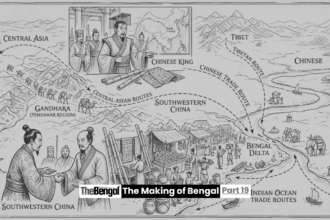
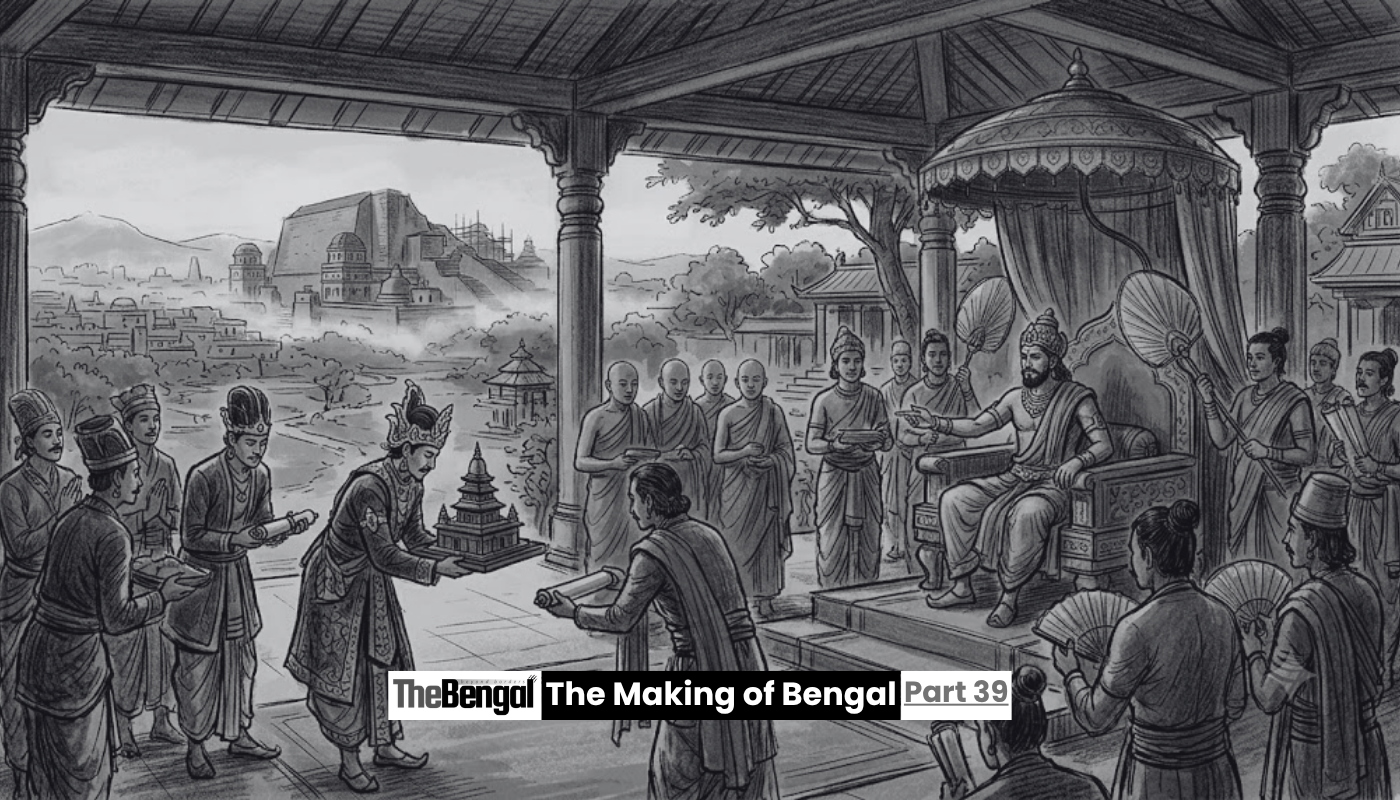
If Devapala’s military claims require careful reading, one episode from his reign needs no such qualification, because it survives through corroborating evidence from outside Bengal entirely. Balaputradeva, the Sailendra king ruling over Java and Sumatra in the Malay Archipelago, sent a formal embassy to Devapala’s court requesting permission and land to construct a monastery at Nalanda specifically for monks from his own kingdom. Devapala granted the request, endowing five named villages, Nandivanaka, Manivataka, Natika, Hasti and Palamaka, for the monastery’s support, and appointed a Brahmin scholar named Viradeva to oversee the Nalanda monasteries more broadly.
This episode connects directly back to the maritime and cultural networks this series traced in its chapters on Bengal’s ancient trade with Suvarnabhumi and Suvarnadvipa, the Land and Island of Gold explored at length earlier in this series. Centuries after Bengali cotton, beads and Buddhist teaching had first begun flowing outward across the Bay of Bengal toward Southeast Asia, a genuine Southeast Asian king was now formally petitioning Bengal’s own ruler for the privilege of building religious infrastructure on Bengali soil, a striking reversal of direction that speaks to just how thoroughly Nalanda’s reputation, sustained through generations of Pala patronage traced across the previous two chapters, had come to be recognised across the wider Buddhist world as this series has followed it since Ashoka’s own missions.
A Court of Poets and Scholars
Devapala’s reign was not remembered solely for conquest and diplomacy. His court included the Buddhist poet Vajradatta, author of the Lokesvarashataka, and Devapala continued his father’s pattern of engaging seriously with Buddhist scholarship, supporting figures such as Haribhadra, already introduced in the previous chapter as Dharmapala’s own spiritual preceptor, alongside the tantric scholar Buddhajnanapada. He maintained the Odantapuri monastery, founded a generation earlier under his father or grandfather depending on which Tibetan tradition one follows, and continued the substantial religious endowments that had, by this point, become a defining feature of Pala kingship across three consecutive reigns.
Art historians studying this period identify Devapala’s reign as coinciding with the maturation of the distinctive Pala school of sculpture, refined stone and bronze depictions of the Buddha and Bodhisattvas that would go on to influence Buddhist iconography across Tibet, Nepal and Southeast Asia for centuries, a visual legacy this series will examine in greater depth in a later chapter devoted specifically to Pala art.
The Peak Before the Long Descent
Devapala died sometime around 850 or 861 CE, depending on which historian’s chronology one accepts, after a reign most sources place at somewhere between thirty-two and forty years, one of the longest of any ruler examined in this entire series. What he left behind, by any reasonable measure, was the Pala Empire at its absolute territorial and cultural zenith, a kingdom whose reach, however inflated in its own court poetry, genuinely touched Assam, Odisha, the Himalayan foothills and the political affairs of northern India, and whose religious and intellectual reputation had grown substantial enough to draw formal diplomatic petitions from a Southeast Asian island kingdom thousands of kilometres away.
It would not last. As the opening chapter of this section already previewed, the Palas entered a long period of stagnation in the decades following Devapala’s death, losing ground steadily to resurgent rivals until Mahipala I’s later revival, examined in a future chapter of this series. But for the roughly forty years of Devapala’s reign, Bengal stood, by nearly every measure this series has tracked since Gangaridai’s brush with Alexander, at the height of its ancient and early medieval power, exactly the golden age this chapter’s title promises.
In the next chapter of this series, we look beyond the battlefield and the throne room to examine the institution that made Devapala’s reign, and the reigns of his father and grandfather before him, genuinely resonate across Asia: the great monastic university of Somapura, and the wider network of Pala learning that carried Bengal’s name as far as Tibet.
Sources: Wikipedia, “Devapala of Bengal” and “Pala Empire”; Banglapedia, “Devapala”; ResearchGate, “Devapala: The Robust King of Pala Dynasty”; GKToday, “Devapala”; Bharatpedia, “Devapala (Pala dynasty)”; Prepp.in, “Devapala (810-850 CE): Important Ruler of Pala Dynasty”; Study&Score, “The Pala Empire and Its Rulers”; Kiddle, “Devapala (Pala dynasty) facts for kids.”