
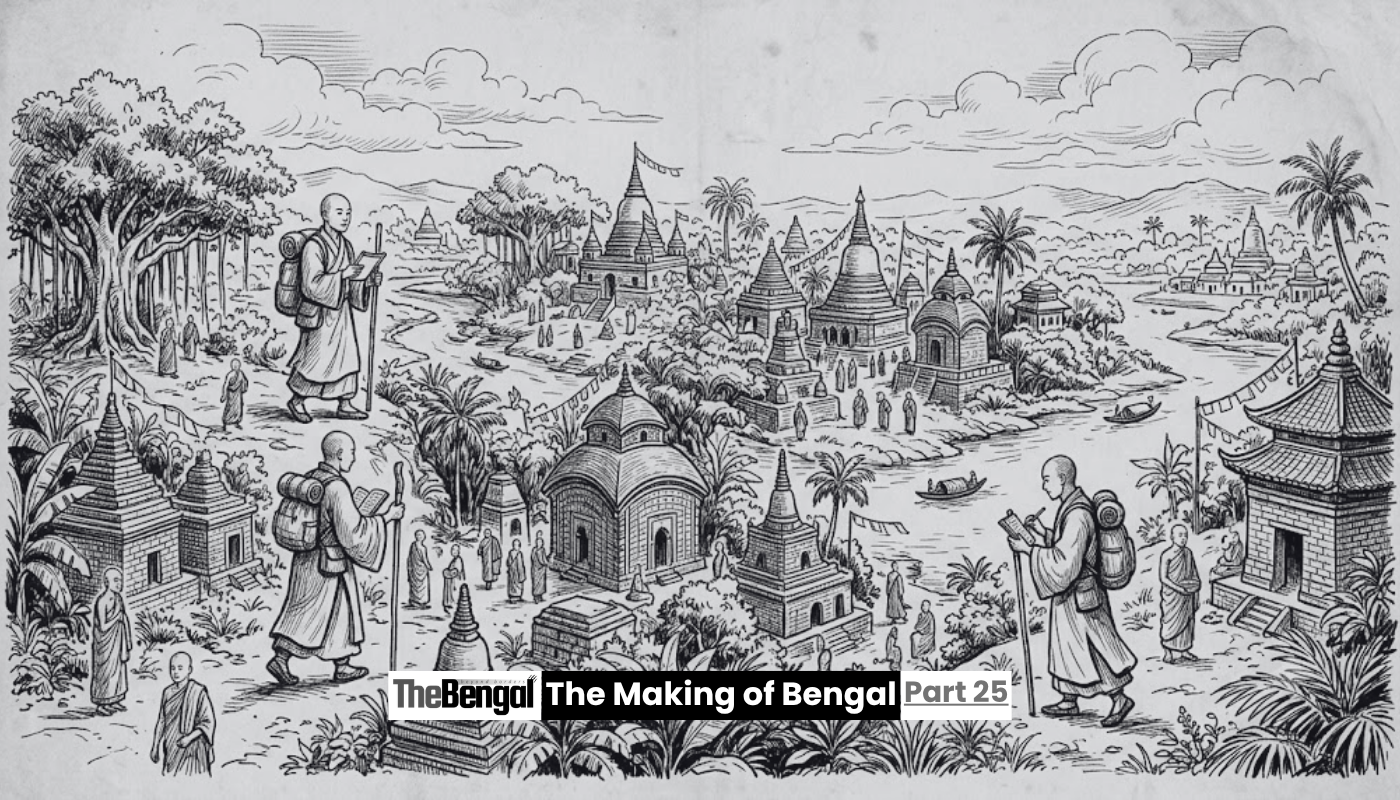

This article is part of The Making of Bengal, a long-form historical series by The Bengal. The previous chapter explored the older folk deities and goddess traditions that predated organised religion in the delta. This chapter follows what happened once Buddhism, first planted during Ashoka’s reign as discussed earlier in this series, took hold and grew into one of the defining religious forces of ancient Bengal.
Roots Older Than Ashoka Himself
Bengal’s connection to Buddhism is generally understood to reach back further even than Ashoka’s third-century BCE missions, discussed at length in an earlier chapter of this series. Scholars researching the religious history of the region trace Bengal’s first contact with Buddhism to the lifetime of the Buddha himself, in the sixth to fifth centuries BCE, with the faith becoming firmly embedded in the region by the time of Ashoka’s reign, roughly two centuries later. That early foundation proved remarkably durable. According to research into Bengal’s Buddhist architectural history, the religion became rooted so deeply during this formative period that even the hostile attitudes of certain later dynasties were never able to fully wipe it out of the region.
That resilience becomes concrete once written and archaeological records improve from the fourth century CE onward, coinciding with the rise of the Gupta Empire, whose broader relationship with Bengal was explored in an earlier chapter of this series through the Mahasthan inscription and the region’s economic significance to successive imperial powers.
A King’s Own Name Tells the Story
One especially telling piece of evidence for Buddhism’s staying power in Bengal comes from something as simple as a king’s name. Historical sources note that although Samatata, the ancient kingdom occupying the trans-Meghna region of southeastern Bengal, remained formally outside direct Gupta control, reduced instead to the status of a tributary state, it appears to have come under fuller Gupta influence by the close of the sixth century CE, at which point the region was ruled by a king whose name ended in Gupta: Vainyagupta.
Vainyagupta’s reign offers direct documentary proof of just how thoroughly Buddhism had embedded itself in official life by this point. The Gunaighar copperplate inscription, dated to 507 CE and discovered in the Tippera region of eastern Bengal, records a formal royal land grant made in support of a Buddhist monastery in Samatata. This was not a private or informal act of piety. It was a documented state transaction, a king allocating land specifically to sustain a Buddhist religious institution, exactly the kind of administrative gesture this series has already seen Bengal’s rulers apply to famine relief, textile production and trade regulation in earlier chapters. Buddhism, by this point, was not merely tolerated in Bengal. It was being actively built into the machinery of the state.
What the Pilgrims Actually Saw
The richest evidence for Buddhism’s flourishing in ancient Bengal comes not from inscriptions but from the firsthand accounts of two Chinese Buddhist pilgrims who each travelled enormous distances specifically to witness Buddhist practice across the Indian subcontinent, and who both happened to pass through Bengal.
The earlier of the two, Faxian, visiting India in the early fifth century CE, made his way through ancient Bengal at a moment when, according to research into the region’s Buddhist history, the faith was in a flourishing condition, a direct legacy of Ashoka’s earlier religious missions discussed in this series. At Tamralipti, the port city examined repeatedly throughout this series for its role in maritime trade and Ashoka’s own Buddhist outreach toward Sri Lanka, Faxian personally counted 24 separate Buddhist monasteries.
Two centuries later, the more famous pilgrim Xuanzang made his own sixteen-year journey across the Silk Road and through the Indian subcontinent between 629 and 645 CE, arriving in Bengal near the end of his travels. What he recorded provides an extraordinarily detailed snapshot of Buddhism’s regional footprint by the seventh century. At Tamralipti, he still found 10 monasteries in active use, each housing a thousand resident monks, a modest decline in the number of monasteries since Faxian’s visit, but an enormous total monastic population nonetheless. Further north, in Pundravardhana, the same territory named in the Mahasthan Brahmi inscription discussed earlier in this series, Xuanzang recorded Buddhism as clearly present and active. At Karnasuvarna, the future capital of King Shashanka discussed in the next section of this series, he visited and described the ruins of the Raktamrittika Mahavihara, a significant Buddhist monastic university.
His most striking figures, however, came from Samatata itself, the southeastern kingdom encompassing much of the greater Comilla and Noakhali region, with influence reaching into parts of Tripura. There, Xuanzang counted thirty separate monasteries housing roughly two thousand monks, all belonging, by his account, to the Theravada school of Buddhism. A later Chinese traveller, Yijing, visiting after Xuanzang, recorded an even larger figure still, describing as many as four thousand Buddhist monks and nuns active in Samatata by his own time, suggesting the region’s Buddhist population had continued to grow rather than decline in the intervening decades.
A Kingdom Built Partly on Buddhist Patronage
Samatata’s political history over these centuries closely tracks its religious prominence. The kingdom rose to particular significance under a succession of ruling houses, including the Khadga dynasty, which governed Vanga and Samatata from the mid-seventh to early eighth centuries CE, followed by the Deva and Chandra dynasties, whose combined rule extended Samatata’s influence across parts of Arakan, Tripura and Kamarupa in Assam, a reach that connects this chapter directly to the wider four-region geography this series has followed throughout.
Research into Bengal’s Buddhist architectural history credits several of these later rulers by name for their active religious patronage, describing how a tolerant outlook among local and regional Brahmin kings during the Gupta period allowed Buddhism to flourish, a trend further reinforced in the post-Gupta era by devout supporters including the emperor Harshavardhana and, within Bengal itself, King Devakhadga and his son Rajabhata, both associated with the Khadga dynasty’s support for Buddhist practice. Land grants made to Buddhist monasteries during this broader period reflect exactly the kind of sustained institutional backing that allowed monastic communities to survive and grow across changes in ruling dynasty, outlasting the individual kings who had originally endowed them.
Faith That Outlived Its Patrons
What emerges from this evidence is a picture of remarkable religious continuity across several centuries of considerable political change. Bengal passed, over this period, from Mauryan administration, through Gupta suzerainty, into a patchwork of independent post-Gupta kingdoms including Samatata under the Khadga and Chandra dynasties, and eventually toward the rise of Shashanka’s Gauda kingdom, the subject of the next section of this series. Through all of these political transitions, Buddhist monasteries at Tamralipti, Pundravardhana, Karnasuvarna and across Samatata continued to function, continued to attract new monks, and, if Yijing’s later figures are accurate, continued to grow.
This resilience mirrors a pattern already established elsewhere in this series. Just as Bengal’s languages absorbed rather than simply replaced earlier substrates, and just as folk deities like Manasa survived by blending into later Brahmanical Hinduism rather than being erased by it, Buddhism in Bengal did not depend on any single dynasty’s exclusive devotion to survive. It embedded itself into the administrative and economic fabric of the region deeply enough, through land grants, monastery construction, and sustained royal patronage across multiple ruling houses, that it could weather changes in political leadership that might have doomed a less firmly rooted tradition.
By the time Xuanzang and Yijing recorded their respective visits, Buddhism in Bengal was no longer simply the legacy of a single emperor’s missionary zeal centuries earlier. It had become a genuinely regional institution, sustained by its own monasteries, its own land endowments, and a population of monks numbering in the thousands, spread across ports, capitals and provincial towns throughout the delta.
In the next chapter of this series, we turn to a further transformation still underway in this same period: the process by which Bengal’s diverse older traditions, Buddhist, folk and Brahmanical alike, began coalescing into what could genuinely be called a distinct Bengali identity.
Sources: Wikipedia and Grokipedia, “Samatata”; Jatland Wiki, “Samatata”; Banglapedia, “History”; National Culture and Heritage, “Ancient Bengal”; Academia.edu, “Monasteries, Mountains, and Mandalas: Buddhist Architecture and Imagination in Medieval Eastern India”; Buddhist Channel, “A Glimpse of Buddhism in Ancient Bangladesh”; Buddhistdoor Global, “Buddhism: The Golden Heritage of Bengal.”