

History often begins with kings.
School textbooks introduce Bengal through the rise of powerful dynasties, celebrated rulers, famous capitals and imperial wars. Readers encounter names such as Shashanka, Gopala or Dharmapala, as if Bengal suddenly appeared when written records became available. Yet this is only the final chapter of a much older story.
Long before there was a kingdom called Gauda, before Buddhism flourished in Paharpur, before the Bengali language took shape and even before the Mauryan Empire expanded eastward, there existed a land unlike any other on Earth. It was a land in constant motion, where mighty rivers shifted their courses, forests stretched to the horizon, and generations of people adapted to one of nature’s most dynamic landscapes.
This article marks the beginning of The Making of Bengal, a long-form historical series by The Bengal exploring how one of South Asia’s most distinctive civilizations emerged over thousands of years. To understand Bengal, we must first look beyond written history and into prehistory, a period when archaeology rather than literature becomes our guide.
The Bengal known today was not born in a single century. It was shaped by geography, climate, migration, innovation and the resilience of countless anonymous people whose names have been lost but whose legacy survives in the land itself.
A Land That Was Still Being Born
Unlike many ancient civilizations that developed around relatively stable landscapes, Bengal itself was still taking shape while humans were learning to survive within it.
The Bengal Delta, formed primarily by the Ganges, Brahmaputra and Meghna river systems, is the largest active delta on Earth. For thousands of years, enormous quantities of sediment carried from the Himalayas gradually built the fertile plains that now stretch across Bangladesh and the Indian state of West Bengal.
This process was neither rapid nor predictable.
River channels frequently changed direction. Entire landscapes disappeared beneath floodwaters before re-emerging elsewhere. New islands formed while older settlements were abandoned. Forests expanded and contracted with changing climatic conditions. The coastline itself moved over centuries.
To modern observers, such instability might seem like a disadvantage. Yet it would eventually become Bengal’s greatest strength.
The annual floods replenished the soil with fresh silt, making agriculture remarkably productive. Rivers served as highways connecting distant communities long before roads existed. Fish, wildlife and fertile land created one of the richest ecological environments in Asia.
Nature was not merely the backdrop of Bengal’s history. It was its principal architect.
The First Humans in Bengal
Determining exactly when humans first entered Bengal remains one of archaeology’s most challenging questions.
Unlike the dry caves of Europe or Central India, Bengal’s humid climate and shifting river systems rarely preserve ancient human remains. Organic materials decompose rapidly, while floods continuously reshape the landscape, burying or destroying prehistoric evidence.
Nevertheless, archaeologists have identified numerous Stone Age tools across different parts of Bengal.
Hand axes, cleavers, scrapers and microlithic implements discovered in regions including present-day West Bengal, northern Bangladesh and adjoining areas suggest that prehistoric hunter-gatherers occupied these landscapes for tens of thousands of years.
These early communities were highly mobile.
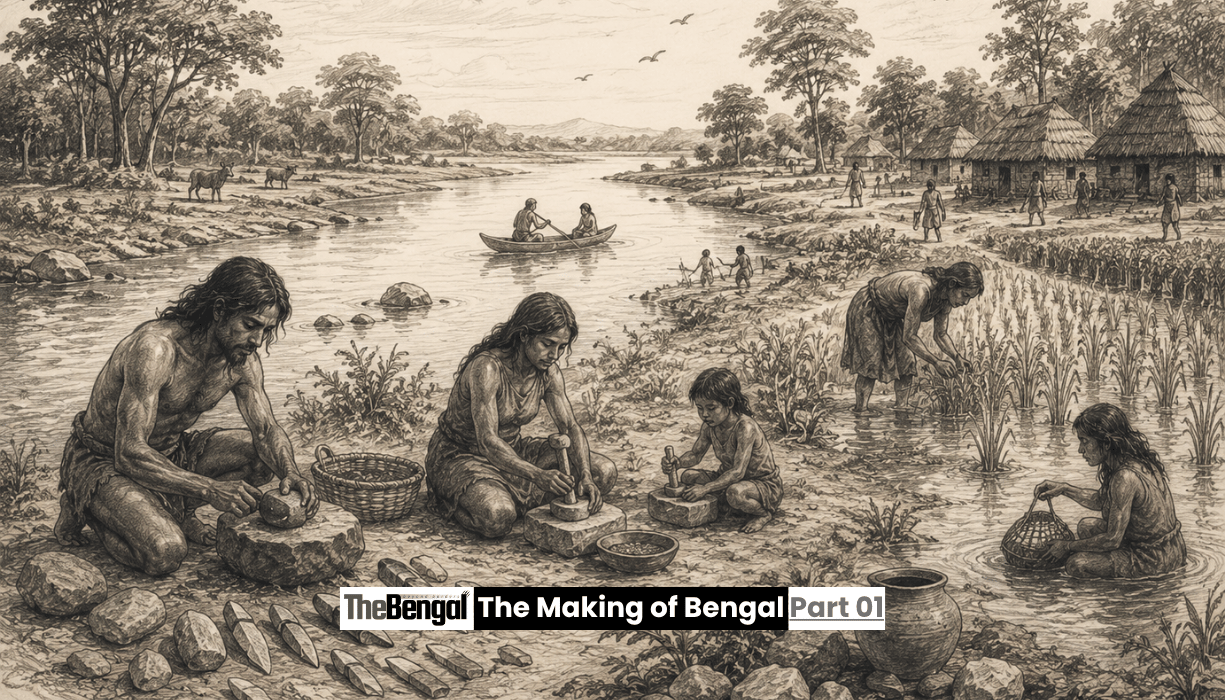
Rather than constructing permanent settlements, they moved seasonally in search of game, edible plants, fish and freshwater. Rivers dictated their movements, providing both resources and transportation.
Life demanded constant adaptation.
Dense forests housed elephants, rhinoceroses, deer, wild cattle and predators. Seasonal flooding altered familiar routes. Tropical diseases posed additional dangers. Survival depended not on monumental architecture or military conquest but on intimate knowledge of nature.
These first inhabitants were not yet Bengalis in any linguistic or cultural sense. However, they were the earliest known people to establish a lasting human presence in the region that would eventually become Bengal.
Learning to Live With Water
If one lesson defines Bengal’s prehistory, it is this: the people did not conquer the rivers. They learned to live with them.
Most early civilizations attempted to control water through large irrigation systems, dams or engineered canals.
Bengal followed a different path.
Communities adjusted their lives to the rhythms of seasonal flooding rather than attempting to eliminate it. Fishing became an essential source of food. Boats evolved into indispensable tools for communication and transport. Villages were often established on naturally elevated ground or artificial mounds to withstand annual inundation.
This adaptive relationship with water would become one of Bengal’s defining characteristics for millennia.
Even today, many aspects of rural life continue to reflect patterns first established in prehistoric times.
The Agricultural Revolution
Perhaps the greatest turning point in Bengal’s early history came not through warfare but through farming.
Around the broader South Asian region, agriculture gradually transformed human society after the end of the last Ice Age. In Bengal, rice cultivation would eventually become the foundation of civilization itself.
Wild rice naturally flourished in the wetlands and floodplains.
Over generations, communities learned how to cultivate, harvest and store rice more efficiently. Agriculture reduced dependence on hunting and gathering while supporting larger populations.
Permanent settlements began to appear.
Instead of moving constantly across the landscape, families built houses, cultivated nearby fields and developed increasingly sophisticated social structures.
The consequences were profound.
Population grew steadily. Food surpluses enabled specialization. Some people devoted more time to pottery, toolmaking or trade while others focused on farming.
Civilization rarely emerges overnight.
Rather, it grows through countless small innovations repeated over generations. Bengal’s agricultural revolution exemplifies this gradual transformation.
Pottery, Technology and Everyday Life
One of archaeology’s greatest strengths is its ability to reconstruct ordinary lives.
Kings leave inscriptions.
Ordinary people leave pottery.
Across Bengal, archaeologists have uncovered ceramic vessels, storage jars, cooking pots and decorative objects dating back thousands of years.
These discoveries reveal communities that were becoming increasingly organized.
Pottery allowed surplus grain to be stored safely. Food preparation became more efficient. Trade became easier because goods could be transported and preserved.
Stone tools gradually became more refined. Later periods witnessed the increasing use of copper and eventually iron, each technological advance expanding agricultural productivity and craftsmanship.
Although these communities left no written records, their material culture demonstrates remarkable ingenuity.
They were laying the technological foundations upon which later kingdoms would build.
Rivers as Highways
Modern maps often encourage us to think in terms of roads and borders.
Ancient Bengal functioned differently.
Its rivers served as natural highways connecting settlements across vast distances.
Boats likely transported food, pottery, timber, stone and other essential materials. Rivers also facilitated cultural exchange, allowing ideas and technologies to spread between communities.
This riverine network would later help transform Bengal into one of Asia’s great trading regions.
Long before international ports emerged, the habit of navigating waterways had already become deeply embedded in local society.
The Mystery Beneath Bengal’s Soil
Despite decades of archaeological research, prehistoric Bengal remains one of South Asia’s least explored historical frontiers.
Several factors explain this paradox.
Rapid urbanization threatens many archaeological sites before they can be properly investigated. Agricultural cultivation often disturbs ancient deposits. Dense vegetation conceals potential settlements, while annual flooding complicates excavation.
Political boundaries also divide archaeological research between Bangladesh and India despite their shared historical landscape.
As a result, many questions remain unanswered.
How large were Bengal’s earliest villages?
Which migration routes first brought humans into the delta?
How rapidly did farming spread?
What languages did these prehistoric communities speak?
Future discoveries may significantly reshape current understanding.
History is never entirely complete.
Why Prehistory Still Matters
Some readers may wonder why the lives of anonymous hunter-gatherers deserve attention when later centuries produced powerful kings and remarkable empires.
The answer lies in continuity.
Civilizations do not emerge from empty landscapes.
Every major achievement of later Bengal rested upon foundations established during prehistory.
Rice cultivation, river navigation, adaptation to seasonal flooding, village organization and ecological knowledge all developed long before written history began.
Even Bengal’s enduring relationship with water, so central to its identity today, originated thousands of years before the first kingdoms appeared.
Understanding prehistory therefore changes how we understand Bengal itself.
Rather than viewing Bengal merely as a political territory created by rulers, we begin to recognize it as a civilization shaped equally by geography, environment and ordinary people.
The Beginning of a Long Journey
The story of Bengal does not begin with a crown.
It begins with rivers carrying Himalayan silt across immense floodplains.
It begins with families learning which plants could be cultivated and which fish returned with seasonal floods.
It begins with stone tools buried beneath fields, fragments of pottery hidden beneath villages and forgotten settlements waiting to be uncovered.
These people left no chronicles.
They built no towering monuments.
Few even imagined that thousands of years later millions would inhabit the same landscape they struggled to survive.
Yet without them there would have been no Gangaridai, no Mauryan Bengal, no Shashanka, no Pala Empire and ultimately no Bengal as we know it.
Their greatest achievement was not conquest.
It was endurance.
In the next installment of The Making of Bengal, we will explore how prehistoric communities gradually evolved into organized societies and examine the archaeological discoveries that reveal the earliest signs of urban life in Bengal, including the remarkable site of Wari-Bateshwar and other settlements that transformed our understanding of the region’s ancient past.
Sources: Archaeological Survey of India (ASI); Bangladesh Department of Archaeology; UNESCO World Heritage Centre; The Rise of Civilization in India and Pakistan; Early History of the Indian Ocean; The Archaeology of Early Historic South Asia; peer-reviewed research published in journals including Asian Perspectives, Man and Environment, and the Journal of Bengal Art.