

Geography rarely explains everything about a region’s politics, but in Bengal’s case, it explains an enormous amount. The Bengal delta sits about a thousand miles from Delhi, wrapped in rivers, monsoon floodplains, and dense forest, a landscape that swallows armies and slows administrators to a crawl. For nearly a thousand years, whoever sat on the throne in Delhi has had to learn the same lesson over and over again. You can conquer Bengal. Holding onto it is an entirely different matter.
This is the story of that pattern, repeating itself across empires, religions, and centuries, right up to the present day.
The Sultans Who Kept Saying No
Bengal formally became a province of the Delhi Sultanate in 1225, under Sultan Iltutmish. It did not stay obedient for long. Delhi’s governors, sent out to administer the region on the empire’s behalf, discovered that the sheer overland distance between Delhi and Bengal made real oversight almost impossible. Ambitious governors simply declared themselves independent rulers instead, again and again, forcing Delhi to send armies east to reassert control, only to watch the cycle repeat with the next governor.
By 1338, Delhi’s attempt to manage Bengal through three separate administrative regions had completely broken down, with each region producing its own separatist ruler. One of them, a former Delhi official named Shamsuddin Ilyas Shah, spent over a decade fighting his rivals before uniting all of Bengal under his own independent throne by 1352. Delhi did not accept this quietly. In 1353, the Delhi Sultan Firuz Shah Tughluq marched a massive army into Bengal to bring Ilyas Shah back under control, forcing him to retreat into the fortified island stronghold of Ekdala. The siege dragged on, worn down by Bengal’s climate and terrain, until Firuz Shah finally gave up and negotiated peace instead. Six years later, his successor tried again against Ilyas Shah’s son Sikandar, laying siege to the very same fort, and once again Delhi’s army eventually withdrew, this time signing a formal peace treaty that recognized Bengal’s independence outright. That recognition held for roughly two centuries. Bengal had, quite literally, out waited two separate Delhi Sultans from behind the walls of the same fort.
The Landlords Who Outlasted Akbar
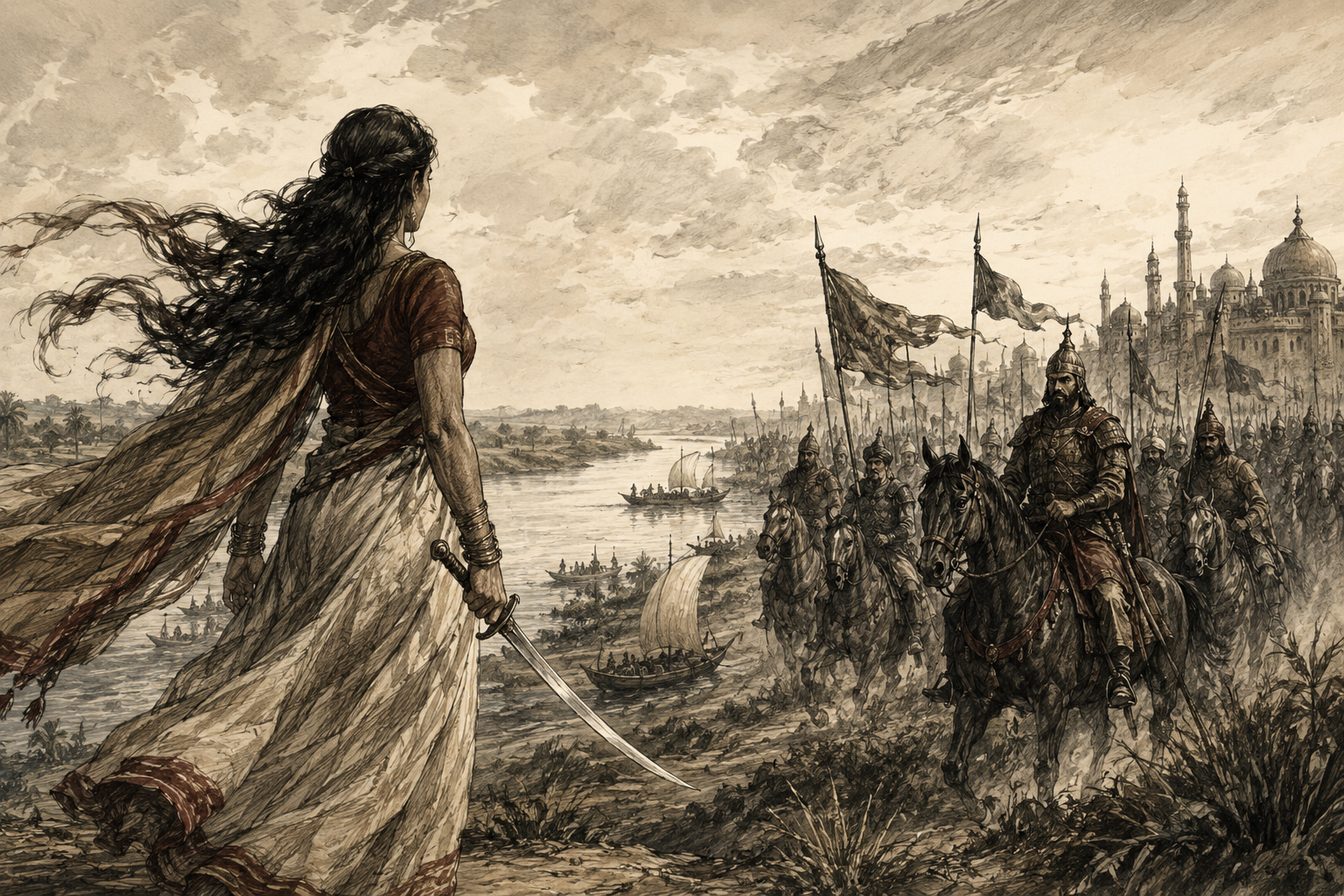
When the Mughals rose to replace the Delhi Sultanate as the dominant power in northern India, they inherited the same geographic headache. Bengal did not simply surrender to Mughal authority the way many other regions eventually did. Instead, after the collapse of the last independent Bengal Sultanate dynasty in 1576, a loose confederacy of local landlords and chieftains, known collectively as the Baro Bhuiyan, or twelve landholders, rose up to defend the region’s autonomy against the world’s wealthiest empire.
Their most famous leader, Isa Khan, based his resistance in the riverine Bhati region around Sonargaon, using the same flooded, boat friendly terrain that had frustrated Delhi’s earlier armies. His forces repeatedly defeated Mughal commanders sent by Emperor Akbar, including a notable naval victory near Bhawal in 1584 that showcased just how effectively local knowledge of Bengal’s rivers could neutralize Mughal cavalry and artillery. Akbar eventually dispatched one of his most trusted generals, the Rajput commander Raja Man Singh, in 1594 to finally crush the confederacy, but even this took years of grinding campaigns. Isa Khan died undefeated in 1599, and it was left to his son Musa Khan to carry on the fight until 1612, when the Mughal governor Islam Khan Chishti finally forced the last of the Baro Bhuiyan to submit. All told, the confederacy had held off two Mughal emperors for close to four decades, a resistance so stubborn that Mughal chroniclers themselves wrote about it with visible frustration.
When Delhi Decided To Move Away From Bengal Entirely
By the time the British East India Company took control of Bengal in the mid eighteenth century, the region had shifted from resisting Delhi militarily to becoming the intellectual and administrative heart of an entirely new empire. Calcutta served as the capital of British India for well over a century, and in that role it also became the undisputed center of Indian nationalist thought. Bengali writers, students, and revolutionaries turned the city into a laboratory for the ideas that would eventually dismantle British rule altogether.
The British tried to break that momentum in 1905, when Viceroy Lord Curzon partitioned Bengal into two provinces, a move widely understood at the time as a deliberate attempt to weaken Bengali political unity by splitting the region along religious lines. It badly backfired. The partition ignited the Swadeshi movement, a mass boycott of British goods, alongside a wave of more radical revolutionary activity, including bombings and assassination attempts against British officials in Calcutta. Faced with sustained unrest, the British formally annulled the partition in 1911.
But the same announcement that reversed the partition also delivered a second, quieter blow to Bengal’s influence. In that very same year, the British government announced it would move the entire capital of India from Calcutta to Delhi. Historians generally agree this was no coincidence. Calcutta had allowed Bengalis to dominate Indian political life far beyond their numbers, and shifting the seat of imperial power away from the city was, in the words of contemporary British officials themselves, a way of gaining distance from a population the government could no longer easily control. One Bengali newspaper at the time mourned that after a hundred and fifty years as the seat of empire, the region was about to lose its political prestige to a city hundreds of miles away, a loss it feared would affect the livelihoods of tens of thousands of Bengalis along with the political standing of the entire nation. It is a striking historical irony that the very intensity of Bengal’s resistance to colonial rule is what pushed Delhi back into the role of India’s capital after roughly a century and a half in the shadows.
A Language, A War, And A New Country
The instinct to resist distant, centralized authority did not fade with independence in 1947. It simply changed direction. When Bengal was partitioned again at independence, its eastern, Muslim majority half became East Pakistan, governed from Islamabad and Karachi rather than Delhi, but the underlying dynamic was strikingly familiar. A distant capital, culturally and linguistically different from Bengal, attempted to impose its own language and priorities on a Bengali speaking population that overwhelmingly outnumbered it. The attempt to make Urdu the sole national language triggered the Language Movement of 1952, whose martyrs are still honored every year on International Mother Language Day.
That same resistance to distant rule matured over the following two decades into the full independence movement led by Sheikh Mujibur Rahman, culminating in the Liberation War of 1971 and the creation of Bangladesh. It is worth noting that this particular chapter was a rebellion against Islamabad, not Delhi, and India in fact provided crucial military support to the Bengali independence movement during that war. Even so, the underlying grievance, a Bengali population refusing to accept political and cultural direction from a distant, non Bengali center of power, sits squarely within the same centuries old pattern that runs through this entire history.
Independent Bangladesh’s Long, Uneasy Relationship With Delhi
Bangladesh’s founding chapter with Delhi actually began on good terms. India provided decisive military support during the 1971 Liberation War, and diplomatic relations began the moment Bangladesh declared independence. But the goodwill did not stay simple for long, and the decades since have produced a long list of specific, recurring grievances that keep resurfacing whenever Bangladesh Delhi relations sour.
The first major flashpoint was water. In 1975, India completed the Farakka Barrage on the Ganges, just upstream of the Bangladesh border in West Bengal, built to flush silt away from Kolkata’s port by diverting river flow into the Hooghly. Bangladesh argued, and still argues, that the barrage starves its own northern rivers during the dry season while worsening flooding when India releases water during the monsoon. The anger over Farakka became so widespread that it produced independent Bangladesh’s first major mass protest movement against India, the Farakka Long March of May 1976, led by the veteran peasant leader Maulana Abdul Hamid Khan Bhashani, the same Red Maulana who appears among Bengal’s most celebrated icons. Bangladesh still marks the anniversary of that march every year, and the underlying grievance was never fully resolved. A similar, still unfinished dispute hangs over the Teesta river in the north, where a proposed water sharing treaty has remained stalled for well over a decade, in large part because of opposition from the West Bengal state government itself, a reminder that Bengal’s internal politics can complicate Bengal’s external relationships too.
The second recurring wound involves the border itself. The India-Bangladesh border stretches over four thousand kilometers, and Indian Border Security Force personnel have shot and killed Bangladeshi civilians attempting to cross it with a regularity that has become a defining grievance in Bangladeshi public opinion. The case that crystallized this anger internationally was the killing of fifteen year old Felani Khatun in January 2011, shot while crossing back into Bangladesh and left hanging on the border fence for hours, an image that triggered protests across the country. Rights groups have documented hundreds of similar killings in the years since, and despite repeated Indian assurances, the shootings have continued, most recently drawing fresh outrage after the killing of another teenager, Swarna Das, in 2024.
These older grievances collided with a genuinely new political crisis in August 2024, when mass student led protests forced long serving Prime Minister Sheikh Hasina from power after hundreds of people were killed in the unrest. Hasina moved to India, where she has remained in exile ever since, and her Awami League government had been widely, and increasingly resentfully, seen inside Bangladesh as closely aligned with Delhi. Because that alignment was so closely associated with her rule, anti-Hasina sentiment and anti-India sentiment became deeply intertwined in Bangladeshi public opinion almost overnight. Bangladesh’s interim government has since formally requested Hasina’s extradition following her conviction on charges related to the deadly crackdown on the 2024 protests, a request India has not granted, further straining the relationship. Bangladeshi analysts have also pointed to India’s continued hosting of exiled Awami League figures, tit-for-tat trade restrictions, inflammatory rhetoric in parts of the Indian media, and unresolved anger over the Citizenship Amendment Act, widely seen in Bangladesh as targeting Muslims, as compounding factors behind a wave of anti Delhi feeling that international analysts now describe as one of the most serious downturns in the relationship since Bangladesh’s founding.
It is worth being careful here, because this is very much a live and contested situation rather than settled history. Indian commentators generally frame the current chill as a response to legitimate security concerns, including the stability of India’s northeastern border states and the risk of extremist elements gaining ground amid Bangladesh’s political transition. Bangladeshi commentators generally frame it as decades of accumulated grievance over water, borders, and perceived political interference finally boiling over once the government seen as Delhi’s closest partner was removed. Both countries have signaled interest in resetting the relationship following Bangladesh’s national elections in early 2026, but as of now the underlying disputes, over rivers, over borders, and over political trust, remain unresolved.
West Bengal And Delhi Today
On the Indian side of the border, the state of West Bengal has continued to occupy an unusually assertive position within India’s federal structure. Bengali politics in the decades after independence produced its own distinct traditions, from the rise of a long running Left Front state government to the more recent dominance of the Trinamool Congress, both of which have, at various points, positioned themselves in direct friction with whichever party controlled the central government in Delhi.
In recent years, that friction has centered on familiar federal fault lines, disputes over the distribution of central tax revenue, disagreements over the implementation of national welfare schemes at the state level, and clashes over contentious national laws such as the Citizenship Amendment Act, which triggered significant protests in West Bengal. Supporters of the central government describe these disputes as necessary efforts to maintain uniform national policy, while state leaders in Kolkata frame them as attempts to override the state’s own democratic mandate and cultural autonomy. As with most contests between India’s states and its center, reasonable people disagree sharply about where legitimate national coordination ends and federal overreach begins, and the dispute remains an active and unresolved part of Indian politics rather than a settled question.
A Delta That Has Never Learned To Sit Still
Look across this entire timeline and a consistent shape emerges. Bengal’s rivers and distance from northern India’s political centers have made the region difficult to govern from afar in almost every era, whether the capital in question was Delhi under the Sultans, Delhi under the Mughals, Calcutta under the British, Islamabad under Pakistan, or Delhi again under the modern Indian republic. Time and again, Bengal has produced its own independent kingdoms, its own confederacies of local resistance, its own revolutionary movements, and its own political parties willing to challenge whichever distant authority currently claims to speak for it.
None of this means Bengal has ever fully separated itself from the wider political fortunes of the subcontinent. It has been conquered, partitioned, and absorbed more than once. But conquest and absorption have never been quite the same as submission. From the bamboo ramparts at Narikelbaria to the marble corridors of modern Indian federalism, Bengal has spent the better part of a millennium insisting, in one form or another, that it intends to be governed with its consent rather than simply governed.
Sources consulted include Banglapedia entries on the Ilyas Shahi dynasty and the Baro Bhuiyans, the Wikipedia articles on the Bengal Sultanate, the Ekdala Wars, the Partition of Bengal, Bangladesh India relations, and deaths along the Bangladesh India border, Britannica’s coverage of the 1905 partition, academic and journalistic accounts of the 1911 transfer of the Indian capital from Calcutta to Delhi, and recent reporting and analysis from the International Crisis Group, the International Institute for Strategic Studies, and Bangladeshi and Indian press coverage of relations since August 2024.