
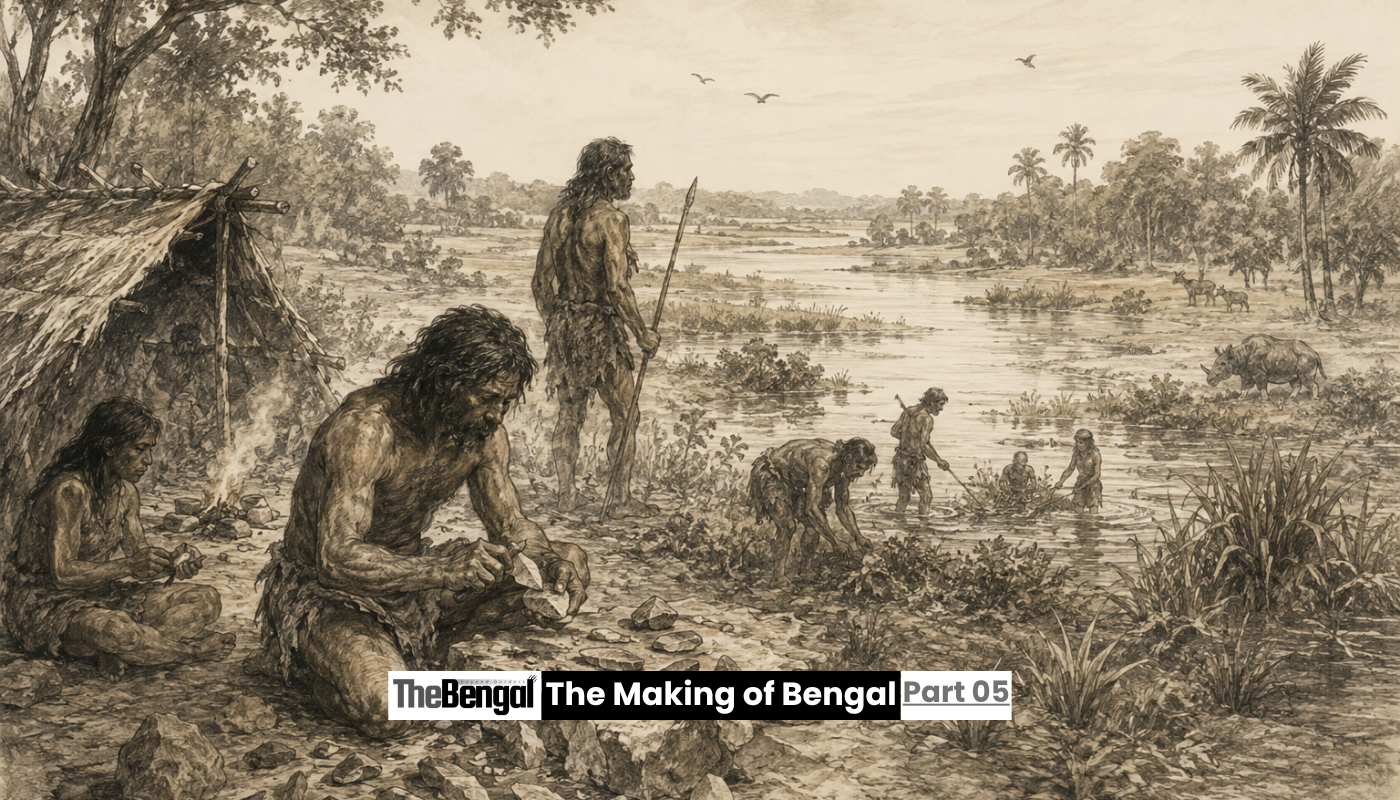

This article is part of The Making of Bengal, a long-form historical series by The Bengal. In the previous chapter, we explored the lost prehistoric world of Bengal, a landscape once home to lions, hyenas and an ancient species of giraffe, alongside early hominins who shaped stone tools from fossilised wood. This chapter turns to a more specific question: when did modern humans, people essentially like us, first arrive in Bengal, and what conditions greeted them when they did.
Leaving Africa, Following the Coast
The story of humans in Bengal cannot be separated from the much larger story of how our species left Africa altogether.
Genetic and archaeological evidence points to modern Homo sapiens dispersing out of Africa sometime around 60,000 to 70,000 years ago, following what researchers describe as a southern coastal route across Asia. This dispersal is understood to have followed the coastline of southern Asia, eventually reaching Australia by roughly 65,000 to 50,000 years ago. Along the way, these migrating populations moved through the Arabian peninsula, along the shores of the Indian subcontinent, and into Southeast Asia, encountering and occasionally interbreeding with older human lineages such as Neanderthals and Denisovans already established across parts of Asia.
Some researchers argue this was not necessarily a single, tidy migration but a more complex process involving multiple dispersals, some potentially far earlier than 60,000 years ago, moving along both southern coastal and more northern inland routes across the continent. What is generally agreed upon is that early migrants out of Africa followed the coasts of Asia, and by around seventy thousand years ago, had made their way into the Indian subcontinent. Given Bengal’s position along the eastern edge of that subcontinent, directly on the route between South Asia and Southeast Asia, it sat squarely within the path that these early wandering populations would have needed to cross.
A Coastline That No Longer Exists
One crucial detail makes this migration easier to picture: the coastline early humans walked along did not look anything like the one that exists today.
During the last ice age, enormous volumes of the world’s water were locked away in glaciers, and global sea levels dropped by roughly sixty metres or more compared to today. This exposed wide stretches of continental shelf that are now submerged beneath the Bay of Bengal, effectively extending the walkable coastline much further out to sea than it currently sits. Early migrants moving along this route were not picking their way through the modern, densely populated Bengal coast at all, but through a very different, now-vanished landscape, one that has since been drowned by rising post-glacial seas.
This matters enormously for archaeology. Much of the physical evidence of these earliest coastal migrations through the Bengal region likely lies not on dry land at all, but somewhere beneath the waters of the Bay of Bengal, in territory that has not been, and may never be, fully excavated. The absence of abundant coastal sites from this very early period in Bengal is not necessarily evidence of absence of people, but quite possibly evidence of a coastline that has simply disappeared.
Bengal’s Own Early Population
While the broader migration story explains how humans could have reached Bengal, the region’s own fossil record offers a tantalising glimpse of who might have actually been here.
As discussed in the previous chapter of this series, human fossil remains recovered from Susunia in Bankura district, West Bengal, include a humerus bone recovered from a stratigraphic layer associated with the period before the Toba supereruption, roughly 75,000 years ago. Researchers involved in analysing this material have described the population it represents as a short and stocky lineage of early Homo sapiens, a population type not previously documented elsewhere in South Asia, persisting in the region from somewhere around 150,000 years ago down to roughly 40,000 years ago.
If this interpretation holds, it places an identifiable population of early modern humans in Bengal across an extraordinarily long stretch of time, spanning the same broad period during which the wider out of Africa migration was unfolding across the rest of southern Asia. Bengal, in other words, was not simply a corridor that people passed through on their way somewhere else. It appears to have supported its own resident population for tens of thousands of years.
Surviving the Sky Turning Dark
Any population living in South Asia around 74,000 years ago would have faced one of the most dramatic natural events in human history: the eruption of the Toba volcano in what is now Sumatra.
The Toba supereruption released an estimated 2,800 cubic kilometres of volcanic material into the atmosphere, making it the largest known explosive eruption of the last two million years. Ash from the eruption fell across much of the Indian subcontinent, blanketing the landscape and, according to some researchers, triggering a period of global cooling severe enough to threaten human populations across the region, sometimes described as a volcanic winter.
For decades, many scientists assumed this catastrophe had wiped out much of the human population living in South Asia at the time. More recent archaeological work has complicated that picture considerably. At Jwalapuram in southern India, researchers found broadly similar stone tools both above and below a thick layer of Toba ash, indicating that the same style of toolmaking continued uninterrupted before and after the eruption. A separate, more recent study at the Dhaba site in the Middle Son Valley of northern India uncovered an eighty thousand year long stratigraphic record showing that Middle Palaeolithic toolmaking populations were present in the region both before and after the eruption, using techniques broadly similar to those seen among Homo sapiens in Africa during the same period.
Bengal, sitting further east along the same subcontinent, would have experienced its own share of this ashfall and its aftermath. Given that human populations elsewhere in India appear to have weathered the eruption and continued much as before, there is little reason to assume that any early Bengali population, including the one apparently represented at Susunia, would have fared any differently. The disaster, in other words, appears to have been survived rather than fatal, here as elsewhere.
A Crossroads, Not a Destination
What emerges from this combination of global migration patterns and local fossil evidence is a picture of early Bengal as a genuine crossroads, rather than an isolated or peripheral corner of the ancient world.
Positioned along the coastal migration route out of Africa, sitting directly between the Indian subcontinent and the gateway to Southeast Asia, Bengal would have been difficult for early human populations to avoid entirely, even if they had wanted to. Some migrants likely passed through on their way toward Myanmar, Thailand and ultimately the islands of Southeast Asia and Australia. Others, as the Susunia evidence suggests, appear to have stayed, establishing a population that persisted across an immense span of time.
This positions Bengal’s human story as considerably older and more continuous than a simple narrative of farmers arriving to till previously empty land would suggest. Long before rice cultivation, long before the fortified towns and river trade explored elsewhere in this series, the landscape had already hosted repeated waves of human presence, shaped by climate, catastrophe and the same restless drive to migrate that carried our species across the entire planet.
What Remains Unknown
It is worth being honest about the limits of this picture. The interpretation of the Susunia fossils as an early and distinct Homo sapiens population remains a matter of ongoing scientific debate, and much of the physical evidence for the earliest coastal migrations through the Bengal region likely lies submerged beneath the modern Bay of Bengal, well beyond the reach of conventional excavation. What survives on dry land is, once again, a set of fragments rather than a complete record.
Even so, those fragments are enough to establish something important. Bengal was not waiting on the sidelines of human history, populated only once agriculture and urban life eventually arrived. It was already part of the story from a very early point, a landscape that early humans crossed, weathered disaster in, and in at least one documented case, appear to have called home for tens of thousands of years before the very idea of Bengal existed.
In the next chapter of this series, we follow these early populations forward in time, from scattered hunting bands toward the first permanent villages of Bengal, as farming began to reshape both the landscape and the people living on it.
Sources: Wikipedia, “Early human migrations” and “Recent African origin of modern humans”; OpenStax, World History Volume 1, “Early Human Evolution and Migration”; ResearchGate, “Re-looking at Prehistoric Susunia, West Bengal”; ScienceDirect, “The dispersal of Homo sapiens across southern Asia”; Max Planck Institute for the Science of Human History, “Human Populations Survived the Toba Volcanic Super-Eruption 74,000 Years Ago”; Science (AAAS), “Humans in India may have survived supereruption 74,000 years ago.”