

This article is part of The Making of Bengal, a long-form historical series by The Bengal. The previous chapter examined Shashanka the man, his coinage, his calendar, and the disputed accusations of religious persecution that have followed his reputation for centuries. This chapter turns to the kingdom he actually built, its capital, its reach, and how quickly it came apart once he was gone.
A City Named for Golden Ears
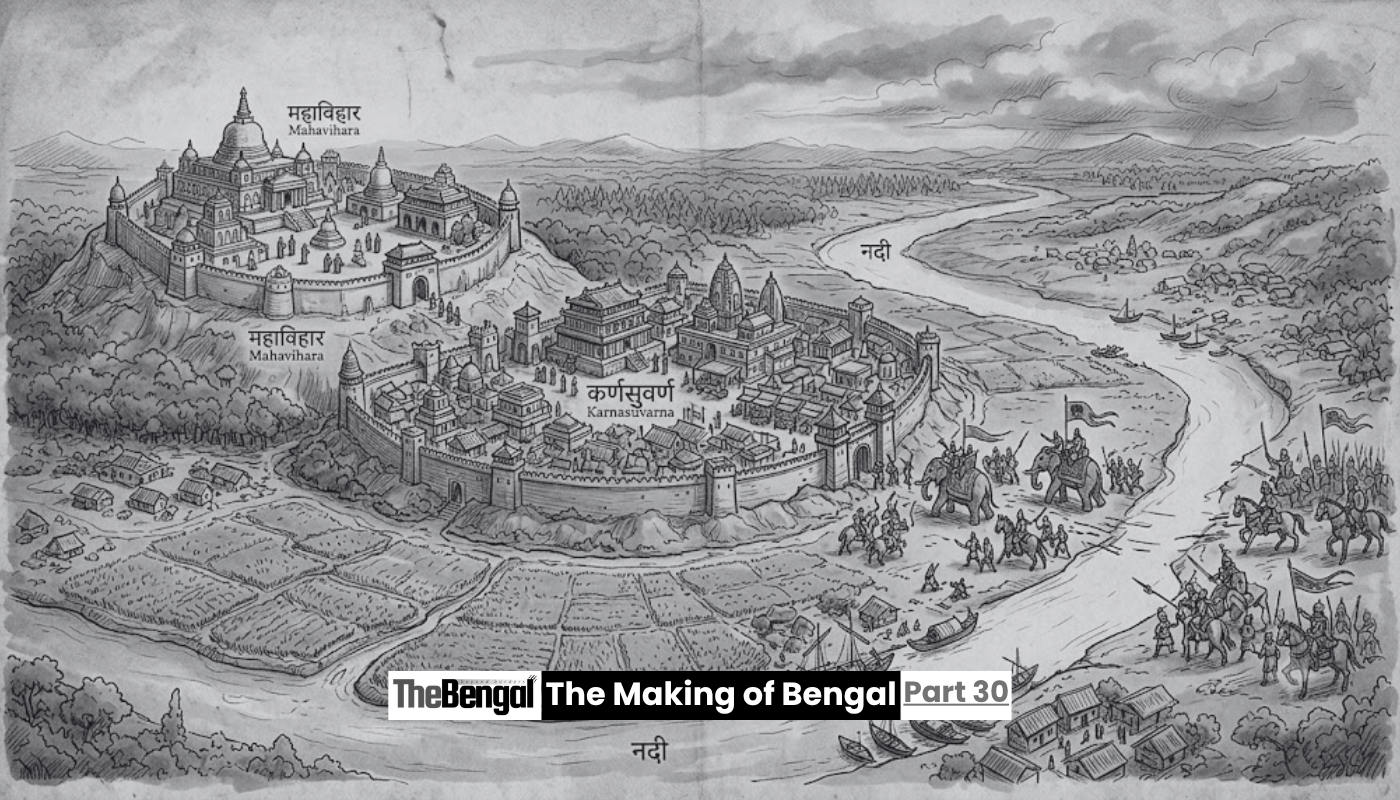
Karnasuvarna’s very name carries a small piece of legend within it. The word combines karna, meaning ear, with suvarna, meaning both beautiful and gold, rendered locally as Kansona, roughly ear of gold. According to local folklore, the city takes its name from Karna, the tragic warrior-king of the Mahabharata, said to have ruled from this very spot in a much earlier, semi-mythical age, an origin story that, whatever its historical accuracy, reflects how deeply this location had already embedded itself in regional memory even before Shashanka made it his own capital.
The physical location of ancient Karnasuvarna has been identified with real confidence. Archaeologists place the site at Rajbaridanga, near Kansona, in Murshidabad district, West Bengal, roughly fifteen kilometres south of Berhampore near the banks of the Bhagirathi river. Excavations there, first undertaken by a team from the University of Calcutta’s Department of Archaeology in 1962 under the direction of S.R. Das, uncovered decisive proof of the site’s identity: a monastic sealing bearing an inscription naming the community of venerable monks residing in the Shri Raktamrittika Mahavihara, the very monastery Xuanzang had described in his own travel account centuries earlier as lying near Karnasuvarna.
A Capital Xuanzang Actually Walked Through
Unlike many of the sites explored earlier in this series, where later readers must reconstruct daily life from scattered terracotta and inference, Karnasuvarna benefits from a genuine eyewitness account. The Chinese pilgrim Xuanzang, travelling through the region around 639 CE, moved from Tamralipti, already examined at length in earlier chapters of this series, into what he recorded as Kie-lo-na-su-fa-la-na, his rendering of Karnasuvarna, describing a monastery called Lo-to-mi-chih standing near the capital, the very Raktamrittika Mahavihara later confirmed by the excavated sealing at Rajbaridanga.
Banglapedia’s own summary of Xuanzang’s observations offers a genuinely vivid glimpse of the city’s character. People belonging to different religions lived there side by side, and Buddhism, notably, was recorded as being in a flourishing state, evident from the magnificent and celebrated Raktamrittika monastery in its immediate vicinity. This detail deserves real emphasis given the previous chapter’s discussion of Shashanka’s contested reputation regarding Buddhism. Whatever the truth of the Bodhi tree accusations levelled against him by later Buddhist tradition, his own capital city, visited by a Buddhist pilgrim within roughly a decade or so of Shashanka’s death, was itself home to a thriving Buddhist monastic community operating openly alongside his Shaivite court. Banglapedia summarises the city’s overall character plainly: Karnasuvarna was famous as a prosperous politico-administrative, military and religious urban centre, though its fame, the same source notes, proved short-lived.
A War That Reached Into Assam
Shashanka’s kingdom did not confine itself to the delta’s core territory. According to the Doobi copperplate inscriptions, a genuinely important and often overlooked episode connects Gauda directly to the wider regional geography this series has followed since its earliest chapters on prehistoric Assam and Tripura. Sometime between roughly 595 and 600 CE, likely during the period when Shashanka was still consolidating power alongside his ally and eventual overlord relationship with the Later Guptas, the Gauda army carried out a military campaign against Susthitavarman, king of Kamarupa in Assam. The Varman king died early in the conflict, and the Doobi plates record that the Gauda forces went on to defeat his two sons and successors, princes Bhaskaravarman and Supratisthitavarman, with Bhaskaravarman’s own later inscriptions specifically describing the Gauda army as fielding a formidable naval force during this campaign, a detail that connects neatly to the river-based military and trading capacity this series has traced across Bengal’s history since its earliest chapters on the Ganges and Brahmaputra.
This was not a minor border skirmish. It represented Gauda’s power reaching directly into the Brahmaputra valley, subordinating, at least temporarily, the ruling house of Kamarupa itself. And it planted a grievance that would outlive Shashanka by only a matter of years.
The Alliance That Undid Gauda
That grievance came due almost immediately after Shashanka’s death. Bhaskaravarman, the very prince whose father’s kingdom Gauda’s forces had defeated a generation earlier, found himself, by the early 600s, aligned against Gauda for an entirely separate reason as well: Shashanka’s role, discussed in the previous chapter, in the killing of Harshavardhana’s brother Rajyavardhana. According to the Wikipedia account of these events, following that killing, Bhaskaravarman sent an envoy named Hangsavega to Harsha’s court at Thaneswar specifically to propose an alliance against their shared rival, an event recorded independently by both Banabhatta and Xuanzang.
The resulting partnership between Harsha of Kannauj and Bhaskaravarman of Kamarupa proved decisive, though not immediately. Shashanka himself, by most accounts, continued to resist this combined pressure for the remainder of his reign, reportedly ruling for close to three decades after his initial break from Later Gupta and Maukhari overlordship, before his death sometime around 636 or 637 CE. Only after that death did the alliance’s full weight finally land on Gauda itself.
A Kingdom That Outlived Its Founder by Months
What followed Shashanka’s death illustrates just how personally his kingdom’s strength had depended on him specifically. His son, Manava, succeeded him, but ruled for only eight months before Gauda was effectively divided between the two allied victors, Harsha and Bhaskaravarman. Bhaskaravarman’s own Nidhanpur copperplate inscription records the outcome directly, describing Karnasuvarna itself as functioning briefly as his jayaskandhavara, his victory camp, language that leaves little room for interpretation: the former capital of Bengal’s first independent king had passed, at least for a time, into the hands of the very Kamarupa ruling house Shashanka’s own army had once defeated in Assam.
Karnasuvarna’s political life did not end there, though what followed reads more like a series of aftershocks than any stable continuation of Gauda’s earlier strength. According to Banglapedia, in the middle of the seventh century the city briefly served as the royal seat of a further ruler named Jayanaga, known from his own Vappa Ghoshavata copperplate grant, a figure whose broader reign and relationship to Shashanka’s own line remains only faintly documented, in keeping with the genuinely murky political record this series has already grappled with in earlier chapters covering Shashanka’s uncertain feudatory origins.
A Short Reign, a Lasting Precedent
Taken as a whole, the story of Karnasuvarna and Gauda is one of remarkable brevity set against remarkable consequence. Shashanka’s independent kingdom, from his decisive break with Later Gupta overlordship around 601 CE to his death roughly three and a half decades later, and its near-immediate dissolution within months of his passing, occupied barely a single generation of Bengal’s much longer history. Its capital, a prosperous, religiously diverse city that Xuanzang himself walked through and admired, passed within a decade of Shashanka’s death from Gauda’s own control into the hands of a rival Assamese king, then to a barely documented successor, its brief moment as the political centre of eastern India already fading by the time the next great power in Bengal’s story, the Pala dynasty, would rise from the very chaos this kingdom’s collapse left behind.
And yet brevity did not diminish significance. For the first time in everything this series has traced, from Gangaridai’s brush with Alexander through centuries of Mauryan and Gupta administration, Bengal had produced a king who answered to no outside emperor, minted his own coinage, established his own calendar, and fielded an army capable of reaching all the way into Assam. Gauda’s collapse within a generation did not erase that precedent. It simply left it waiting, in the political vacuum this brief kingdom’s fall created, for the next dynasty willing to try again, on a considerably larger and more lasting scale.
In the next chapter of this series, we turn to that very question: why Shashanka’s brief, contested reign continues to divide historians so sharply, and what that disagreement reveals about how Bengal itself chooses to remember its own founding king.
Sources: Wikipedia, “Shashanka,” “Karnasuvarna” and “Bhaskaravarman”; Banglapedia, “Karnasuvarna”; Grokipedia, “Karnasuvarna” and “Kingdom of Gauda”; District Murshidabad, Government of India, “Karna Subarna (Capital of Shashanka)”; LaughaLaughi, “Karnasuvarna: The First Independent Capital of Bengal”; IndianNetzone, “Shashanka.”