
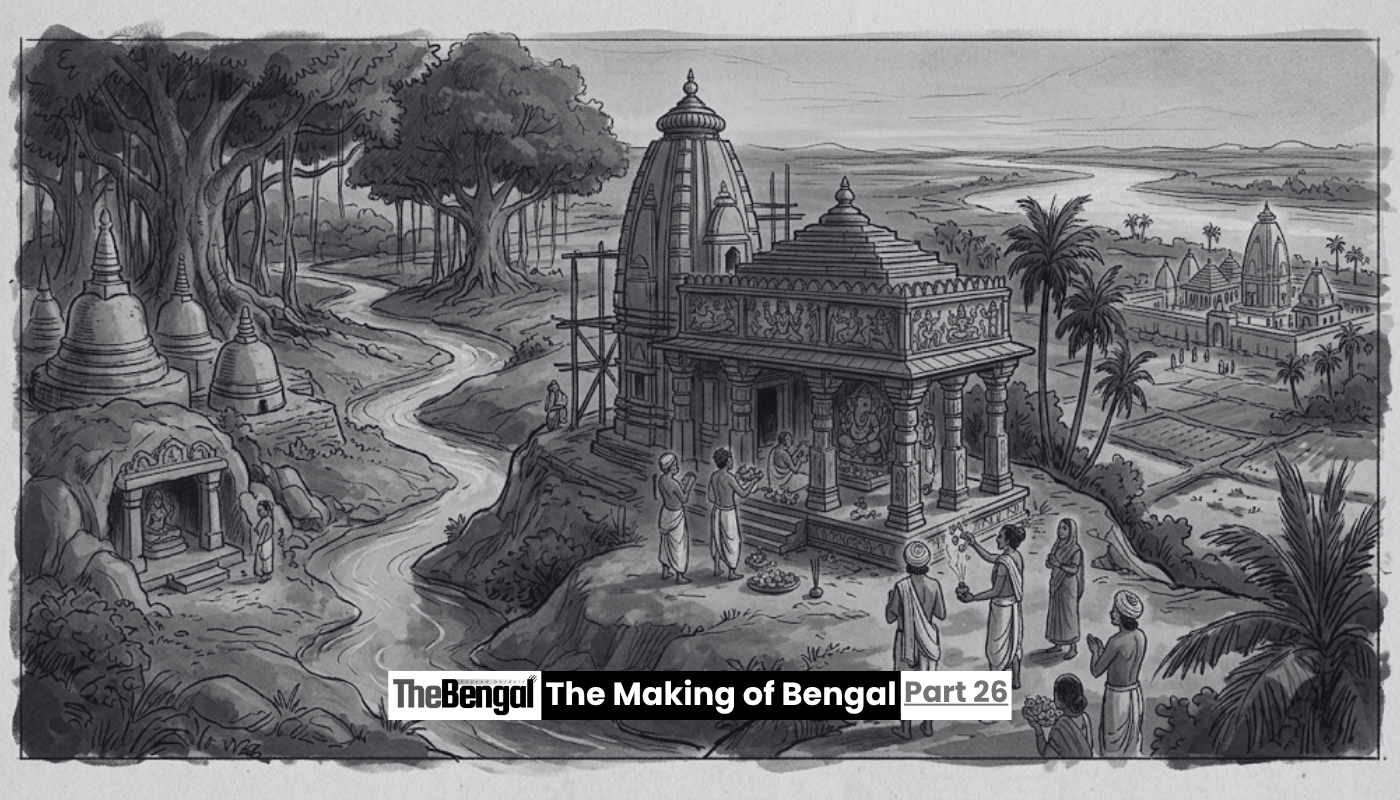

This article is part of The Making of Bengal, a long-form historical series by The Bengal. The previous chapter traced how Buddhism flourished across Bengal through royal patronage and monastic growth. This chapter follows a parallel and, in the long run, equally consequential development: the rise of a new, more devotional and image-centred form of Hinduism that would eventually come to define much of Bengal’s religious character.
A Golden Age, and a Quiet Transformation
Historians have long described the Gupta period, roughly 320 to 550 CE, as a golden age of Indian civilisation, an era of artistic, scientific and literary achievement. Less obviously dramatic, but arguably more consequential in the long run, was what happened to religion during this same span of time. Across northern India, and reaching directly into Bengal, an older form of Vedic Brahmanism, centred on ritual sacrifice conducted by priests on behalf of patrons, gradually gave way to something new: a devotional, temple-centred, image-based Hinduism that historians now generally call Puranic Hinduism.
This was not a sudden replacement. Researchers studying the process are consistent on this point: Puranic Hinduism gradually supplanted earlier Vedic Brahmanism through assimilation, negotiation and the incorporation of local religions, rather than through any sudden or rapid transformation. Vedic ideas did not simply vanish. They persisted as one strand woven into a much larger, evolving religious fabric, one that also absorbed heterodox movements like Shaivism, Vaishnavism and the Shakti tradition, along with countless local and regional cults that had existed long before any of these organised systems arrived.
The Evidence Buried in Bengal’s Own Soil
This was never simply a theoretical shift happening elsewhere in India and eventually trickling into Bengal secondhand. Direct physical evidence places this religious transformation squarely within the delta itself. Fifth-century inscriptions from Damodarpur, a site in present-day Bangladesh already connected to Kotivarsha and the wider administrative network discussed in an earlier chapter of this series on Bengal’s first cities, record Shaivite worship taking hold in the region, including the presence of linga symbols associated with the god Shiva. Researchers studying this evidence describe it as reflecting a genuine blend of older Vedic Rudra worship, Rudra being a somewhat obscure early deity later identified as an ancestor of Shiva, with local fertility cults already rooted in Bengal’s own religious landscape, precisely the kind of layered synthesis this series has already traced in language and folk religion alike.
This matters because Damodarpur was not a peripheral or obscure site. It sat within the same administrative network as Kotivarsha and Pundravardhana, territories this series has already followed through the Mahasthan inscription and Bengal’s earliest urban development. Finding clear Shaivite religious evidence there confirms that this broader Gupta-era religious transformation was not confined to distant imperial centres like Pataliputra. It reached directly into Bengal’s own administered territory, carried by the same networks of royal grants, inscriptions and official patronage this series has already documented shaping the region’s economy, cities and earlier Buddhist monasteries.
Stories for People Who Could Not Read
One of the most significant tools driving this transformation was literary rather than architectural: the Puranas themselves. The majority of these sprawling mythological and genealogical texts were compiled and codified specifically during the Gupta period, and the Gupta rulers themselves are widely credited as their patrons. Their purpose went well beyond scholarly record-keeping. Researchers studying this period describe the Puranas as serving a specific and deliberate social function, disseminating mainstream religious ideology to rural and largely non-literate populations, groups who would never have had direct access to Sanskrit Vedic ritual texts reserved for a narrow priestly elite.
This is a crucial point for understanding how this religious revolution actually reached ordinary people across Bengal, rather than remaining confined to royal courts and temple priesthoods. Through the Puranas, complex theological ideas, and crucially, space for local and regional deities to be woven into a shared mythological framework, could spread through storytelling and oral tradition to communities who had never studied Sanskrit scripture directly. It is precisely this kind of absorption that the previous chapter of this series traced with the goddess Manasa, whose later Puranic origin stories, describing her as the daughter of the sage Kashyapa or of Shiva himself, read exactly like this deliberate process in action: an older, popular, tribal-rooted deity given a respectable place within the newly expanding Puranic framework, her worship neither erased nor left untouched, but folded carefully into the larger religious system taking shape around her.
From Sacrifice to Temple, From Ritual to Devotion
Alongside this narrative and mythological expansion came a genuine shift in religious practice itself. Where earlier Vedic Brahmanism had centred on elaborate animal sacrifices performed by priests, the Gupta period saw sacrifice steadily decline in significance, replaced by the growing practice of puja, personal and collective devotional worship, along with an increasing emphasis on pilgrimage to sacred sites and locations. Deities were sculpted in stone and terracotta, temples were constructed to house them, and idol worship, largely absent from the earliest Vedic tradition, became a defining and permanent feature of the emerging Hindu practice.
This shift toward image-based devotion connects directly back to material this series has already explored. The terracotta figures of Yakshis, deities and household scenes recovered from Chandraketugarh, discussed in earlier chapters covering daily life and folk religion, represent exactly this kind of visual, image-centred devotional culture, and it is worth noting that terracotta religious imagery was already well established in Bengal before this formal Puranic synthesis reached its mature form, suggesting that Bengal’s own artisan traditions may have been unusually well positioned to embrace, and perhaps even help shape, this broader shift toward temple- and image-based worship happening across the wider subcontinent.
Two Traditions Growing Side by Side
It would be a serious mistake to read this chapter as describing the decline of Buddhism in Bengal. As the previous chapter of this series demonstrated in considerable detail, Buddhism continued to flourish across the delta for centuries after this Puranic Hindu synthesis began taking shape, sustained by royal land grants, thriving monasteries at Tamralipti and Samatata, and a Buddhist monk population numbering in the thousands as late as the seventh century, according to the eyewitness accounts of Xuanzang and Yijing.
What Bengal experienced during this period, then, was not one religion replacing another, but two increasingly sophisticated devotional systems, an expanding Buddhist monastic tradition and a newly consolidating Puranic Hinduism, developing and competing for royal patronage and popular support simultaneously, across the very same cities, courts and river valleys. This coexistence would not last forever. As the next section of this series will explore, the rise of King Shashanka and the Gauda kingdom in the early seventh century is widely understood by historians as marking a genuine resurgence of Hindu political power in Bengal, one that would gradually begin tilting the balance of royal patronage in a new direction.
A Foundation Laid Quietly
What makes this religious revolution distinctive is how quietly it unfolded compared to the dramatic political and military events this series has followed elsewhere, Alexander’s retreat, Ashoka’s conquest of Kalinga, the founding of independent kingdoms. There was no single battle or conquest that marked Puranic Hinduism’s arrival in Bengal. It arrived instead through inscriptions at Damodarpur, through Puranic storytelling reaching illiterate villagers, through slowly changing temple architecture, and through the patient, centuries-long absorption of goddesses like Manasa into an expanding devotional framework.
Yet the consequences of this quiet transformation would prove every bit as significant as any battle. The temple-centred, image-based, devotionally organised Hinduism that took shape in Bengal during this period laid the religious groundwork for everything that followed in the region’s subsequent history, from the Hindu resurgence under Shashanka to the later flourishing of Vaishnavite devotion that would eventually produce some of Bengal’s most celebrated religious and cultural movements.
In the next chapter of this series, we turn to a related and equally quiet transformation: the slow process by which the diverse peoples, languages and traditions explored throughout this series began coalescing into something recognisable as a distinct Bengali identity.
Sources: IndianNetzone, “Religious Movements in Gupta Period”; Testbook, “Puranic Hinduism: Vaishnavism, Shaivism, and Shaktism”; Wikipedia, “History of Hinduism” and “Historical Vedic Religion”; Grokipedia, “Bengali Hindus” and “Hinduism in Bangladesh”; World History Edu, “Religion in Ancient India”; eGyanKosh, “Religions and Religious Practices.”