
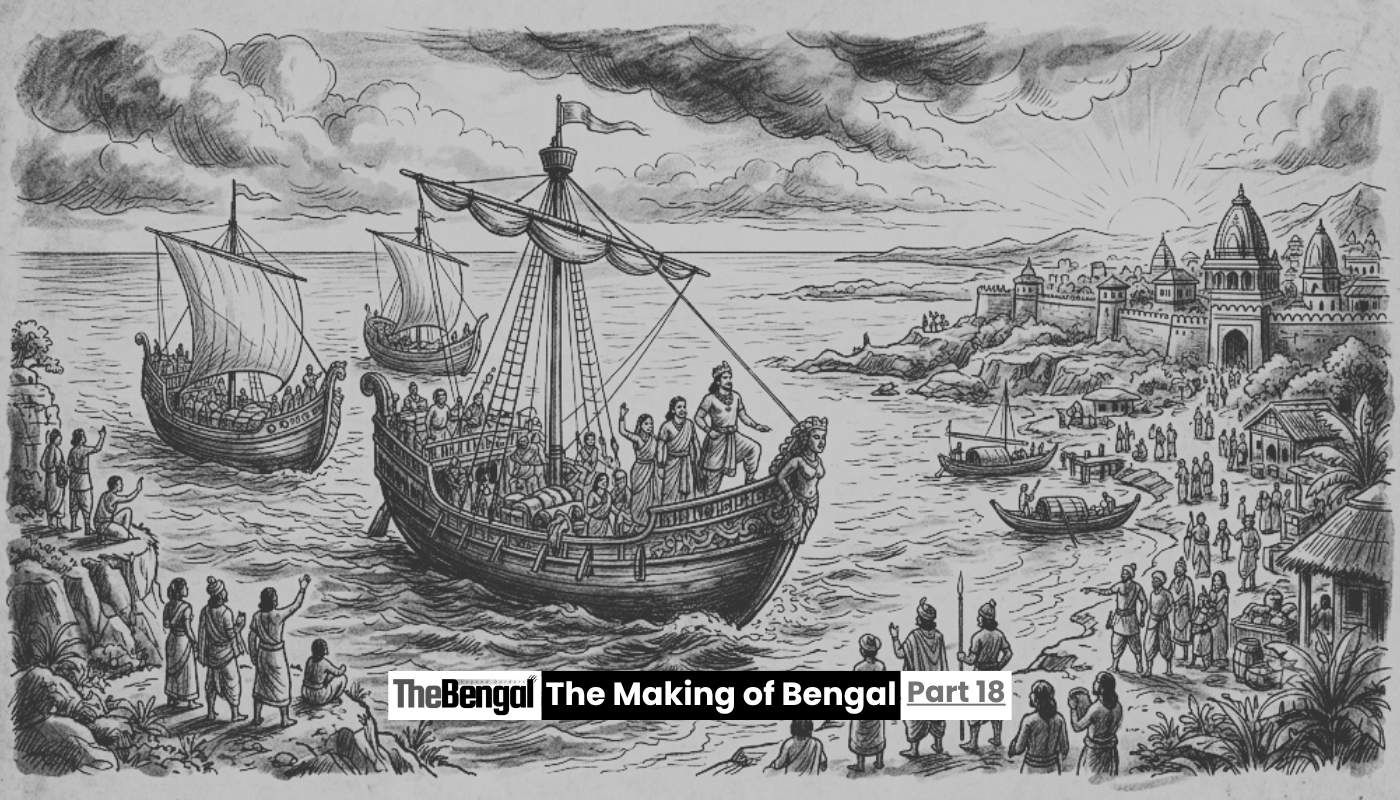

This article is part of The Making of Bengal, a long-form historical series by The Bengal. The previous chapter established Bengal’s place within the Bay of Bengal’s ancient trading world, its ports, its exported beads and cotton, its imported bronze. This chapter looks more closely at what that maritime reach actually looked like in practice, beginning with a legend that, whatever its historical truth, sits right at the heart of Bengal’s ancient seafaring reputation.
A Prince Exiled by Sea
Sri Lanka’s own national chronicle, the Mahavamsa, composed by Buddhist monks in the fifth or sixth century CE, opens its history of the island with a story set almost entirely in Bengal. According to the text, the king of Vanga, the historical name for the Bengal region explored throughout this series, married a princess named Mayavati from the neighbouring kingdom of Kalinga. Their daughter, Suppadevi, left home as an adult and was abducted in a forest by a lion, bearing him two children before her son, Sinhabahu, killed his father and freed the family. Sinhabahu went on to found a city called Sinhapura, and it was his own son, Vijaya, who was eventually expelled from that kingdom along with seven hundred followers for repeated bad behaviour.
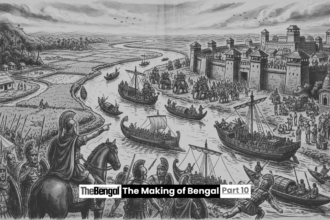
Those seven hundred exiles, according to the Mahavamsa, were placed on ships and sent out to sea, their wives and children dispatched separately on other vessels. Vijaya’s own ship eventually reached the island later called Lanka, landing, the chronicle says, on the very day the Buddha himself died in northern India. There he defeated the island’s Yakkha inhabitants with the help of a local princess named Kuveni, later married a princess from the Pandyan kingdom in South India to legitimise his rule, and became, in Sinhalese tradition, the founding ancestor of the Sinhala people, whose very name is said to derive from Sinhabahu, the lion-armed.
Myth, but Not Necessarily Empty Myth
Modern historians are understandably cautious about treating this story as literal fact. The Mahavamsa itself was composed roughly a thousand years after the events it claims to describe, written by Buddhist monks with an obvious interest in linking the island’s royal lineage to a legitimising narrative that coincided, rather conveniently, with the Buddha’s own death. Scholars examining the text point out that no contemporary inscriptions, coins or archaeological remains corroborate Vijaya as a specific historical individual, and note that the story’s more fantastical elements, a woman bearing children to a lion, chief among them, read far more like foundational myth than recorded history.
And yet dismissing the story entirely would miss something important. Many researchers treat the broader Vijaya narrative as a plausible echo of a genuine historical process: an early wave of Indo-Aryan, Prakrit-speaking settlers arriving in Sri Lanka from the coastal regions of northern India, quite possibly Bengal specifically, sometime around the sixth century BCE or earlier, bringing with them the language that would eventually develop into Sinhala. Archaeological evidence from Sri Lankan sites such as Anuradhapura and Mantai shows organised, continuously inhabited communities stretching back tens of thousands of years before any Vijaya could plausibly have arrived, meaning the island certainly was not empty territory awaiting a founding prince. What the legend may actually be preserving, in heavily mythologised form, is something closer to a memory of contact and settlement, one wave among several, arriving by sea from the Bengal-Kalinga coast and folding into an already established island society.
Either way, the story’s very existence is telling. Sri Lanka’s own foundational national chronicle, composed on the island itself, chose to root its royal origin story specifically in Vanga, Bengal, rather than any other part of India. That choice reflects, at minimum, how firmly Bengal’s coastline was already associated, in the memory of the wider region, with the kind of maritime reach capable of sending princes, exiles and settlers out across open water.
What the Ships Actually Carried
Set the legend of Vijaya aside, and the more grounded evidence for Bengal’s maritime reach toward Sri Lanka and beyond is still considerable. Kautilya’s Arthashastra, the Mauryan-era statecraft manual already discussed in an earlier chapter of this series for its detailed naming of Bengal’s textile-producing regions, also records specific knowledge of Sri Lankan pearls and gems, naming a particular pearl variety, kauleya, collected from a location called Mayurgram in Sinhala, alongside a valued gemstone called parasamudra. That level of specific, catalogued knowledge about goods from across the Bay of Bengal, recorded in a Mauryan administrative text, points to established, functioning maritime contact between the Indian mainland’s eastern coast, very much including Bengal, and Sri Lanka by at least the third century BCE, regardless of what one makes of Vijaya himself.
This matches precisely the picture built up in the previous chapter of this series: Bengal’s ports at Tamralipta and Gange exporting cotton, muslin, semi-precious beads and pottery, while importing bronze vessels, camphor and gold from Southeast Asia. Tamralipta’s own documented role, discussed earlier, in dispatching Ashoka’s son Mahinda toward Sri Lanka carrying a branch of the sacred Bodhi tree, offers a second, considerably better-attested example of Bengal’s coast serving as a literal departure point for a mission that would permanently reshape Sri Lankan religious and cultural life. Between Vijaya’s semi-legendary voyage and Mahinda’s well-documented one, Tamralipta appears twice in Sri Lankan tradition as the Bengali shore from which a founding, civilisation-shaping figure set sail.
An Empire Without an Emperor
It is worth being precise about what kind of empire this actually was. Ancient Bengal never conquered Sri Lanka, Thailand or the Malay Archipelago in any military sense, and there was no single Bengali ruler commanding fleets or garrisoning distant coastlines the way later colonial powers would. What existed instead was something more diffuse but, in its own way, just as consequential: a sustained, centuries-long pattern of ships, sailors, merchants, monks and settlers moving outward from Bengal’s ports, carrying goods, language, religion and royal legitimising myths across the bay, and returning with bronze, gold and camphor in exchange.
This was an empire built not on standing armies or administered provinces, but on tides, monsoon winds and the accumulated weight of repeated voyages, each one small on its own, but collectively substantial enough that a foundational national chronicle on the far side of the bay would, a thousand years later, still choose to trace its own royal bloodline directly back to a Bengali kingdom’s shore.
A Coastline That Launched Nations
Taken together with the previous chapter’s account of Bengal’s trading network, the Vijaya legend adds a different, more human dimension to the story of Bengal’s maritime reach. This was not simply about beads, cotton and bronze bowls changing hands at coastal entrepots. It was, in the memory of at least one neighbouring civilisation, about people, exiled princes, abducted princesses, entire shiploads of settlers, crossing the same waters that carried Bengal’s cargo, and becoming, whether through embellished legend or genuine historical migration, the foundational ancestors of another nation’s people and language.
Bengal’s ancient maritime empire, then, was never simply commercial. It was also demographic and cultural, a coastline capable, at least in regional memory, of launching the very origin story of the people living on the other side of the bay.
In the next chapter of this series, we step back from the sea and return to land, examining what everyday life actually looked like for ordinary people living in ancient Bengal, away from the ports, the courts and the epic tales of exiled princes.
Sources: Wikipedia, “Prince Vijaya” and “History of Sri Lanka”; Grokipedia, “Prince Vijaya”; Ceylon History Stories, “The Arrival of Vijaya: Founding of the Sinhala Nation”; AmazingLanka.com, “King Vijaya [543-505 BCE]”; Facts and Details, “First Humans and Prehistory of Sri Lanka”; Renaissance Sri Lanka, “Sri Lanka: A Fascinating History Marked by Its Unique Position in the Indian Ocean”; LankaWeb, “Was There Really a Prince Vijaya and Did He Arrive in Sri Lanka?”