
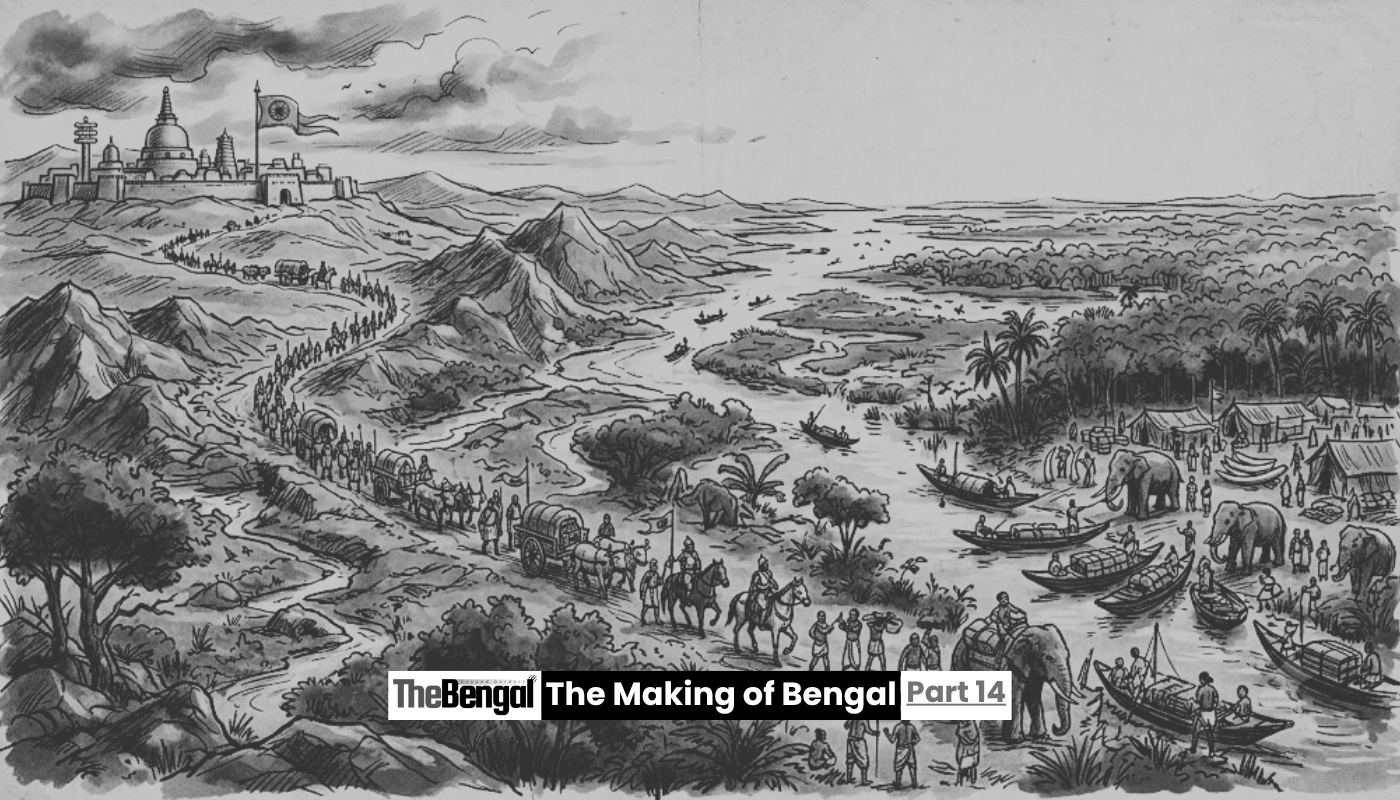

This article is part of The Making of Bengal, a long-form historical series by The Bengal. The previous chapter examined Ashoka’s religious and political investment in Bengal, from Tamralipta’s role in Buddhist missions to the monasteries later seen by the pilgrim Xuanzang. This chapter asks a more practical question: setting religion aside, what did the Mauryas actually get out of holding onto a distant, flood-prone delta at the eastern edge of their empire?
An Economy Built on Careful Bookkeeping
The Mauryan Empire was, by the standards of its time, an unusually centralised and closely managed state. Kautilya’s Arthashastra describes a government that directly owned and operated major economic activities rather than simply taxing private enterprise from a distance. Coinage, mining, salt production and shipbuilding were treated as state monopolies. Officials such as the Panyadhyaksha regulated markets and fixed wholesale prices, while a Superintendent of Commerce oversaw trade more broadly. Agriculture itself contributed heavily to state revenue, with the king’s traditional share of produce, the bhaga, set at one sixth, alongside additional irrigation taxes described in the Arthashastra.
This was not an empire content to leave its provinces to their own devices. It was one that expected every region under its control to contribute something specific, measurable and useful to the machinery at Pataliputra. Bengal, distant as it was, turns out to have contributed rather a lot.
The Fabric the Arthashastra Named by Region
Perhaps the clearest evidence of Bengal’s economic value to the Mauryas comes from textiles, and specifically from how precisely Kautilya’s own treatise names the region. The Arthashastra identifies particular areas of the empire as sources of specific, prized fabric varieties, rather than treating textile production as a generic, undifferentiated activity. Among these named regions are Vanga, corresponding to eastern Bengal, Pundra, corresponding to what is now northern Bengal, and Suvarnakudya, located in Assam, all three credited with producing a fine white and soft cloth known as dukula. Separately, Pundra is also named alongside Kashi, modern Varanasi, as a source of linen textiles referred to as kshauma.
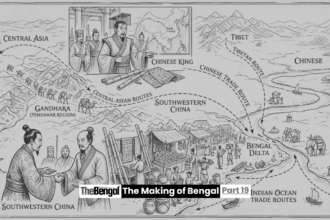
This level of specificity matters. An empire’s foundational manual on statecraft does not bother naming individual provinces for a minor or interchangeable product. The fact that Vanga, Pundra and the Assamese region of Suvarnakudya are each singled out by name for a particular textile variety indicates that Mauryan administrators understood these areas as genuinely distinct, valuable production centres, not simply undifferentiated eastern territory. Trade records from the period further note that textiles from Bengal and Assam were counted among the significant exports moving along Mauryan trade routes, alongside silks from China, wool from Nepal and hides from the Himalayan regions.
Given that the Mauryan state treated textile production as a closely regulated industry, with guilds required to employ paid labour, output stamped at the point of manufacture, and profits capped with the surplus directed to the treasury, Bengal’s dukula and linen production was not simply a matter of local craftsmanship left to its own devices. It was an economic asset actively managed as part of a much larger imperial system.
A Port That Made the Empire Global
Textiles alone would not have made Bengal indispensable. What sealed its strategic importance was geography, specifically, the port of Tamralipta on the delta’s southwestern coast, already discussed in the previous chapter of this series for its role in Ashoka’s Buddhist missions.
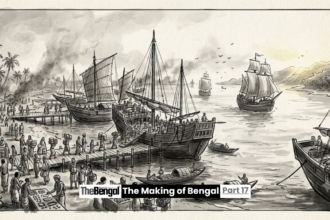
Tamralipta’s religious significance sat on top of a more fundamental commercial reality: this was the Mauryan Empire’s chief maritime gateway, the point through which communication and trade between Magadha and Sri Lanka were maintained. For an empire whose capital at Pataliputra sat well inland, hundreds of kilometres from open sea, a functioning, reliable eastern port was not a convenience. It was the only way Mauryan goods, envoys and religious missions could reach the maritime world at all from the empire’s core territory. Bengal held the key to that access, and whoever controlled Bengal’s coastline controlled the empire’s connection to the sea lanes running toward Sri Lanka and, from there, into the broader trading world of the Indian Ocean and Southeast Asia.
Wider Mauryan trade records describe an extensive network of exports, cotton textiles, spices, ivory, pearls and gems moving outward, and horses, gold and glass moving in, much of it dependent on functioning ports feeding into both overland routes and maritime channels. Bengal’s coastline, and Tamralipta specifically, formed an essential piece of that machinery, one the empire could not simply route around.
Elephants, and the Region’s Older Reputation
There is a further resource worth returning to, one this series has already encountered from a very different angle. Long before the Mauryas, Greek and Roman writers had credited the Gangaridai, the delta kingdom explored earlier in this series, with the largest and most feared war elephant corps in the region, a reputation substantial enough to help convince Alexander’s own soldiers to mutiny rather than face it. That same broader Bengal delta region, now absorbed into Mauryan territory, sat squarely within one of the areas most closely associated with elephant supply and expertise in the ancient Indian world.
Mauryan warfare depended heavily on war elephants as a distinct and valued military asset, used to break enemy lines and project imperial power, and the empire’s administrative apparatus included officials specifically dedicated to managing this resource. A region with Bengal’s established reputation for elephant strength represented more than agricultural or textile output. It represented military capacity itself, precisely the kind of asset a centralising empire, having just renounced further wars of conquest under Ashoka, would still have wanted firmly secured and available, rather than left in the hands of a potentially resurgent local power.
Rice, Revenue and a Region Worth Defending
Underlying all of this was Bengal’s agricultural wealth, discussed at length in an earlier chapter of this series devoted specifically to rice. A delta capable of producing rice surpluses substantial enough to sustain dense population growth was, from a purely administrative standpoint, a tax base worth protecting. The Mahasthan Brahmi inscription discussed two chapters ago shows precisely this kind of administrative concern in action: an imperial official directing grain and coin be released from state storehouses to manage a local crisis, evidence that Pundravardhana’s agricultural output and the government’s careful oversight of it were treated as serious state business, not an afterthought.
Put simply, Bengal offered the Mauryas a genuinely rare combination: valuable, name-checked textile production, a functioning port town linking the empire to the wider maritime world, a legendary reservoir of elephants and martial reputation, and a fertile agricultural base capable of generating steady tax revenue even during emergencies. Few frontier provinces anywhere in the empire could claim to offer all four at once.
A Frontier Worth Every Mile of the March
None of this means Bengal was ever treated as equal to the Mauryan heartland around Pataliputra, Ujjain or Taxila. It remained, throughout this period, a distant eastern frontier, administered through officials like the mahamatra recorded at Pundranagara rather than governed directly from the centre. But distance and centrality are not the same as unimportance. The specificity with which Kautilya’s own treatise names Bengal’s textile regions, the empire’s dependence on Tamralipta as its maritime lifeline, and the region’s long-standing reputation for elephants and agricultural wealth together explain why the Mauryas invested so consistently in Bengal’s administration, from famine relief decrees to religious patronage to careful economic oversight.
Bengal was not held out of imperial vanity or sentiment. It was held because it paid, quite literally, in cloth, coin, elephants and rice, for the empire’s continued reach all the way to the sea.
In the next chapter of this series, we turn to the physical cities that grew out of this Mauryan-era integration, tracing the rise of Bengal’s earliest confirmed urban centres beyond Pundranagara and Tamralipta.
Sources: Kautilya, Arthashastra, as cited in Universal Group of Institutions, “Mauryan Empire: The First Great Indian Empire”; IndianNetzone, “Trade under Mauryan Empire”; PWOnlyIAS, “Mauryan Empire Economy: Agriculture, Crafts, Trade and Urban Expansion”; English Curiosity, “Economic Conditions of Mauryan India”; Edukemy and Prepp.in, “Mauryan Economy” notes; Testbook UGC NET History, “Mauryan Economy: Agriculture, Trade, Tax System and Revenue Administration”; Wikipedia, “History of Bengal.”