

This article is part of The Making of Bengal, a long-form historical series by The Bengal. The previous chapter used terracotta evidence to reconstruct ancient Bengal’s food, clothing and toys. This chapter closes the section on trade and society by looking more closely at something harder to recover from ruins alone: the shape of family life, the position of women, and how far foreign contact reached into the way ordinary Bengalis dressed and adorned themselves.
A Family Preserved in Clay
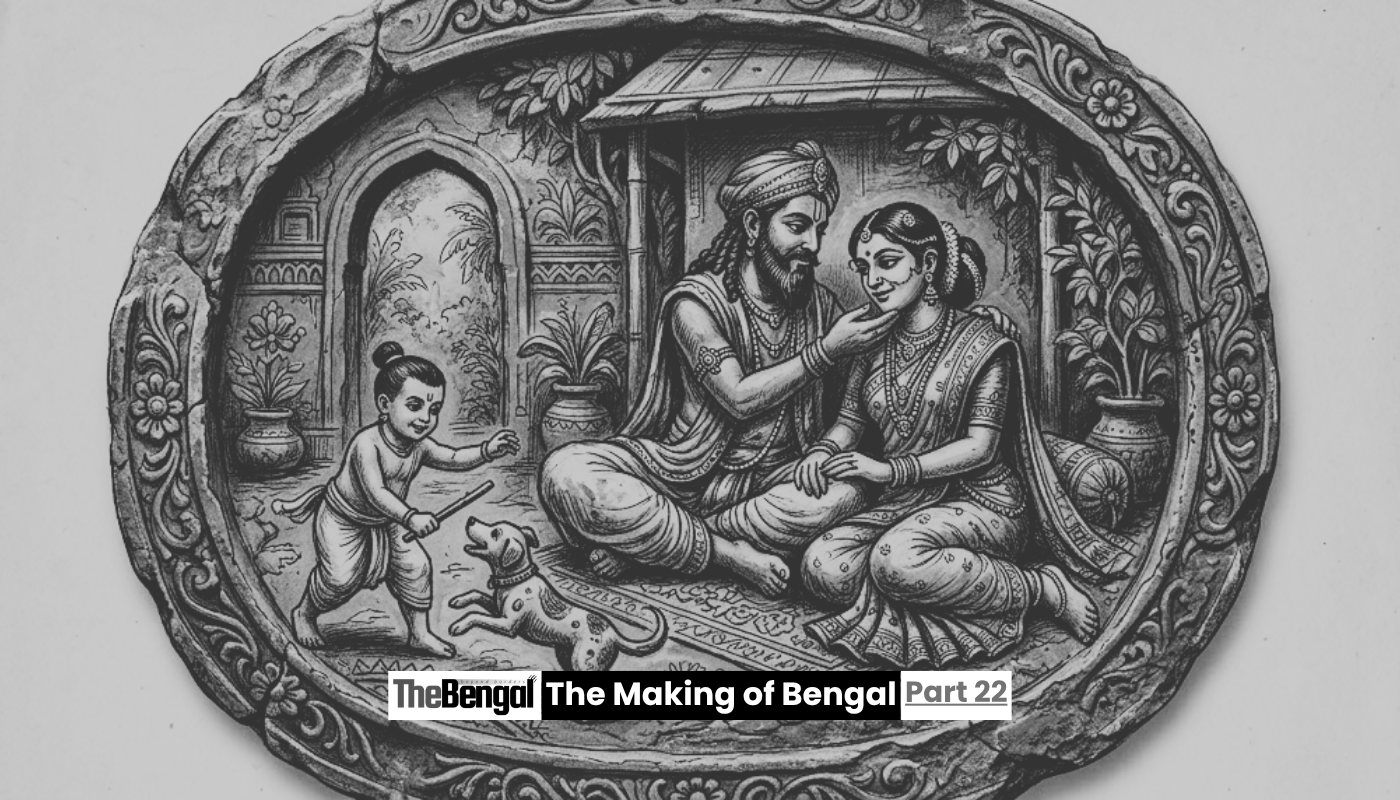
Among the thousands of terracotta objects recovered from Chandraketugarh, one plaque stands out for reasons that have little to do with grandeur or religious significance. Dated to the first century BCE and now held at the Metropolitan Museum of Art in New York, it depicts what museum curators describe as a family scene marked by an intimacy unusual in Indian terracotta art of the period. A man sits on a chair, his left hand resting on the back of his wife’s head, while she stands before him, gently touching his knees. In the foreground, a small figure believed to represent their son sits beside a dog he holds on a leash. Two ducks appear at the lower corner of the scene, and fragments of a monkey climbing the leg of the chair are visible at the far right.
Whatever ritual or votive purpose this object originally served, likely functioning as a personal cult object during the Shunga period, its lasting value today is almost accidental: a candid, tender household scene, pets included, that offers a rare and remarkably human glimpse into what family affection may have actually looked like in ancient Bengal, two thousand years before anyone thought to write it down.
A Society Divided, Even Without a Clear Caste Record
Reconstructing the social structure of ancient Bengal is notoriously difficult, and researchers studying Chandraketugarh have been candid about the limits of the evidence. Brahmanical texts of the period describe Indian society through the framework of varna and jati, while Buddhist texts use a different vocabulary entirely, organising society around kula, kamma and shilpa, lineage, occupation and craft. Because Chandraketugarh has yielded no textual record of its own describing which system, if either, applied locally, scholars examining the site have found it impossible to confidently map its population onto the traditional varna-jati hierarchy at all.
What the archaeology can support is a more grounded, material form of social stratification. Excavators have identified two broad layers of society based simply on the pottery different households used. Wealthier residents used rouletted ware, a fine pottery style also traded northward across India, and Northern Black Polished Ware, an especially prestigious ceramic associated elsewhere with early historic urban elites. Poorer households, by contrast, used cruder, locally produced wares of noticeably lower quality. It is a modest but telling kind of evidence: even without inscriptions naming ranks or castes, the pots people ate from quietly record the same economic inequality that likely shaped every other aspect of their daily lives.
The Women of Ancient Bengal, in Fragments
Recovering the specific experiences of women in ancient Bengal is harder still, and researchers working on the subject have been open about why: most surviving sources focus on the expansion of states, the administration of kings, and the deeds of rulers, leaving daily and domestic life, women’s lives above all, drastically underrepresented. What survives has to be pieced together from scattered inscriptions, literary references, sculpture and terracotta plaques rather than any single connected account.
Some of what emerges is genuinely evocative. Later inscriptions, including the Idilpur grant of Keshab Sen and the Sahitya Parishad grant of Bishwarup Sen, mention women known as shavanandinis, performers whose music and presence were prized enough in royal courts and pleasure houses that the sound of their anklets is specifically recorded as accompanying courtly gatherings, granting them a recognised, if narrowly defined, place within royal and elite society.
Other evidence points to considerably darker realities. Sources describe a long-standing custom in ancient Bengal of keeping maidservants specifically for sexual purposes, a practice discussed in some detail by the ancient scholar Vatsyayana in his Kamasutra, and researchers note that these women were treated and traded as property. It is an important and uncomfortable corrective to any romanticised picture of the past: alongside the tenderness captured in plaques like the Chandraketugarh family scene, ancient Bengali society also structured deep inequality and exploitation directly into its domestic arrangements, particularly for women without status or family protection.
Weddings, Housewives and the Painted Threshold
Marriage customs, by contrast, offer a somewhat gentler glimpse into ordinary domestic ritual. According to research into women’s roles in ancient Bengal, housewives were specifically responsible for arranging the wedding bed at the time of marriage, a practical and symbolically important task entrusted to female family members rather than outside specialists. Male family members and Brahmins, meanwhile, handled the more public and formal elements of the ceremony, including the recitation of mantras.
Women also carried out one of the most visually distinctive parts of the ritual themselves: drawing alpana, decorative patterns traditionally created using rice paste, at the site where the marriage ceremony would take place. This is, again, a tradition with striking continuity into the present day, where alpana designs remain a familiar feature of Bengali festivals and ceremonies, their roots stretching back through centuries of documented wedding custom in the region.
Fashion Shaped by Foreign Hands
Ancient Bengal’s fashion sense, as recorded in terracotta, was never purely local in inspiration. Detailed studies of unique terracotta figurines from Chandraketugarh have identified clear Hellenistic and Roman stylistic influence in the headdresses and hairstyles depicted, dated broadly to between 200 BCE and 100 CE, and attributed by researchers to immigrant communities arriving from India’s northwest, a region with its own long history of contact with the Greek and Roman world, and settling in Bengal, where they left a visible mark on local aesthetics.
One particularly striking example is a terracotta plaque depicting a Yakshi, a female tree spirit or nature deity, standing in a formal upright posture with one hand resting on her waist. She wears an unusual headdress resembling a hat, decorated with a ribbon bearing four threads and a flower motif, a style researchers identify as showing clear foreign influence rather than purely indigenous design. Her wavy hair, rendered with distinct texture and volume, further reinforces this reading of outside stylistic input shaping local religious art.
This is a genuinely important detail for understanding ancient Bengal’s broader place in the world already sketched out across this series. A region connected by sea to Rome and Southeast Asia, by overland routes to Central Asia and China, and by river to the wider Gangetic plain, was never going to develop its fashions in isolation. The headdresses on Chandraketugarh’s terracotta figures are a small, physical confirmation that the same trade networks carrying muslin, silk and cowrie shells were also carrying aesthetic ideas, absorbed and reworked by local artisans into something distinctly their own.
A Society Recovered in Pieces
What this chapter, and the one before it, have tried to do is recover something that ancient Bengal’s kings, inscriptions and classical geographers almost entirely ignored: the texture of ordinary life. A family embracing on a terracotta plaque. A poorer household eating from crude local pottery while a wealthier neighbour used fine imported ware. A housewife arranging a wedding bed while a shavanandini’s anklets rang out in a distant royal hall. A Yakshi’s headdress quietly borrowing a ribbon-and-flower motif from a craftsman who had, at some point, seen or heard of fashions from far to the west.
None of it amounts to a complete picture. Too much has been lost, looted, or simply never written down in the first place. But what survives, fragment by fragment, plaque by plaque, is enough to insist that ancient Bengal was never simply a backdrop for kings and conquerors. It was, first and always, a place where families sat together, women navigated a society that both celebrated and exploited them, and fashion quietly absorbed the whole wide trading world this series has spent so many chapters describing.
In the next chapter of this series, we turn from society to language itself, exploring what people in ancient Bengal actually spoke before Bangla emerged as the region’s defining tongue.
Sources: International Journal of Scientific Research, “Social Stratification at Chandraketugarh”; The Metropolitan Museum of Art, “Plaque with a Royal Family,” India, Chandraketugarh, Shunga period; ResearchGate, “History of Ancient Bengal: Life, Role and Participation of Women”; Academia.edu, “Foreign Influences as Noticed on Some Unique Terracotta Figurines from Chandraketugarh”; Heritage: Journal of Multidisciplinary Studies in Archaeology, “Terracotta Yakshi Plaques from Chandraketugarh.”