

This article is part of The Making of Bengal, a long-form historical series by The Bengal. Earlier chapters in this section followed Bengal’s trade routes, its ports and its silk, cotton and spice cargo. This chapter turns away from commerce and toward something more personal: what did an ordinary day actually look like for the people living in ancient Bengal, away from ports, palaces and epic battles?
A Clay Record Kept Underground
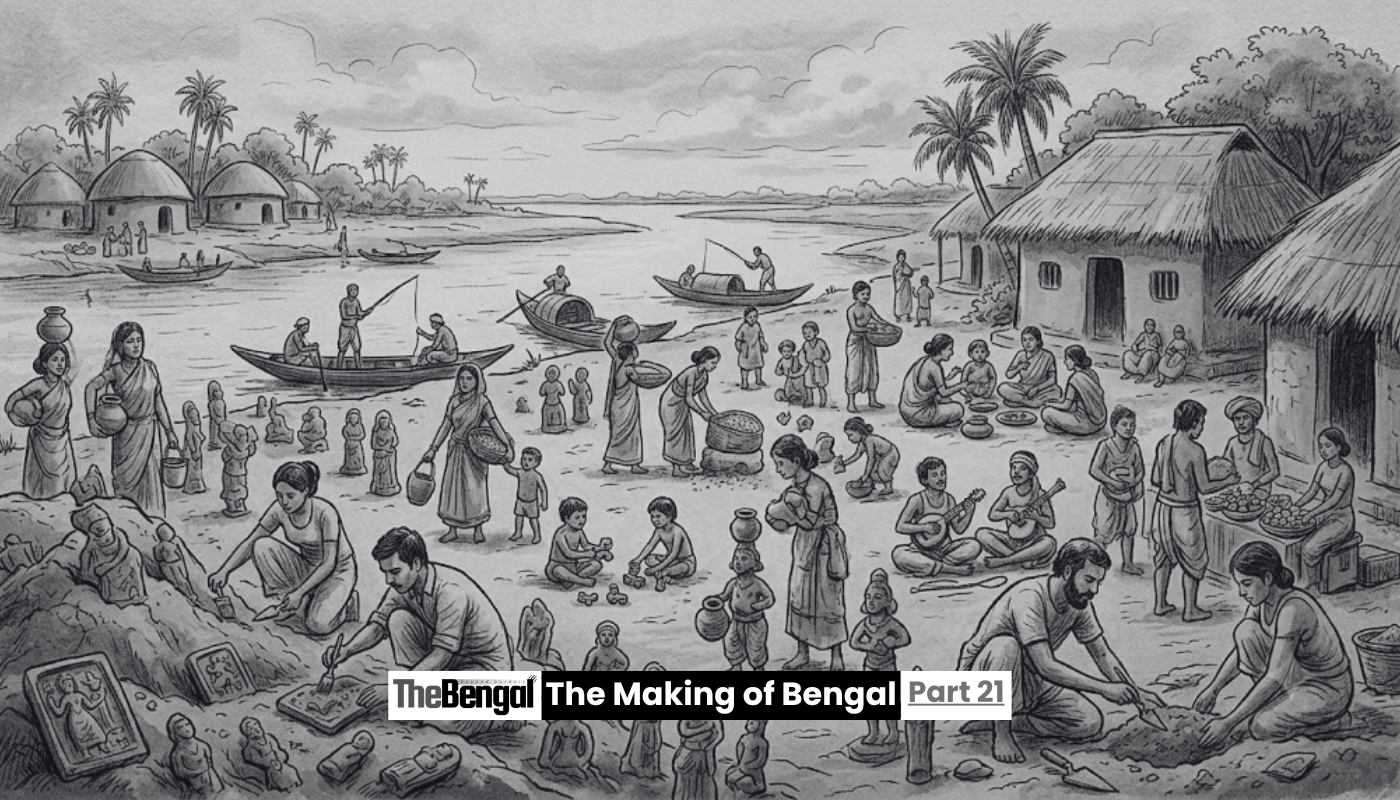
Much of what we know about daily life in ancient Bengal survives not through texts but through terracotta, small, fired clay objects that ordinary potters and craftsmen produced by the thousands across the delta’s early historic cities. Chandraketugarh alone has yielded terracotta objects, dated broadly between the third century BCE and third century CE, that together constitute the greatest number and variety of specimens from this period found anywhere in the Indian subcontinent. Similar material has also emerged from Tamluk, ancient Tamralipta, and Harinarayanpur in West Bengal, and from Paharpur and Mainamati further east in Bangladesh.
Unlike stone sculpture, which tended toward formal religious imagery, terracotta plaques and figurines captured something closer to everyday reality: household scenes, market activity, children’s toys, jewellery, hairstyles and clothing, rendered in enough physical detail that historians today can reconstruct fragments of a lived world that no inscription or classical geographer ever bothered to describe.
Rice, Fish and a Familiar Table
Start with food, and the picture that emerges from Bengal’s ancient terracotta record looks remarkably familiar to anyone who knows the region today. As explored in an earlier chapter of this series devoted to rice cultivation, the crop had already become central to Bengali life by this period, and terracotta and literary evidence confirms that fish sat right alongside it as the other pillar of the everyday diet.
Plaques recovered from Paharpur and Mainamati depict scenes of fish being cut and carried to market in baskets, ordinary commercial activity captured in clay with enough specificity that historians can identify it as a genuine slice of daily routine rather than symbolic or religious imagery. Historical sources also specifically mention the use of hilsa fish oil, a detail attributed to the medieval scholar Jimutavahana, suggesting that hilsa, still considered Bengal’s most beloved fish today, was already prized in the region many centuries ago, its oil used for various household purposes beyond simply eating the fish itself.
This is a small but genuinely moving continuity. The rice-and-fish meal considered quintessentially Bengali today was not a later invention. It was already the backbone of daily eating in the delta well over a thousand years ago, recorded not by chroniclers who considered it worth writing about, but by anonymous potters who simply modelled what they saw around them.
Dressed for the Delta’s Climate
Clothing tells a similar story of deep continuity paired with some genuine change. Men in ancient Bengal commonly wore the dhuti, a length of unstitched cloth wrapped and tied around the waist and legs, well suited to the delta’s hot, humid climate. Women wore the saree, a garment whose basic form, a single length of cloth draped around the body, has remained recognisably similar for two millennia, even as the specific styles of draping, the fabrics used and the occasions on which it is worn have shifted considerably.
What has changed is largely a matter of context rather than form. Both garments, once standard daily wear across the population, have in the present day become associated more with festivals and special occasions than with the practical, everyday clothing of an average morning, a reminder that clothing traditions can persist across centuries even while their social role within a culture continues to evolve.
Terracotta figurines from Chandraketugarh add considerable visual detail to this picture, particularly for women, depicting elaborate earrings, pendants, hairpins and ornate headdresses, evidence of a genuine local jewellery and personal adornment culture rather than simple, undecorated dress. Some figures show elaborate turbans on male subjects as well, including one seated figure wearing a turban with a distinctive conical projection, suggesting status or ceremonial distinctions were expressed through headwear in ways that later written sources rarely bother to describe.
Toys, Games and the Texture of Ordinary Life
Among the most quietly revealing objects recovered from Chandraketugarh are simple children’s toys: carts and rattles, modest, functional objects that speak less to grand civilisational achievement and more to the ordinary rhythms of family life in an ancient delta city. Alongside these appear narrative plaques depicting couples, known in art historical terms as mithuna figures, and scenes described by researchers as amorous or domestic in nature, evidence that the same urban population commissioning religious imagery and trade goods was also, in perfectly ordinary fashion, decorating its homes with scenes of everyday affection and companionship.
Deities appear frequently in this same terracotta record, including figures identified as forms of the goddess Lakshmi, bestower of riches, molded and fired in the same workshops producing toys and household wares. Religious and domestic life, in other words, were not kept in entirely separate spheres. The same clay traditions served both.
A Society Wider Than Its Cities
It would be a mistake to imagine ancient Bengal’s population as consisting only of farmers, traders and city dwellers along the lines already explored throughout this series. The same terracotta record that captures fish markets and rice cultivation also preserves scenes of deer hunting, associated specifically with forest-dwelling communities identified in historical sources as the Shabar and Pulinda, groups that lived alongside, rather than fully within, the settled agricultural and urban society this series has largely focused on so far.
This detail matters. It is a reminder that ancient Bengal was never a uniform society of rice farmers and river traders. It included distinct forest-dwelling populations with their own separate way of life, hunting and gathering in wooded tracts that existed alongside, and likely in ongoing contact and exchange with, the villages, ports and fortified towns explored elsewhere in this series. The delta’s ancient population was, in this sense, considerably more layered and varied than a single narrative of farming and trade can fully capture.
Neglect, Looting and What Has Been Lost
There is an uncomfortable postscript to this story, one already touched on in an earlier chapter of this series concerning Chandraketugarh’s broader archaeological fate. Much of the terracotta evidence that makes it possible to reconstruct ancient Bengal’s everyday life has, over the past century, been steadily removed from its original context through illegal excavation and antiquities trafficking. Objects originally recovered from Chandraketugarh’s soil now sit in museum collections around the world, including the Musée Guimet in Paris, the Linden Museum in Germany, the Ashmolean Museum in the United Kingdom, and quite possibly the British Museum and the Victoria and Albert Museum as well, scattered across institutions thousands of kilometres from the delta that produced them.
This matters for more than questions of ownership. Every plaque removed without proper documentation of where exactly it was found, and in what layer, represents a small loss of precisely the kind of contextual detail historians need to build an accurate picture of daily life at a specific place and time. What survives in museums abroad can still be studied and admired, but the fuller story those objects might have told, about which household used them, in which decade, alongside what other evidence, has in many cases already been permanently lost.
A Life Recognisable Across Two Thousand Years
Even with these gaps, what remains paints a portrait of ancient Bengal that feels surprisingly close to home. Rice and fish on the table. Cloth wrapped rather than stitched, suited to a humid climate. Children playing with clay rattles and carts. Couples and deities modelled side by side in the same household wares. Forest communities living their own separate rhythm alongside the farmers and traders explored throughout this series.
None of this was recorded because anyone thought it historically significant at the time. It survived by accident, buried in the same soil that has already given up Chandraketugarh’s coins, Wari-Bateshwar’s roads and Mahasthangarh’s inscriptions, waiting patiently to show later generations that the people who built ancient Bengal’s civilisation were not so different, in the small daily details of eating, dressing and raising children, from the people living in the same delta today.
In the next chapter of this series, we look at the languages spoken across ancient Bengal before Bangla itself emerged, tracing the linguistic world that existed beneath and alongside the region’s more famous political and religious history.
Sources: International Journal for Multidisciplinary Research, “Everyday Life of Ancient Bengal People: Food Habits and Clothing”; Grokipedia, “Chandraketugarh”; Sahapedia, “Chandraketugarh: Neglected Heritage of Bengal”; Impart, “Chandraketugarh Terracotta Objects”; Enroute Indian History, “The Legacy of Terracotta Dolls of West Bengal”; GetBengal, “The Untold Story of Chandraketugarh.”