
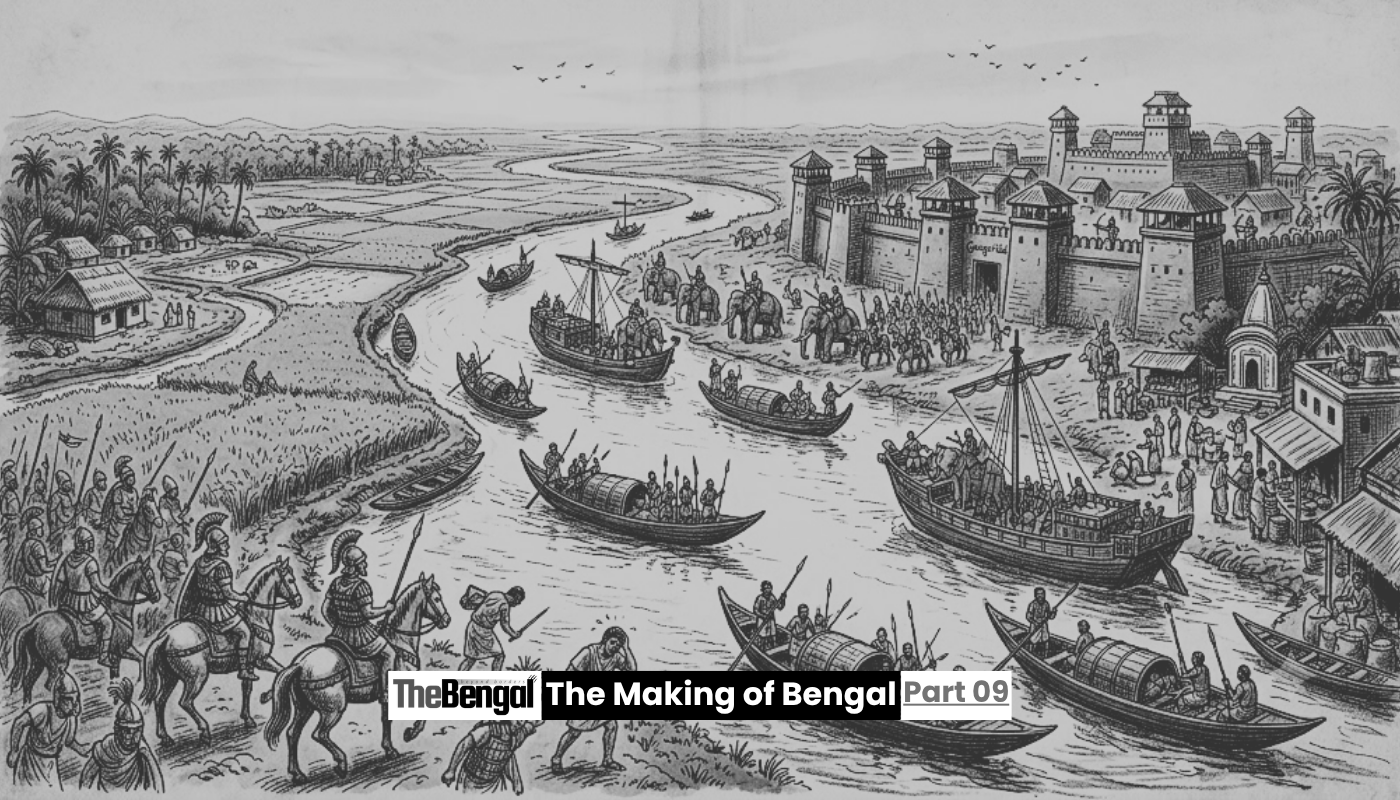

This article is part of The Making of Bengal, a long-form historical series by The Bengal. Having traced the deep geological origins of the delta, its earliest farming communities, the rise of rice, and the buried cities still being uncovered beneath its soil, we now step firmly into the world of recorded history, the moment Bengal first appears by name in the writings of the wider ancient world.
That first appearance came, fittingly enough, in the context of a conqueror choosing not to conquer.
The Man Who Had Never Turned Back
By the summer of 326 BCE, Alexander the Great had spent a decade dismantling the largest empire the world had ever seen. He had crushed the Persian Achaemenid Empire, defeated King Porus in a brutal battle at the Hydaspes River in Punjab, and pushed his exhausted Macedonian army deeper into the Indian subcontinent than any Western force had gone before. Alexander, by every account, intended to keep going. His stated ambition, according to ancient historians, was to reach the edge of the world itself.
He never got the chance. At the Hyphasis River, known today as the Beas, his own soldiers stopped him.
The Kingdom That Frightened an Army
According to the Greek historian Diodorus Siculus, writing in his Bibliotheca Historica, Alexander’s troops had by this point heard reports of what lay further east: two formidable powers, the Nanda Empire of Magadha, and beyond it, a kingdom called Gangaridai, occupying the delta of the Ganges. What they heard about Gangaridai in particular appears to have unsettled them badly.
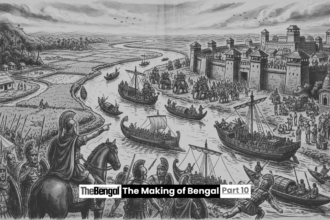
Diodorus describes the Gangaridai as possessing the largest and most numerous war elephants in the region, a force so formidable that, in his words, no foreign king had ever conquered their country, since every rival nation feared the sheer number and strength of these animals. Plutarch, writing later, put a number on the reported threat: the kings of the Gangaridai and their neighbours the Prasii were said to be waiting with an army of eighty thousand cavalry, two hundred thousand infantry, eight thousand war chariots and six thousand fighting elephants. Curtius Quintus gave a similarly staggering account of the river’s far bank, described to Alexander’s men as swarming with armed men, horsemen and elephants, guarding a crossing said to be several kilometres wide and enormously deep.
Modern historians treat these specific figures with appropriate caution, ancient chroniclers were not above exaggeration, and the numbers vary considerably between sources. What is far less disputed is the effect this intelligence had on Alexander’s army. Already worn down by years of continuous campaigning, monsoon rains, and the costly fight against Porus’s own war elephants at the Hydaspes, the prospect of facing an even larger elephant corps guarding an even wider river proved too much. When Alexander pressed his men to continue, they refused outright. His officer Coenus spoke for the exhausted troops, reportedly telling Alexander that the men longed simply to see their parents, wives and children again. Alexander, after days of trying to persuade them otherwise, relented.
He turned south instead, following the Indus toward the sea, then eventually back toward Persia and Macedon, where he would die in Babylon a few years later. The Hyphasis marked the easternmost point his empire would ever reach. Gangaridai, and the wider Gangetic world beyond it, remained the one frontier he chose to leave behind rather than fight for.
A Kingdom Known Only by Its Reputation
There is something genuinely striking about Gangaridai’s place in history: an entire kingdom, credited by multiple classical writers with turning back the most successful conqueror the ancient world had seen, and yet it appears nowhere in the surviving historical record of India itself.
This is not, in itself, unusual for the period. Ancient India relied heavily on oral tradition, what later Sanskrit sources called shruti, for preserving knowledge, and durable writing materials capable of surviving over two millennia in Bengal’s humid, flood-prone climate were scarce. As a result, virtually everything known today about Gangaridai comes from outside observers, Greek and Roman writers working from secondhand reports, merchant accounts and the occasional captured envoy, rather than from any inscription, chronicle or text produced by the Gangaridai themselves.
The name itself appears in various forms across these classical sources, Gandaridae in Diodorus, Gandaritae and Gandridae in Plutarch, and Gangaridae in Latin poetry, first coined, by some accounts, by the Roman poet Virgil. Later, in the second century CE, the geographer Ptolemy placed the Gangaridai around the mouths of the Ganges and named their capital as a city called Gange, a name apparently derived directly from the river itself.
Locating a Lost Capital
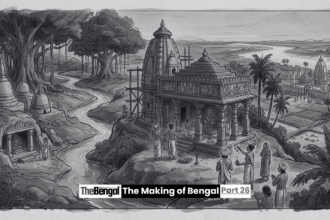
Where exactly Gangaridai was centred remains a genuine scholarly puzzle, and one this series has already brushed up against. Historian R.C. Majumdar argued that early Greek writers likely used the name Ganges loosely enough to refer to the Padma, an eastern distributary of the river, which would place Gangaridai more toward the eastern delta. Archaeologist Dilip Kumar Chakrabarti has instead located the centre of Gangaridai power near the now-dried Adi Ganga channel of the Hooghly river, identifying Chandraketugarh, the buried port city discussed in the previous chapter of this series, as the strongest candidate for its centre, with the nearby site of Mandirtala as a secondary possibility. British civil surgeon James Wise, working in the nineteenth century, instead pointed to Kotalipara in present-day Bangladesh, while archaeologist Habibullah Pathan, whose family’s decades of collecting first drew attention to Wari-Bateshwar, argued that those ruins themselves belonged to Gangaridai territory.
None of these identifications has been settled conclusively, and it is entirely possible that Gangaridai was never a single tightly centralised state at all, but a wider confederation or cultural zone spanning much of the delta, encompassing both West Bengal and Bangladesh and quite possibly reaching toward southern Bihar and Odisha as well. What virtually all serious researchers agree on, however, is the basic geography: this was a delta power, built on the wealth, fertility and defensive advantages of Bengal’s river systems, powerful enough that its reputation alone reshaped the plans of the most ambitious military campaign in the ancient world.
An Empire Defined by What It Deterred
There is an obvious irony at the heart of this story. Gangaridai’s most famous historical legacy is not a battle it won, a city it built that survives intact, or a ruler whose name is confidently known. It is a war that never happened. Alexander’s decision to turn back at the Hyphasis, driven in large part by the reputation of Bengal’s war elephants and manpower, is what preserved Gangaridai’s place in the historical record at all, immortalised by writers describing a threat they never actually had to face in open battle.
That absence of direct confrontation leaves plenty of room for doubt. Some historians, including Sir William Woodthorpe Tarn, have questioned whether the Greek accounts of Gangaridai’s military strength were accurate at all, suggesting the numbers may have been inflated, whether by frightened soldiers, opportunistic officers looking for an excuse to turn back, or simply the natural exaggeration of secondhand reports passed along an already exhausted chain of command. It is entirely possible that the real Gangaridai, whatever its true strength, was talked up into something larger and more fearsome than it actually was.
Yet even accounting for exaggeration, the underlying claim of the classical sources has held up: this was, and remained, a Bengal delta power that no foreign conqueror of the ancient world successfully subdued. Bengal enters recorded history not as a conquered province, but as the frontier a world-conquering army chose not to cross.
In the next chapter of this series, we look more closely at what archaeology and later Indian sources can tell us about Gangaridai itself, and how this delta power’s reputation for military strength connects to the wider story of ancient Bengal’s rise as an urban and commercial centre.
Sources: Wikipedia, “Gangaridai,” “Indian campaign of Alexander the Great” and “Alexander the Great”; Homegrown India, “The Lost Kingdom of Gangaridai: The Bengal Power That Stopped Alexander”; Grokipedia, “Gangaridai”; World History Edu, “Alexander the Great’s Indian Campaign”; Diodorus Siculus, Bibliotheca Historica, Books II and XVII; Plutarch, Life of Alexander.