

For more than forty years, the Teesta has been less a river than a grievance. It rises in the glaciers of Sikkim, cuts through the tea gardens of North Bengal, and finally reaches the plains of Rangpur and Nilphamari in northern Bangladesh, a lifeline for roughly 73 percent of the population in that stretch of the country, according to the Asia Foundation’s often-cited 2013 assessment of the basin. Every dry season, though, the river that floods dangerously in the monsoon shrinks to a trickle by the time it crosses the border, leaving Bangladeshi farmers staring at cracked earth where irrigation canals should be running.
That contradiction, a river that drowns Bangladesh in June and abandons it in January, is a product of geography. But the failure to manage it fairly is a product of politics. And in 2026, after nearly fifteen years of watching a signed-in-principle water-sharing deal gather dust in New Delhi, Bangladesh has done what many analysts long predicted it eventually would. It has turned to China.
A River Divided by Partition, and by Politics Ever Since
The roots of the dispute go back to 1947, when the Radcliffe Line sliced through the Teesta’s catchment and handed the upper basin to India while leaving the lower floodplain to what was then East Pakistan. Bangladesh’s independence in 1971 did not fix that imbalance. It simply gave Dhaka a seat at the table. The Indo-Bangladesh Joint Rivers Commission, formed in 1972, was meant to manage 54 shared rivers, including the Teesta, but the river’s allocation went unaddressed for more than a decade.
The first real attempt at a formula came in 1983, when an ad hoc ministerial agreement gave India 39 percent of the river’s water and Bangladesh 36 percent, leaving the remaining quarter unallocated pending further study. It was explicitly temporary, meant to last only until 1985. Four decades later, it remains the only sharing arrangement either country has actually signed, a “temporary” fix now older than most of the people who depend on it.
The real turning point came in 1998, when India completed the Gajoldoba Barrage in Jalpaiguri district, upstream of Bangladesh’s own Teesta Barrage at Dalia. Gajoldoba’s 54 gates allow India to divert the river’s flow into the Teesta-Mahananda canal system for irrigation in North Bengal, effectively giving New Delhi unilateral physical control over how much water reaches its downstream neighbor, treaty or no treaty. Bangladesh’s own barrage project, designed to support three cropping seasons a year for millions of farmers, was built on the assumption of a fair share that never materialized.
Hope arrived, briefly, in September 2011. Indian Prime Minister Manmohan Singh traveled to Dhaka with a draft agreement that would have given Bangladesh 37.5 percent of the Teesta’s dry-season flow and India 42.5 percent. Not equal, but at least fixed and legally binding. West Bengal Chief Minister Mamata Banerjee, citing concerns for her own state’s farmers, refused to travel with the prime minister and blocked the deal at the last possible moment. Because water is a state subject under India’s constitution, and because Banerjee’s party was then a critical coalition partner in New Delhi, the agreement could not proceed without her consent. It has not moved since. Successive visits by Sheikh Hasina in 2015, 2017, 2019 and 2022 produced warm statements and no signature. Banerjee’s government also floated alternative proposals, such as sharing rivers like the Torsa instead, that Dhaka never regarded as an adequate substitute.
The Legal Vacuum Bangladesh Has Been Left In
What makes the Bangladeshi position compelling is not just moral urgency but the weak legal footing India has offered in return. Customary international water law, reflected in the 1997 UN Convention on the Law of Non-Navigational Uses of International Watercourses, rests on two pillars: equitable and reasonable utilization among riparian states, and an obligation on upstream states not to cause significant harm to those downstream. India has never ratified that convention, and in practice it has treated the Teesta as a matter of domestic infrastructure policy rather than shared trusteeship, building and operating Gajoldoba unilaterally while a permanent sharing treaty sat unsigned.
Bangladesh, as the lower riparian state, has comparatively little formal leverage under international law without India’s cooperation. There is no binding international water court that Dhaka can compel Delhi into, and bilateral goodwill has been the only real mechanism at play. The 1983 ad hoc arrangement was never elevated to treaty status, the 2011 draft was never ratified, and the independent joint hydrological monitoring envisioned back in 2011 was never fully implemented either. For a country whose downstream population is essentially at the mercy of decisions made upstream, that is a precarious legal position, and it is one Dhaka did not create. Bangladeshi officials have increasingly argued, with some justification, that the absence of a treaty is itself an injustice: it allows India to make continuous unilateral withdrawals while Bangladesh has no enforceable claim to the equitable share the two governments themselves negotiated in good faith in 2011.
What the Delay Has Cost Bangladesh
The human and economic cost of this stalemate has fallen almost entirely on one side of the border. Six northern Bangladeshi districts depend directly on the Teesta for irrigation, drinking water and fisheries. During the December to March dry season, when Bangladesh has argued it needs roughly half the flow just to sustain agriculture, India has in practice retained the larger share, leaving Bangladeshi farmers to face:
- Shrinking irrigation capacity, threatening food security in a region where the floodplain accounts for around 14 percent of the country’s total cultivated land.
- Riverbed desertification and erratic flow, as reduced dry-season discharge combines with heavy siltation, turning stretches of the Teesta into sandbars for part of the year even as monsoon floods worsen elsewhere.
- Ecological degradation, with declining fish stocks and riverine biodiversity compounding the loss of livelihoods for fishing communities.
- Distress migration, as farming families in Rangpur, Nilphamari, Lalmonirhat and Kurigram lose reliable access to irrigation water and are pushed toward towns and cities.
- Climate compounding, as unpredictable Himalayan glacial melt and monsoon patterns make an already unfair allocation even less workable year to year.
Every one of these pressures has built up over more than a decade while a signed political commitment, the 2011 draft, sat unimplemented because of a dispute internal to India’s own federal politics. From Dhaka’s vantage point, it is hard not to see the Teesta impasse as a case where India’s domestic coalition arithmetic was allowed to override a bilateral commitment to a neighboring country’s food security.
Enter Beijing: The Teesta River Comprehensive Management and Restoration Project
Frustrated by the deadlock, Bangladesh began exploring Chinese assistance for a large-scale river management project as early as the mid-2010s, an idea Sheikh Hasina’s government approached cautiously given India’s known sensitivities. That caution largely evaporated in 2026. Bangladesh’s political landscape shifted after Hasina’s departure, and a February 2026 general election brought Tarique Rahman to power as prime minister. Rahman moved quickly to press the Teesta issue on a new track.
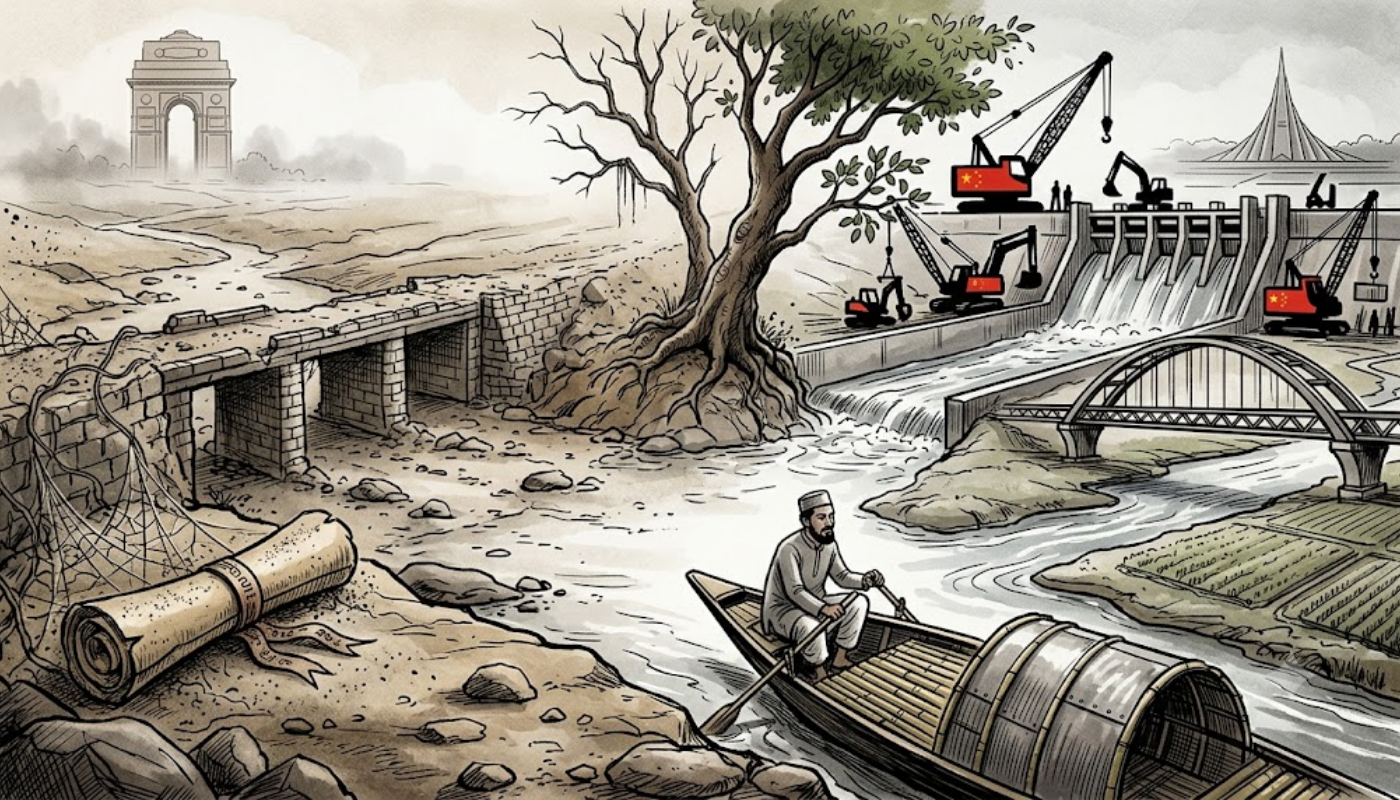
In early May 2026, Bangladesh’s foreign minister, Khalilur Rahman, met his Chinese counterpart Wang Yi in Beijing, where China signaled readiness to align its Belt and Road Initiative with the Teesta River Comprehensive Management and Restoration Project, or TRCMRP, a scheme worth roughly $1 billion aimed at dredging and rehabilitating more than 100 kilometers of the river, building embankments and reservoirs, and modernizing irrigation infrastructure. Days later, Prime Minister Rahman formally requested Chinese backing for the project.
The relationship deepened further when Rahman made a four-day official visit to Beijing in late June 2026, meeting Premier Li Qiang, National People’s Congress Chairman Zhao Leji, and President Xi Jinping, who pledged that China would remain Bangladesh’s “trusted friend.” A fifteen-point joint communiqué issued at the close of the visit committed China to supporting the TRCMRP “within its capacity,” including help expediting the project’s feasibility study, alongside broader cooperation on hydrological forecasting, flood prevention and river dredging technology. Bangladeshi officials described bilateral relations as having reached their “highest level,” with Foreign Minister Khalilur Rahman noting “significant progress” on the Teesta project specifically. Chinese foreign ministry spokesman Guo Jiakun went further, publicly framing the project as a “livelihood” initiative and rejecting the suggestion that Chinese involvement was directed against India or any third party.
Crucially, Dhaka has structured the TRCMRP as a domestic infrastructure project entirely within Bangladeshi territory: dredging, embankments and reservoirs on the Bangladeshi stretch of the river rather than a renegotiation of cross-border allocation. That framing matters diplomatically. It allows Bangladesh to argue it is simply exercising its sovereign right to manage water resources within its own borders, sidestepping the transboundary allocation dispute that India has been unable to resolve internally for over a decade.
Reading the Regional Reaction
India has not stayed silent. Its Ministry of External Affairs has said it will factor “all related developments” into its approach to Bangladesh, and Indian security analysts have voiced concern that Chinese engineering activity so close to the Siliguri Corridor, the narrow strip of land sometimes called the “Chicken’s Neck” that connects India’s mainland to its northeastern states, carries strategic as well as hydrological implications. Those concerns are genuine and worth acknowledging as part of a full picture. No country welcomes a geopolitical rival’s state-owned enterprises operating near its most sensitive connectivity corridor, and it is fair for Indian planners to weigh that risk.
But it is worth being clear about how this situation arose. Bangladesh did not seek out Chinese involvement in a vacuum. It did so after fifteen years of a stalled agreement that India itself negotiated and initialed in 2011, and after repeated summit-level assurances from Delhi that yielded no ratified treaty. A newly elected Bangladeshi government facing acute water stress in its northern districts, and holding no enforceable legal claim under a treaty that was never signed, was left with limited options. Pursuing infrastructure investment for a domestic river-restoration project, while continuing, as officials in Dhaka have stressed, to regard India as its “most important partner,” is a reasonable exercise of sovereignty rather than a hostile pivot. Indian commentary that frames Dhaka’s move primarily as provocation risks obscuring a more basic point: the leverage China now has in this dispute exists largely because India did not use the leverage it already had to close the deal on its own terms.
There has been one recent development that may reopen the door. The BJP’s victory in the 2026 West Bengal state elections ended Mamata Banerjee’s long tenure as chief minister, removing the single most consistent obstacle to a Teesta agreement over the past fifteen years. Whether a new state government in Kolkata will actually reverse course, given that electoral considerations in North Bengal shaped Banerjee’s opposition and could still constrain her successors, remains to be seen. Bangladeshi officials have said plainly that they welcome renewed Indian engagement but “cannot simply sit and wait.” That is a defensible position for a government whose citizens have waited since 1983 for basic clarity on a river that determines whether their fields flood or fail.
The Teesta dispute is, at its core, a story about what happens when a downstream state has no enforceable claim to water it depends on for survival. Bangladesh has spent four decades negotiating in good faith, accepting an “ad hoc” formula that was supposed to last two years but has lasted forty, and watching a fully drafted 2011 treaty die because of a dispute inside India’s federal system that had nothing to do with Dhaka. Turning to China for a domestically contained river-restoration project is not a betrayal of the relationship with India. It is the predictable consequence of a vacuum India itself created and has so far failed to fill. Whether the renewed opening in West Bengal politics translates into an actual treaty, or whether Bangladesh’s engineering-led, China-backed path becomes the de facto solution to a problem India would not solve diplomatically, will shape not only the future of the river but the credibility of India’s claim to be the region’s indispensable partner.