


China and Bangladesh like to talk about their relationship as something new, built on modern trade deals and state visits. But the truth is far older and far stranger. This friendship has been alive for well over two thousand years, carried across deserts and oceans by monks, merchants, sailors, and even the occasional gifted animal. Long before either country existed in its current form, people from these two lands were already learning from each other, trading with each other, and in some cases, falling for each other’s culture completely.
Monks Who Crossed a Desert for Bengal
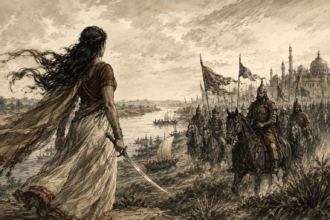
The story begins not with kings, but with pilgrims. In 399 CE, a 63 year old Chinese Buddhist monk named Fa Hien set out along the southern Silk Route from Chang’an, becoming the first recorded Chinese traveler to reach the lands that are now Bangladesh, India, Pakistan, Nepal, Sri Lanka, and Indonesia. He spent two years in Bengal, deeply moved by the region’s devotion to Buddhism, and marveled at the bustling international port of Tamralipta, from which Bengali textiles, sugar, spices, and rice were shipped out to Sri Lanka, Sumatra, Java, and beyond.
A century later came Hiuen Tsang, arguably the most famous of all Chinese travelers to the subcontinent. Arriving around 629 CE, he spent years studying under the great Buddhist scholar Shilabhadra, a native of what is now Chandina in Comilla, and later documented his journey in his renowned travelogue on the western regions. He also studied and lived at Nalanda University, then the intellectual heart of Buddhist Asia, alongside another Chinese scholar monk, I Tsing, who journeyed to Bengal around 617 CE and spent roughly three decades traveling and studying across the subcontinent, eventually compiling two books, including a Sanskrit dictionary.
These monks did far more than simply visit. Their translations of Buddhist scriptures into Chinese, along with their firsthand accounts of Bengal’s monasteries at Mahasthangarh, Vikrampur, Paharpur, and Karnasuvarna, carried Bengali Buddhist thought deep into East Asia and kept it alive there for centuries.
The Silk Route’s Forgotten Bengali Chapter
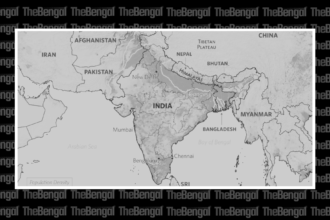
Long before container ships existed, the Silk Route connected Bengal to China, allowing Chinese silk and wool to flow into the subcontinent while spices and fine cloth traveled the other way. Historians note that Chinese travelers frequently boarded Bengali ships at Tamralipta to sail home by way of Sri Lanka, and that Buddhist missionaries used the same vessels to carry their faith onward to China and Japan. This maritime trade network flourished for centuries until the decline of Rome and the rise of Arab controlled sea routes slowly pushed it into obscurity by the ninth century.
When Sultans and Emperors Became Pen Pals
The relationship resurfaced dramatically in the 14th century. Under the Ilyas Shahi dynasty, Sultan Ghiyasuddin Azam Shah of Sonargaon personally initiated diplomatic contact with China, sending goodwill envoys whose names, including Syed Mohammad, Bayazid, Osman, Ziaul Ahmed, and Nasir, were recorded in Chinese chronicles of the Ming era. Between 1408 and 1439, Bengal’s Sultans dispatched envoys to China on multiple occasions, and Chinese emissaries, including the legendary admiral Zheng He, made repeated visits to Sonargaon and Pandua.
The most talked about episode of this era arrived in 1414, when Sultan Saifuddin, son of Ghiyasuddin, presented Chinese Emperor Yongle with an African giraffe as a token of friendship. The animal was so unfamiliar to the Chinese court that it caused a sensation, a diplomatic gift unlike anything China had ever received before.
Zheng He’s own voyages were staggering in scale. Between 1421 and 1431, he commanded fleets of fifty to sixty ships and roughly 27,000 to 28,000 sailors, visiting some thirty countries including Bengal. Chinese envoys who traveled to Sonargaon described sailing from Sumatra to Chittagong in twenty days, then continuing by smaller boats along roughly 250 kilometers of river to reach Sonargaon, where they were received with grand ceremony at the Sultan’s guesthouse.
A Bengali Monk Who Became a Legend in Tibet and China
No account of this relationship is complete without Atish Dipankar, the Buddhist scholar born in 982 CE in the village of Bajrayogini in Vikrampur. After attaining enlightenment at 29, he traveled to Tibet in 1038 at the invitation of the king of Guge, where he spent around sixteen years and authored more than two hundred texts on Buddhist philosophy. He is remembered as the first Bengali known to have tasted tea in China, and his influence on Buddhist thought across China and Tibet was so profound that many feared Buddhism itself might fade if he ever returned home.
Trade, Crops, and Everyday Exchange
This connection was not only spiritual or diplomatic. It reshaped everyday life on both sides. Silk cultivation and weaving techniques from China’s Sichuan and Yunnan regions eventually spread to Bengal and India, as did tea and sesame cultivation, which originated in Yunnan and Guizhou. Iron smelting knowledge traveled from China into Bengal, while Bengali crops such as gourds, pumpkins, pears, eggplants, and sugarcane made their way to China. Rice cultivation itself is believed to have first taken root in Yunnan and India’s Assam region, showing just how deeply intertwined these two civilizations’ agricultural histories became.
From Colonial Rupture to a New Republic’s Friendship
The bond frayed in the 17th century under aggressive British colonial rule, but it did not stay broken for long. After the partition of India, ties resumed, and the 1950s visit of Chinese Premier Zhou Enlai helped rebuild a close relationship with what was then East Bengal. During this period, a young nationalist leader named Sheikh Mujibur Rahman visited China twice at the Premier’s invitation, forging personal friendships with figures like Mao Zedong, Zhou Enlai, Zhu De, and Liu Shaoqi.
In 1978, this centuries old friendship produced one more deeply symbolic gesture. Chinese and Bangladeshi Buddhist associations arranged for a portion of Atish Dipankar’s relics to be brought back to Bangladesh from Beijing, where they remain preserved today at Dharmarajika Buddhist Temple in Dhaka, a tangible link between two civilizations separated by geography but united by a friendship older than most recorded history.
2026: A New High Point in an Old Friendship
Fast forward to today, and the relationship shows no sign of slowing down. In June 2026, Bangladesh’s Prime Minister Tarique Rahman made his first official overseas trip as head of government to China, visiting from June 22 to 26 at the invitation of Chinese Premier Li Qiang. The visit began with the Summer Davos meeting in Dalian before moving to Beijing, where Rahman met President Xi Jinping at the Great Hall of the People.
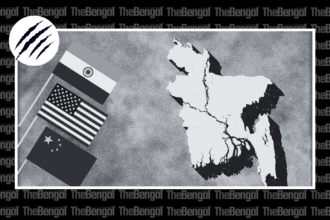
The two sides announced they would build a “China Bangladesh community with a shared future in the new era,” effectively elevating their comprehensive strategic cooperative partnership to the highest level of engagement China offers any bilateral partner. Xi told Rahman that no matter how the world changes, China will remain a trustworthy friend, neighbor, and partner to Bangladesh.
The joint communiqué that followed covered remarkable ground. China pledged support for Bangladesh’s bid to join BRICS and to become a partner of the Shanghai Cooperation Organisation. Beijing also offered backing for the Teesta River Comprehensive Management and Restoration Project, agreed to push forward the modernisation of Mongla Port, and confirmed plans for a Chinese economic and industrial zone in Chattogram along with a second industrial zone in Mongla. Bangladesh, for its part, welcomed zero tariff treatment across all tariff lines for its exports and promised favourable conditions for Chinese businesses operating in the country.
Beyond trade and infrastructure, the two countries agreed to deepen cooperation in green energy, digital technology, artificial intelligence, healthcare, education, and defence, and to advance the China Myanmar Bangladesh Economic Corridor for wider regional connectivity. Bangladesh also reaffirmed its commitment to the One China policy. Foreign Minister Khalilur Rahman later called the outcome the highest step Bangladesh has ever reached in its bilateral engagement with China. Seen against the backdrop of everything that came before, from Fa Hien’s two year pilgrimage to Zheng He’s fleet of giant ships to a giraffe crossing an ocean as a gift, the 2026 agreement feels less like a diplomatic milestone and more like the latest page in a very long, very human story. Two civilizations, separated by mountains and seas, have spent two and a half thousand years finding reasons to stay close. If history is any guide, they are not about to stop now.