

China has reiterated its commitment to developing the Bangladesh–China–Myanmar Economic Corridor (BCMEC), describing it as a regional connectivity initiative that could strengthen economic cooperation and eventually support the repatriation of Rohingya refugees.
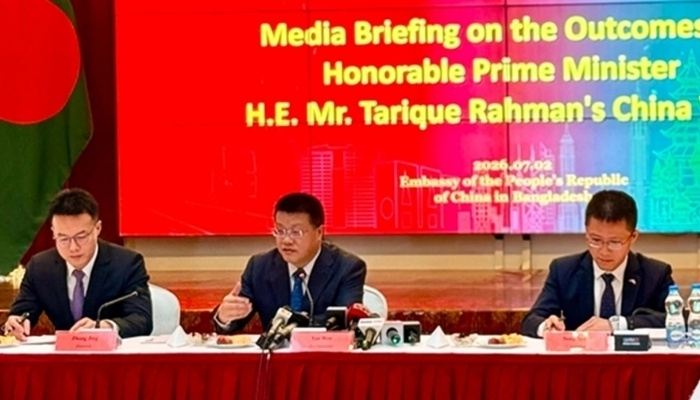
Speaking at a press conference at the Chinese Embassy in Dhaka, Chinese Ambassador Yao Wen said the proposed corridor is intended purely to improve regional connectivity and promote shared economic growth.
“This is purely a connectivity project. Our entire purpose is regional economic cooperation,” the ambassador said.
Responding to a question about whether countries such as India could join the initiative, Yao said the corridor remains open to participation from other countries.
The briefing followed Prime Minister Tarique Rahman’s official visit to China from June 22–26, during which Bangladesh and China agreed to elevate their relationship by establishing a Bangladesh–China Community for a Shared Future.
During the visit, the two countries signed 17 memorandums of understanding (MoUs) and agreements covering a wide range of sectors. These included cooperation under the Global Development Initiative (GDI), the development of a Chinese Special Economic Zone in Anwara, Chattogram, and the modernization and expansion of Mongla Port.
China also proposed launching a 2+2 dialogue involving diplomatic and defence officials from both countries. In addition, Beijing raised the Bangladesh–China–Myanmar Economic Corridor and pledged support for a joint feasibility study on the Teesta River management project by experts from Bangladesh and China.
Yao said the economic corridor could play a constructive role in addressing the Rohingya crisis over the long term by creating conditions that may facilitate the safe and sustainable repatriation of displaced people.
The ambassador recalled that China had earlier proposed the Bangladesh–China–India–Myanmar Economic Corridor (BCIM), but the initiative failed to move forward because India did not show interest.
When asked about the security situation in Myanmar, Yao said China would need to work closely with the Myanmar authorities on issues related to the corridor and regional stability.
On the proposed Teesta River management project, he said the initiative is designed to improve the livelihoods of nearly 10 million people in northern Bangladesh.
“This is cooperation between Bangladesh and China, not anybody else,” he said, rejecting suggestions that the project was directed against any third country.
Describing Prime Minister Tarique Rahman’s visit as a major diplomatic achievement, Yao said it had opened a new chapter in bilateral relations.
“It is a complete success. It is a milestone in Bangladesh–China relations, which have reached a new strategic height,” he said, adding that the visit had further strengthened mutual trust between the two countries.
On defence cooperation, the ambassador said it remains an important part of the broader Bangladesh–China partnership but declined to comment on any specific defence procurement plans.
Chinese Embassy Director Zhang Jing and Counsellor Song Yang also attended the press briefing.