

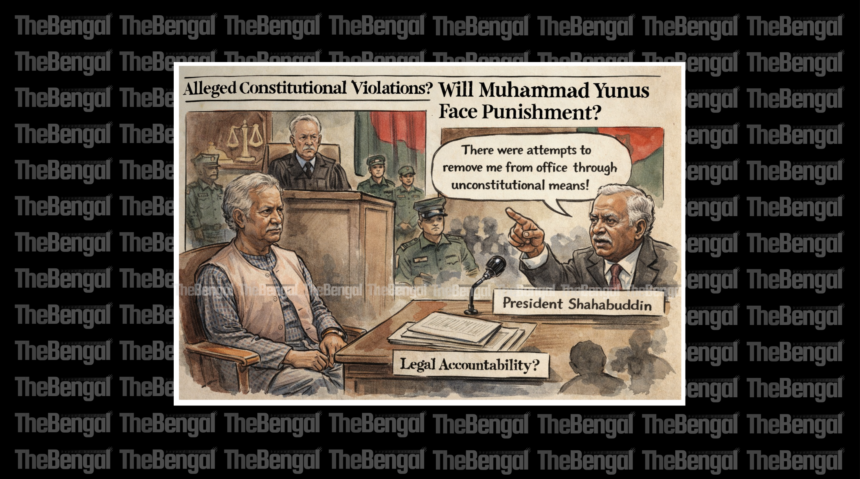
DHAKA: The formal transfer of power from the interim administration to an elected government was expected to bring closure to a politically sensitive period. Instead, it has triggered a new wave of constitutional debate. The 18-month tenure of Chief Adviser Muhammad Yunus is now under scrutiny following serious allegations raised by President Mohammad Shahabuddin.
In a detailed interview reflecting on his time during the interim government, the President described what he characterized as an extended period of political isolation, institutional marginalization, and pressure to relinquish office. His remarks were not merely personal recollections. They carried constitutional weight. If the claims are substantiated, they could raise fundamental concerns about how executive power was exercised during the interim period.
Alleged Attempts to Remove the President
At the core of the controversy are claims that efforts were made to remove the sitting President through unconstitutional means. President Shahabuddin suggested that political negotiations were conducted in a way that could have led to his forced exit if sufficient political alignment had been achieved. He further alleged that, at one stage, there was discussion of installing a former Chief Justice in his place outside the formal constitutional removal process.
Bangladesh’s Constitution provides a structured and clearly defined procedure for removing a President. Any attempt to bypass that process would represent a direct violation of constitutional order. However, it is important to note that these remain allegations presented by one side of the political equation. No judicial body has yet examined or verified the claims.
More Read
If such actions were seriously pursued, they would represent not simply a political dispute but a test of institutional integrity. The presidency, though largely ceremonial in some respects, represents the symbolic continuity of the state. Undermining that office outside constitutional channels would have far-reaching implications.
Breakdown in Executive Coordination
The President also alleged a significant breakdown in communication between his office and the Chief Adviser. According to him, he was not briefed following multiple foreign visits undertaken by Muhammad Yunus, despite constitutional provisions that require executive coordination. He claimed he was blocked from attending international engagements, including high-level events in Kosovo and Qatar, and that decisions about his participation were made without consultation.

Such claims raise broader concerns about the interpretation of executive roles during the interim period. In parliamentary systems, executive authority is often concentrated in the head of government. Yet constitutional norms require coordination with the head of state, particularly in matters of foreign affairs and formal representation. If communication channels were deliberately severed, it suggests institutional friction that goes beyond routine political disagreement.
The President portrayed these actions as part of a deliberate effort to minimize his visibility both domestically and internationally. Whether that interpretation reflects political tension or constitutional overreach remains to be determined.
Institutional Marginalization and Symbolic Power
Beyond procedural disputes, President Shahabuddin described symbolic measures that he believes were intended to weaken his office. He alleged that his official portrait was removed from Bangladeshi diplomatic missions abroad, that his press wing was dismantled, and that his official messages were excluded from national publications marking important state occasions.
Symbolism matters in constitutional democracies. The presence of a President’s portrait in diplomatic missions represents state continuity rather than individual power. Similarly, press releases and ceremonial messages reinforce institutional legitimacy. The removal or suspension of these practices, if politically motivated, would indicate a deeper contest over institutional authority.
These steps, according to the President, were designed to reduce his exposure and prepare the ground for his possible removal. While critics may argue that interim administrations often reshape administrative arrangements, the constitutional implications of sidelining a sitting President are significant.
Civil-Military Reassurances
Another sensitive aspect of the President’s remarks involved the role of the armed forces. He stated that the chiefs of the three services reassured him of their support in defending constitutional continuity during moments of crisis, including protests near the presidential residence.
The involvement of military leadership in affirming constitutional order can be interpreted in different ways. On one hand, it may reflect institutional commitment to stability. On the other, it raises important questions about civil-military boundaries in politically charged contexts. In constitutional democracies, the armed forces are expected to remain neutral and subordinate to civilian authority. Even statements of reassurance can become politically consequential in tense environments.
Political Alignments and the Role of Opposition
In his account, President Shahabuddin credited the Bangladesh Nationalist Party and its then acting chairman Tarique Rahman for supporting constitutional continuity. He suggested that their refusal to endorse removal efforts prevented the situation from escalating.
This acknowledgment reshapes elements of the political narrative surrounding the interim period. It also underscores how constitutional disputes often intersect with strategic political calculations. Support for procedural continuity may arise from principle, political interest, or a combination of both.
The Question of Legal Accountability
The central issue now is whether these allegations will lead to formal legal action against Muhammad Yunus or members of the interim administration. Accountability in constitutional democracies is determined not by interviews or political statements but by due process.
For punishment to occur, formal complaints must be filed, evidence must be presented, and courts must independently assess whether constitutional provisions were violated. The new elected government faces a delicate decision. Initiating legal proceedings could reinforce the supremacy of constitutional norms. It could also deepen political polarization if perceived as retribution.
Bangladesh’s constitutional framework allows for investigation and prosecution if public officials exceed their authority. However, such actions require careful institutional balance to ensure they strengthen, rather than weaken, democratic stability.
Beyond Individuals: A Test of Institutional Strength
This controversy is larger than any individual. It is ultimately about the resilience of Bangladesh’s constitutional order during political transitions. Interim governments are expected to maintain neutrality and preserve institutional integrity. If constitutional boundaries were stretched, the precedent could affect future transitions.
At the same time, competing narratives are common after contentious political periods. Allegations require impartial investigation. Democratic strength lies not in suppressing claims but in examining them transparently and lawfully.
Whether Muhammad Yunus faces punishment will depend on evidence, judicial independence, and political maturity. The outcome will signal how Bangladesh defines accountability in moments of institutional stress.
The interim chapter has ended. The constitutional reckoning, however, may just be beginning.