

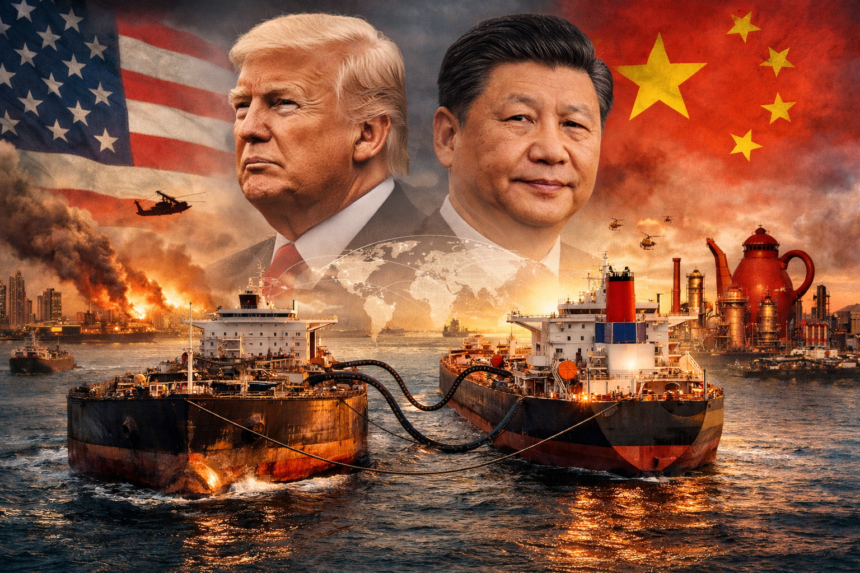
DHAKA: Across the world’s busiest shipping lanes, a hidden drama unfolds every day. Near Singapore’s coast, tankers frequently conduct ship-to-ship (STS) transfers—moving crude from one vessel to another. While some of these operations are routine, many take place in legal and regulatory gray zones, just outside Singapore’s port limits. Here, vessels can avoid hefty port charges while operating in waters that are technically under Malaysian jurisdiction but lightly enforced. It is in these in-between zones that the global oil trade’s shadow economy thrives, forming what can be described as a “dark fleet.”
These dark fleets are central players in a global contest over energy, finance, and geopolitical influence—what can aptly be called the Great Oil Battle. To understand their significance, it helps to examine the bifurcated structure of modern oil trade. System A, controlled largely by the United States and Western institutions, governs the legal and financial infrastructure of oil: which tankers carry crude, which ports can unload, how insurance is issued, and how payments flow through dollar-based banking networks. Insurance, issued mainly through Western-dominated Protection and Indemnity (P&I) clubs, is the linchpin. Without it, tankers cannot dock at most ports, giving the West enormous leverage to enforce sanctions against countries like Iran, Venezuela, or Russia.
Yet sanctions have limitations. This is where System B emerges—a parallel, largely Chinese-influenced framework that operates with remarkable flexibility. Chinese entities purchase aging tankers through shell companies, transporting crude from sanctioned producers while switching off tracking transponders to avoid detection. These tankers rendezvous in gray-zone waters, transferring oil into legally insured vessels and often blending shipments with legitimate crude, creating a façade of compliance. The oil is then sent to China’s eastern coast, particularly Shandong province, where privately owned “teapot refineries” process it. These refineries are nimble: names, ownership structures, and corporate registrations can be changed quickly to evade sanctions. Transactions are often conducted in Chinese yuan, bypassing the US financial system entirely.
The implications of this shadow system extend far beyond the oil industry. For the United States, it represents a direct challenge to dollar dominance and the efficacy of sanctions, weakening its traditional tools of geopolitical leverage. For China, it creates a flexible mechanism to secure energy supplies and strengthen strategic alliances with sanctioned producers. Meanwhile, countries like Venezuela, Russia, and Iran find a lifeline in this system, enabling them to sell oil outside Western control.
This energy rivalry, often hidden beneath maritime operations and complex financial networks, directly shapes global conflicts and crises. Venezuela’s political turmoil, for instance, is not simply an internal issue; it is a critical node in the Great Oil Battle. Local conflicts, uprisings, and even proxy wars often reflect deeper contests over energy flows, financial dominance, and access to critical resources. What appears as regional instability is, at its core, a chessboard where major powers—primarily the US and China—maneuver for strategic advantage.
The stakes are immense. The Great Oil Battle affects not only the global economy but also the prospects for peace. Energy security is increasingly linked to conflict zones, while the erosion of dollar dominance and the emergence of alternative financial networks complicate diplomatic solutions. As shadow fleets and gray-zone trading expand, every regional crisis has the potential to ripple globally, turning localized disputes into strategic flashpoints.
Ultimately, the Great Oil Battle is more than an energy competition—it is a struggle for influence, control, and the rules that govern the modern world. Behind every sanctioned shipment, every maritime maneuver, and every teapot refinery lies a contest whose outcomes will shape global peace, stability, and the future of international order.