
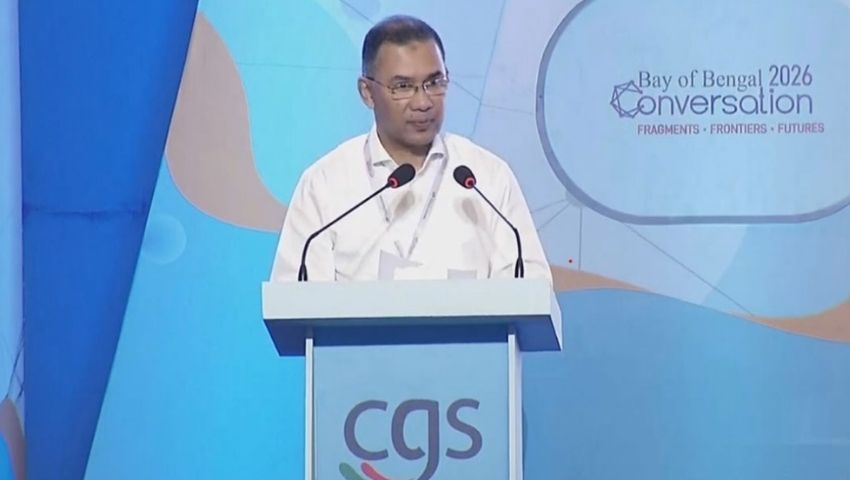

Bangladesh wants to transform the Bay of Bengal into a centre of regional cooperation and shared prosperity, Prime Minister Tarique Rahman said at the opening of the Bay of Bengal Conversation 2026 in Dhaka on Saturday.
Speaking at the inaugural session of the three-day international conference, the prime minister highlighted the potential for deeper cooperation among countries around the Bay of Bengal in trade, energy, education, technology, climate action and maritime affairs. He said stronger regional partnerships could create new opportunities for economic growth while strengthening connections among countries across South and Southeast Asia.
The fifth edition of the Bay of Bengal Conversation is being held from October 3 to 5 at the Pan Pacific Sonargaon in Dhaka. The event is organised by the Centre for Governance Studies (CGS) under the theme “Fragments, Frontiers and Futures: Navigating Power, Technology and Trust in a World Rewritten.” Organisers said the conference has brought together more than 200 speakers, over 300 delegates and more than 1,000 participants from more than 100 countries.
The prime minister said Bangladesh’s geographical and strategic position gives the country significant opportunities to connect more closely with the global economy through its seaports, waterways and coastal economy. He pointed to the potential of shipping, fisheries, tourism, energy and regional supply chains as areas where greater cooperation could generate economic opportunities.
The Bay of Bengal has increasingly emerged as an important strategic area linking South Asia with Southeast Asia and the wider Indo-Pacific. The organisers of the conference say the region is becoming increasingly important in discussions surrounding maritime security, connectivity, trade, energy, climate resilience, technology and geopolitical competition.
Beyond regional cooperation, Tarique Rahman outlined several domestic development priorities during his address. He spoke about plans to introduce a Family Card, Farmer Card, Health Card and Universal Card as part of efforts to expand government support and services for disadvantaged sections of society.
On healthcare, he referred to a plan to recruit 100,000 health workers, with women expected to account for around 80 percent of the new workforce. The initiative, according to the address, is intended to expand access to healthcare services and strengthen delivery at the community level.
Education was another major focus of the speech. The prime minister outlined plans to provide free school uniforms, schoolbags, midday meals and scholarships from the first grade. He also highlighted the expansion of technical and vocational education, opportunities for learning a third language and wider access to free education for girls through the undergraduate level.
Youth employment and skills development were also given significant attention. Tarique Rahman said Bangladesh needs to prepare young people for a rapidly changing global economy by expanding technological education, artificial intelligence, innovation, entrepreneurship and startup opportunities. The government has separately outlined a strategy to connect highly educated Bangladeshis living abroad with domestic education, research and innovation networks as part of an effort to turn “brain drain” into “brain circulation.”
Agriculture, described as a foundation of the economy, also featured prominently in the prime minister’s address. He spoke about improving access to technology, irrigation, agricultural finance and markets while supporting fisheries, livestock and rural entrepreneurs. Greater emphasis is also being placed on agro-processing and expanding exports of agricultural products.
Water management and environmental protection formed another major part of the government’s development plans. The prime minister referred to a target of excavating and re-excavating 20,000 kilometres of canals and waterways over the coming years. The government has already launched a nationwide canal excavation and re-excavation programme, with the stated objectives including improving irrigation, strengthening water management and increasing the availability of surface water.
He also referred to plans to move forward with the Padma Barrage project and develop a comprehensive plan for the Teesta. On environmental protection, the government has set a target of planting 250 million trees over five years, alongside efforts to expand solar power, recycling and environmentally friendly industries. The 250-million-tree target and 20,000-kilometre waterway programme have been identified as major components of the government’s environmental agenda.
The Rohingya crisis was also addressed during the speech. Tarique Rahman said Bangladesh continues to host around 1.2 million Rohingya refugees and stressed that their return to Myanmar should be voluntary, safe, dignified and sustainable. He called for continued international political support and financing to help resolve the crisis.
On regional relations, the prime minister said Bangladesh wants to expand cooperation in trade, energy, education, technology, climate and maritime sectors while protecting national interests and sovereignty. He emphasised dialogue, mutual respect and engagement with regional and global partners.
The Bay of Bengal Conversation 2026 is designed as a platform for discussions on major geopolitical, economic, technological and environmental challenges. Its five central pillars are power in transition, the technology frontier, the new economic geography, climate resilience and human security, and trust, democracy and governance.
With policymakers, diplomats, business leaders, researchers, academics, journalists and other experts attending from around the world, the conference places Dhaka at the centre of a wide-ranging discussion on the future of the Bay of Bengal and its connection to the broader Indo-Pacific region.