
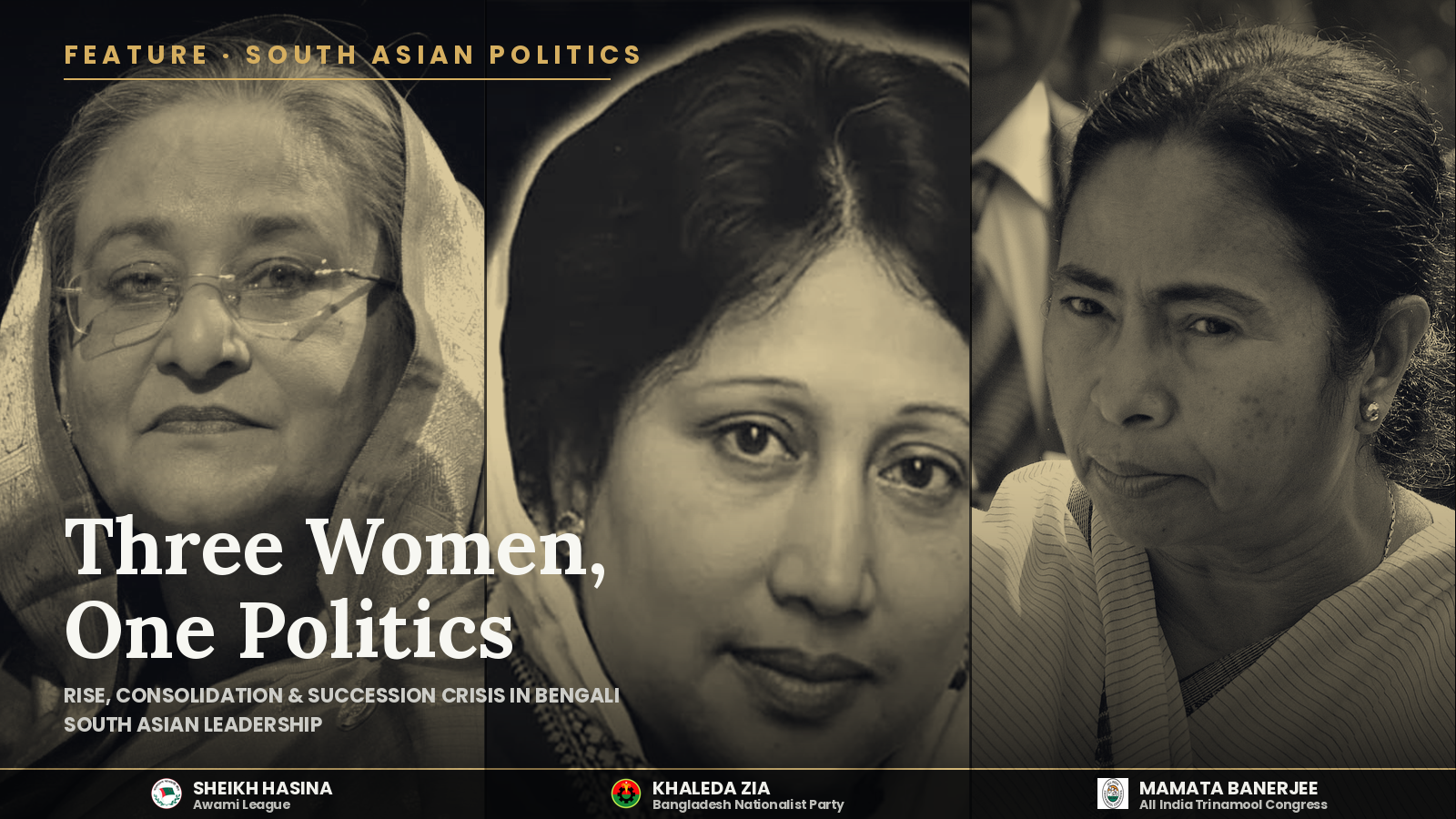

It took less than two years for the political order that defined Bengali South Asia for a generation to come apart.
In August 2024, student protesters stormed Sheikh Hasina’s residence in Dhaka and the prime minister, in power continuously since 2009, boarded a military helicopter and disappeared into exile in New Delhi. In December 2025, her lifelong rival Khaleda Zia died after years of imprisonment and illness, just five days after her son returned from seventeen years in London to claim the leadership she was no longer able to hold. And in May 2026, Mamata Banerjee, the last of the three still standing, lost her own assembly seat in Kolkata and watched her party splinter into rival factions within weeks of her defeat.
Three women. Three parties. Three endings, within eighteen months of each other. It is, political scientists now argue, less a coincidence than a verdict on a particular style of politics that Bengali South Asia has practised for half a century, one that all three of these leaders, in different ways, mastered and were ultimately undone by.
Built Around One Person
For decades, Hasina’s Awami League, Zia’s Bangladesh Nationalist Party, and Banerjee’s Trinamool Congress were less institutions than extensions of the women who led them. Political scientists call this “personalized” politics: parties that run not on ideology or internal process, but on loyalty to a single figure whose survival the whole organization depends on.
All three leaders rose out of crisis. Zia inherited the BNP after her husband, President Ziaur Rahman, was assassinated in 1981. She was thirty five, a mother of two, and dismissed by many at the time as a placeholder. She proved otherwise, leading street protests against military rule and eventually becoming Bangladesh’s first female prime minister in 1991. Hasina’s path was, if anything, even more dramatic. She returned from exile in 1981 as the sole surviving adult member of her family after the 1975 assassination of her father, the nation’s founding leader Sheikh Mujibur Rahman, along with seventeen relatives. She carried his legacy into government from 2009 until her ouster fifteen years later. Banerjee’s rise looked different on the surface. It was built from the ground up through years of street activism and a 1998 break from the Congress party. But it produced the same result: a party that existed, in every meaningful sense, because she did.
That structure delivered remarkable staying power. All three women survived election defeats, years out of office, and legal prosecution. But it came at a cost that researchers say is only now becoming fully visible. None of the three parties built the internal machinery, the leadership pipelines, succession rules, or independent power centres, that would let them function without their founder.
The Reckoning
Bangladesh absorbed the sharpest blow first. What began in mid-2024 as student protests over government job quotas escalated after Hasina branded the demonstrators collaborators, a term loaded with the darkest associations from the country’s 1971 liberation war. The crackdown that followed, involving security forces and paramilitary units, left an estimated 1,400 people dead. A United Nations fact finding mission later found reasonable grounds to believe crimes against humanity had been committed. On 5 August 2024, as protesters closed in on her residence, the seventy seven year old prime minister fled the country. A Bangladeshi court sentenced her in absentia to death that November. India has so far declined to extradite her, and she remains in exile, dismissing the country’s subsequent election from afar as a “well planned farce.”
The Awami League, barred from contesting the election that followed in February 2026, has essentially stopped functioning as a political force. There was no succession plan. Hasina’s son had occasionally been mentioned as a possible heir, but no institutional pathway had ever been built for him or anyone else. Analysts describe a party that, without her, has almost no independent institutional substance left at all.
The BNP’s experience ran in the opposite direction, but arrived at a strikingly similar underlying truth. Khaleda Zia’s death in December 2025, after years in and out of custody and prison adjacent hospital care, formally ended what one Bangladeshi political scientist described as her long standing role as the party’s “guardian,” a figure whose mere presence had kept rival factions in check even while she was largely absent from day to day politics. Her son, Tarique Rahman, had returned from exile just five days before her death. Weeks later, the BNP led coalition won a two thirds majority in Bangladesh’s parliament, and Rahman was sworn in as prime minister in February 2026, a stunningly fast ascent for a man who had spent seventeen years abroad. But it was a dynastic victory, not an institutional one. What carried him to power was his name, not a party machine rebuilt in his absence. His organization’s fundraising networks and internal discipline had atrophied badly during his years away. It was blood, not bureaucracy, that put him in office.
West Bengal’s unravelling has been slower and, in some ways, more revealing. Mamata Banerjee governed for fifteen years on the back of popular welfare programmes, cash transfers for women and schoolgirls, free bicycles for students, that kept rural and lower income voters loyal even as corruption scandals and, more recently, public fury over the 2024 rape and murder of a trainee doctor at a Kolkata hospital eroded her standing. In the April to May 2026 state election, the Bharatiya Janata Party won power in West Bengal for the first time, and Banerjee lost her own constituency to a former lieutenant turned rival. She called the result rigged and initially refused to step down, but was forced out when the assembly’s term expired.
What happened next is, for researchers studying these three cases, the clearest evidence yet of the underlying pattern. Within weeks of the defeat, a long simmering rift between Banerjee loyalists and a younger faction aligned with her nephew, Abhishek Banerjee, broke into the open. A rival faction convened its own party session and elected a competing chairperson. By June 2026, two separate factions had submitted rival leadership lists to India’s Election Commission. Asked back in 2024 who might succeed her, Banerjee had famously deflected: “I am not the party; we are the party.” Her party’s post defeat fracture suggests that non answer has become, in effect, the TMC’s succession plan.
A Pattern, Not a Coincidence
Taken individually, each story has its own texture: a violent uprising, a death in custody, an electoral defeat and internal revolt. Taken together, scholars argue, they describe the same structural failure playing out in three different registers.
The logic is almost mechanical. Concentrating authority in one person is precisely what allows that person to survive setbacks that would sink a more conventional politician. All three women weathered defeats, exile, or prosecution that might have ended other careers. But the very same concentration starves the party of everything it would need to survive without her: no internal competition to produce future leaders, no procedures for transferring authority, no organizational identity separate from the founder’s. When the leader finally goes, by force, by death, or by the ballot box, there is nothing underneath to catch the fall.
It also complicates any easy story about what these three women’s rise meant for women in politics more broadly. Their gender shaped how they were seen and the symbolism they could draw on: Hasina as her father’s political heir, Zia as her husband’s widow turned warrior, Banerjee as the outsider who took on entrenched machine politics. But none of it changed the underlying architecture of power they operated within. If anything, all three reinforced it.
There are hints, too, that the old order they represented is being displaced rather than simply reshuffled. In Bangladesh’s February 2026 election, the Islamist party Jamaat e Islami posted its best result ever, and a new student founded party emerged onto the scene. It is early evidence that the three decade rivalry between the Awami League and the BNP may no longer be the only game in Bangladeshi politics. Bangladesh’s interim government has floated constitutional reforms, including presidential term limits, aimed explicitly at preventing a repeat of the concentration of power that defined the Hasina years.
What Comes Next
The most consequential open question left behind by all this upheaval is whether any of it leads somewhere different. Tarique Rahman now has the chance to convert a dynastic mandate into something more durable, an institutionalized party with rules that outlast any one family. Bangladesh’s proposed reforms may or may not provide the scaffolding for that. The Awami League’s future, for now, is barely a question at all. Barred from politics and stripped of its leadership, it has no obvious path back. And in West Bengal, the outcome of the standoff between Mamata and Abhishek Banerjee will decide whether the TMC becomes a cautionary tale of a movement that could not outlive its founder’s authority, or finds some way to reinvent itself in opposition.
What is harder to dispute is the lesson these three overlapping collapses have already delivered. For half a century, personalized leadership was the region’s most reliable route to political power. The 2024 to 2026 period suggests it may also be the most reliable route to political ruin. It just runs on a longer fuse.
This article draws on political science research examining personalized authority, dynastic succession, and democratic institutions in South Asia, along with reporting from official election commissions, the United Nations, and regional and international news organizations.