

DHAKA: When Muhammad Yunus, the Nobel Peace Prize laureate renowned for his microfinance initiatives, assumed the leadership of Bangladesh’s interim government on 8 August 2024, expectations were high. Citizens hoped his visionary approach could stabilize the economy and restore public trust in governance. Yet, by the end of his 18-month tenure, the country faced one of its most turbulent periods in recent history — marked by mob violence, cultural destruction, rising crime, and economic turmoil.
Crime and Lawlessness on the Rise
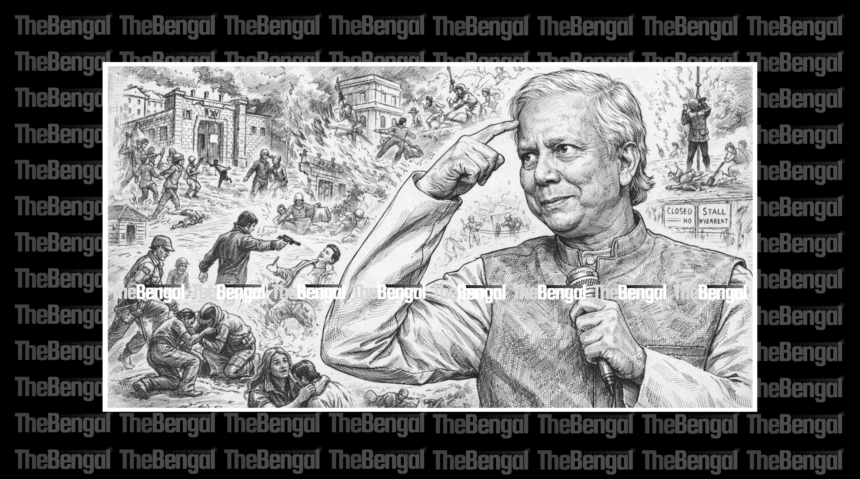
During Yunus’s government, over 2,200 prisoners escaped from correctional facilities nationwide. Among them were nine convicted terrorists and 60 individuals sentenced to death or life imprisonment. Hundreds remain at large, prompting growing concerns about national security. Violent crimes, including public shootings and armed robberies, became increasingly frequent. In Old Dhaka’s Shyambazar, a businessman was killed in broad daylight, while another in Banshree was shot and robbed of 200 bhori of gold.
Kidnappings surged, with 1,102 reported in 2025 alone — a 72% increase compared to previous years. Street crime, including snatching and muggings, also rose sharply, with snatch-and-grab incidents up by 69%.
Mob Violence and Minority Persecution
Under Yunus, mob violence became alarmingly common. Across 18 months, 259 people were killed in mob-related incidents. Minority communities were particularly vulnerable, with attacks on homes and properties reported in multiple districts.
Significant cultural and religious sites were also targeted. Ninety-seven shrines were attacked nationwide, leaving three dead and 468 injured. Murals commemorating the Liberation War, statues of national heroes, and even Dhaka University’s campus spaces became targets of organized mob destruction. The Dhanmondi 32 monument, a symbol of cultural and historical importance, was repeatedly attacked and vandalized.

Public events and exhibitions were not spared. At the 21st Book Fair, mobs forced the closure of two stalls, while mobs attacked pharmacies and small businesses following prior announcements.
Economic Decline and Job Losses
The Yunus government’s policies coincided with a sharp economic downturn. Approximately 1.2 million citizens lost their jobs, hundreds of factories and workshops were shut down, and foreign investment dropped to historic lows. Around 3 million people were newly classified as poor. Critics highlight that government decisions prioritized protecting certain institutions — including tax exemptions for Yunus’s Grameen Bank amounting to 600 crore BDT — over national economic stability.
Human Rights Abuses and Extrajudicial Killings
Human rights observers raised alarms over widespread extrajudicial incidents. More than 40 politically or socially motivated killings occurred outside of the judicial process. Victims ranged from activists, students, and journalists to ordinary citizens. Notable cases include:
- The public killing of student Dipu Chandra Das, whose body was exhumed and burned.
- The killing of child Asiya in a locked room.
- Attack and murder of Dhaka University student Tofazzal during post-meal celebrations.
- The lynching of a student at Jahangirnagar University, with perpetrators later released without accountability.
Journalists and media houses, including Chayanot Udichi, Prothom Alo, and Daily Star, faced mob attacks, highlighting the regime’s inability — or unwillingness — to protect press freedom.
National Security Challenges
The interim government struggled with border security. Repeated cross-border attacks from Myanmar resulted in civilian casualties. National assets, such as Chittagong port facilities, were sold to foreign entities, raising concerns about sovereignty and economic exploitation.
A Legacy of Unrest
While the Yunus government claimed to stabilize reserves and halt certain development projects, the social and economic costs were enormous. Schools, hospitals, cultural sites, and public institutions suffered. Ordinary citizens bore the brunt of rising crime, job losses, and social instability. Observers argue that the government’s short-term focus on financial metrics came at the expense of human security, rule of law, and social cohesion.
The contrast is striking: a Nobel laureate once celebrated worldwide for uplifting the poor now presided over a period where millions faced violence, fear, and uncertainty. The 18 months under Yunus serve as a cautionary tale about how reputation and good intentions cannot substitute for effective governance and the protection of human life.