

DHAKA: Civilisation is measured less by the accumulation of wealth or the construction of monuments than by the moral framework that governs power. The recent disclosures surrounding the Jeffrey Epstein case offer a stark illustration of how modern Western elites shielded by wealth, influence, and institutional indifference can operate with near-total impunity. Epstein’s criminal enterprise, which involved sexual abuse and trafficking of underage girls, was facilitated not by chaos but by highly structured social and institutional networks. Court documents, flight logs, depositions, and civil suits reveal a society in which proximity to power effectively neutralised accountability. The scandal does not merely concern a single man; it lays bare a civilisational failure.
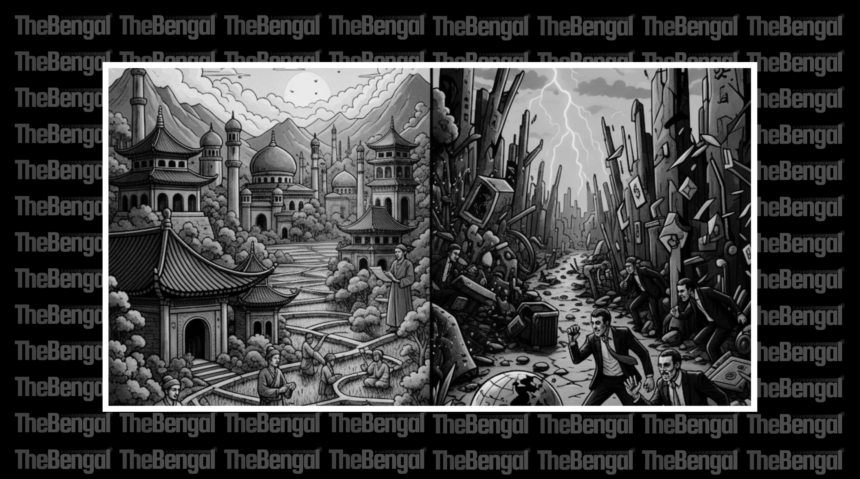
By contrast, Islamic and broader Asian civilisations, despite their historical imperfections, have long emphasized the subordination of power to ethics. In Islamic governance, rulers are accountable to God, to the people, and to an enduring moral law. Corruption, exploitation of the weak, or abuse of power is not only criminal; it is sacrilegious. Classical Islamic jurisprudence and ethical treatises consistently stress protection of the vulnerable— orphans, women, and the poor as a benchmark of societal virtue. Similarly, in Confucian-influenced Asian societies, leadership is defined by the capacity for moral example and the obligation to maintain social harmony. The violation of ethical norms, especially through exploitation of innocents, is considered a failure of both personal character and societal integrity.
The Epstein scandal illustrates what occurs when wealth and influence replace moral constraint with privilege. Epstein, a convicted sex offender, maintained relationships with presidents, billionaires, academics, and celebrities. For years, he operated with minimal legal consequence, benefiting from settlements, prosecutorial discretion, and the protective buffer of elite networks. Institutions that claim to uphold justice instead acted as instruments of concealment. This is not an isolated procedural failure but a systemic pattern, emblematic of a civilization where the rule of law bends for the powerful and moral outrage is reserved for the powerless.
The contrast is striking. In Islamic ethical frameworks, the abuse of a child is among the gravest sins imaginable. Prophet Muhammad’s (PBUH) teachings emphasize the protection of the vulnerable as a societal responsibility. Legal systems in Muslim-majority societies historically intertwined civil and ethical obligations, imposing severe consequences on those who exploit their authority. In Confucian and South Asian ethical thought, moral virtue is inseparable from public duty. Leaders are judged by their adherence to societal norms, their ability to protect those without power, and the fairness of their actions. In these traditions, ethical lapses at the top are visible, shameful, and socially destabilizing.
Western elite barbarism, in contrast, often manifests quietly, beneath the veneer of legality and respectability. Epstein’s operations were not secret in the traditional sense; they were embedded within social and political hierarchies that made intervention inconvenient. Media coverage was cautious, legal settlements prevented public accountability, and victims faced intimidation and disbelief. This is the modern form of structural barbarism: organized, polite, and legalistic, yet morally corrosive. It demonstrates that a society can appear civilized— wealthy, educated, technologically advanced while simultaneously allowing horrific abuses to persist without consequence.
More Read

The broader implication is clear: the West often judges morality externally while failing internally. Western powers lecture the Global South on women’s rights, child protection, and ethical governance. Yet, when crimes occur within the apex of their own social structures, the response is restrained, cautious, and framed in terms of legal procedure rather than moral urgency. This creates a dangerous double standard: moral outrage is contingent upon who is harmed, not whether harm has occurred. Power becomes the arbiter of morality.
Islamic-Asian civilisations, in contrast, embed the idea that no one is above ethical scrutiny. Wealth, status, and influence are means to societal responsibility, not shields from justice. This does not imply perfection. Like any civilisation, there have been failings, and historical injustices exist. Yet, the philosophical and ethical infrastructure creates pressure points against impunity. Misdeeds are considered a stain on society itself, not merely on the individual. Collective moral standards function as a check on private corruption.
The Epstein case highlights another critical distinction: Western elite barbarism thrives in secrecy, but it depends on social complicity. Networks of wealth, influence, and legal protection coalesce to shield wrongdoing. The victim becomes invisible, their suffering secondary to the preservation of reputations. Islamic and Asian ethical frameworks, by contrast, place the victim at the center of moral consideration. Society is structured to elevate the protection of the vulnerable over the convenience of the powerful.
This contrast is particularly relevant in the global context. The West has dominated narratives of modernity, progress, and civilization. It promotes itself as the pinnacle of moral, scientific, and political development. Yet the Epstein scandal and similar cases suggest that material and technological advancement alone do not guarantee moral progress. Civilisation is defined not by affluence or cultural influence, but by the capacity to restrain power through ethics and accountability.
A civilisation that tolerates structural impunity cannot claim superiority. The Epstein files should be understood as a mirror, reflecting a broader truth about Western elite power: it is often insulated from morality, protected by institutional structures that prioritize influence over justice. In Islamic-Asian traditions, no comparable insulation exists in principle. Authority is always accountable to ethical standards, and violations are considered societal failures, not merely personal ones.
Finally, the lesson is clear for societies observing Western power: civilization cannot be measured by wealth, technology, or geopolitical dominance. True civilisation is measured by how it protects the powerless, holds the powerful accountable, and maintains moral clarity in the face of opportunity. The Epstein scandal illustrates how Western elites, despite decades of moral and legal rhetoric, can fail spectacularly. Islamic and Asian ethical traditions offer a cautionary mirror, demonstrating that restraint, accountability, and moral duty must precede, not follow, social advancement.
In conclusion, the Epstein files are more than a scandal. They are a civilisational test. They ask whether societies value morality over wealth, human dignity over influence, and accountability over reputation. Western power, as revealed in this case, fails that test repeatedly. Islamic-Asian civilisations, with all their imperfections, provide enduring frameworks for ethical governance, social responsibility, and the protection of the weak. In an age where affluence often obscures ethics, these traditions remain a vital reminder that civilisation is more than appearance; it is integrity.