


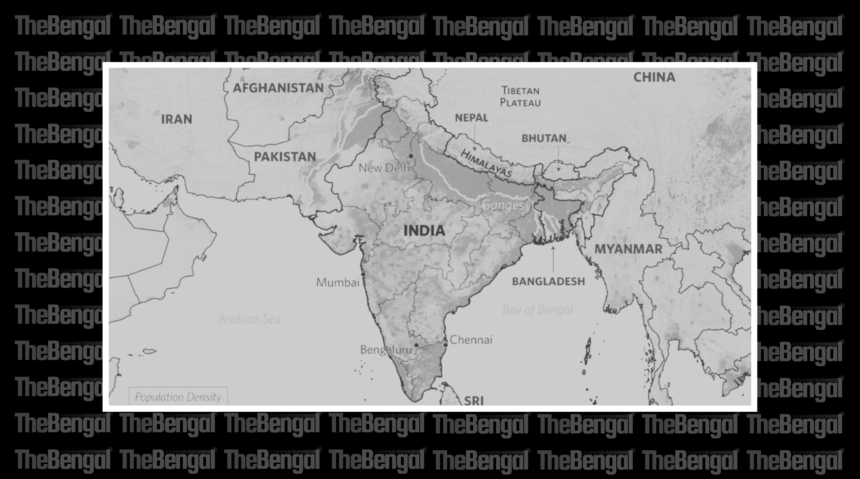
DHAKA: The global order is no longer shaped by a single center of power. A multipolar world is steadily taking form, defined by competing regional influences, shifting alliances, and overlapping economic and security interests. Within this evolving landscape, Bengal has emerged as a region of growing geopolitical relevance. Located between South Asia and the wider Indo-Pacific, and shaped by history, geography, and political division, Bengal increasingly illustrates how regional spaces are influenced simultaneously by multiple global and regional powers. Examining Bengal’s evolving role offers valuable insight into how multipolar geopolitics is reshaping influence, strategy, and stability in this part of the world.
Bengal has long existed beyond political borders. Long before the emergence of modern nation-states, the region functioned as a connected civilizational space shaped by rivers, trade routes, language, and shared cultural memory. Although contemporary boundaries divide Bengal between Bangladesh and India’s West Bengal, geopolitics continues to view the region as a single strategic reality. Global powers, regional actors, and economic forces engage with Bengal not as a peripheral space, but as a critical crossroads linking South Asia, Southeast Asia, and the Indo-Pacific.
The geopolitical importance of Bengal is deeply rooted in history. For centuries, the region was among the most prosperous in the world. Its fertile delta supported extensive agriculture, while its river systems enabled both internal and maritime trade. Bengali merchants maintained commercial links with Arabia, Southeast Asia, and China. During the Mughal era, Bengal played a significant role in global commerce, particularly through textiles such as muslin and silk. European colonial powers quickly recognized this value, and British dominance in South Asia began with control over Bengal. The legacy of colonial exploitation transformed the region into a central node of imperial politics, patterns that continue to influence its economic and political structures today.
The partition of Bengal in 1947 marked a turning point in the region’s geopolitical trajectory. The division into East Bengal and West Bengal was not merely administrative. It fractured economic networks, divided communities, and reshaped identities. East Bengal’s transformation into Bangladesh following the Liberation War of 1971 further internationalized Bengal’s geopolitical significance. That conflict itself was shaped by Cold War dynamics, drawing in regional and global powers. Since then, Bengal has remained strategically sensitive, influenced by regional rivalries, border politics, and shifting alliances.
Geography remains Bengal’s most enduring strategic asset. The Bay of Bengal, once viewed as a peripheral maritime space, has become central to contemporary geopolitical thinking. It serves as a vital corridor for international trade, energy transportation, and digital connectivity. A substantial share of global shipping passes through the broader Indo-Pacific region, with the Bay of Bengal forming its western anchor. For Bangladesh, access to the Bay is essential for economic growth, maritime security, and long-term development through the blue economy. For India, particularly through West Bengal, the Bay provides a critical gateway to Southeast Asia and underpins its eastern strategic outlook.

In recent years, the Bay of Bengal has attracted increasing attention from global powers. The United States views the region as part of its broader Indo-Pacific strategy, emphasizing freedom of navigation, regional stability, and strategic partnerships. China considers Bengal and the Bay of Bengal integral to its Belt and Road Initiative, investing significantly in infrastructure, ports, and energy projects in Bangladesh. Japan and other regional actors have also expanded their economic and strategic engagement. This convergence of interests has transformed the region into a space where cooperation and competition operate side by side.
Bangladesh occupies a particularly sensitive position within this evolving geopolitical environment. Its rapid economic growth, large population, and strategic location make it an important partner for multiple powers. Dhaka has pursued a carefully balanced foreign policy, maintaining constructive relations with China, India, the United States, and other global actors. This approach reflects a pragmatic understanding of geopolitics, where development goals, sovereignty, and stability must be managed simultaneously. In this context, Bengal’s geopolitical reality is less about alignment and more about navigation within a complex multipolar system.
West Bengal, while embedded within India’s federal structure, also holds distinct geopolitical significance. It connects India’s northeastern states with the rest of the country and serves as a bridge to Bangladesh, Nepal, Bhutan, and Southeast Asia. Kolkata’s historical role as a commercial and cultural center continues to shape regional diplomacy and trade. Infrastructure development, cross-border commerce, and people-to-people exchanges all reinforce West Bengal’s importance within India’s broader regional strategy.
Economic geopolitics plays a central role in shaping Bengal’s position in the global system. Bangladesh’s integration into global supply chains, particularly through the garment sector, connects millions of workers to international markets. Remittance flows from migrant workers further link the region to the Middle East and other parts of the world. At the same time, regional connectivity initiatives aim to revive Bengal’s historical role as a commercial hub. Investments in roads, railways, ports, and inland waterways hold the potential to reconnect South Asia internally and link it more effectively with Southeast Asia.
Yet geopolitical realities often complicate economic logic. Trade barriers, political mistrust, and security concerns continue to limit regional cooperation. Water-sharing disputes, border management challenges, and migration-related anxieties shape relations between neighboring states. These issues highlight how deeply geopolitics influences everyday economic and social realities across Bengal.
Climate change has added a new and urgent dimension to Bengal’s geopolitical significance. The region is among the most climate-vulnerable in the world. Rising sea levels, intensifying cyclones, river erosion, and salinity intrusion threaten livelihoods across coastal and deltaic areas. The Sundarbans, shared by Bangladesh and India, face existential risks with serious environmental, economic, and security implications. Climate-induced migration could reshape population patterns and strain political systems, making climate change an increasingly central geopolitical concern for the region.
Beyond power politics and economics, culture remains one of Bengal’s strongest transnational connectors. The Bengali language, literature, music, and intellectual traditions transcend political boundaries. Cultural figures such as Rabindranath Tagore represent a shared heritage that belongs not only to Bengal, but to the world. Cultural exchanges, academic collaboration, and media continue to generate soft power that complements formal diplomacy and sustains regional connections.
Bengali nationalism has also long engaged with global ideas. The Language Movement of 1952 influenced international debates on linguistic rights, while the Liberation War of 1971 resonated globally as a struggle for self-determination. Today, Bengali identity exists within a globalized environment shaped by digital communication, migration, and transnational networks. The challenge lies in preserving cultural depth while remaining open to global engagement.
Looking ahead, Bengal’s geopolitical future will depend on strategic choices made at both national and regional levels. Greater cooperation could unlock significant economic and social potential, while persistent rivalry and mistrust could constrain progress. Bangladesh has the opportunity to act as a bridge between South and Southeast Asia, while West Bengal can strengthen its role as India’s eastern gateway. Together, the broader Bengal region can transform geography into strategic advantage.
As global power continues to shift toward Asia, Bengal’s relevance is likely to grow. Great power competition, climate pressures, and economic transformation will shape the region’s trajectory. Understanding Bengal’s place in global geopolitics is therefore no longer a purely academic exercise. It is essential for policymakers, citizens, and media platforms seeking to engage seriously with a changing world.
Bengal’s rivers flow across boundaries, its people live across continents, and its future is deeply interconnected with global developments. In an era defined by shifting power and uncertain borders, Bengal stands not at the margins, but increasingly at the center of global change. Beyond borders, Bengal matters.