

DHAKA: The Bangladesh–India border stretches for more than 4,000 kilometers. It cuts through villages, rivers, farmlands, forests, and even homes. On maps, it appears as a sharp political line. On the ground, it is something else entirely. It is lived, felt, and negotiated every day by millions of ordinary people.
For those who live far from the frontier, the border is often discussed in terms of security, migration, smuggling, or diplomacy. For those who live beside it, the border is a constant presence. It shapes their work, movement, safety, and identity. Their stories rarely make headlines, yet they reveal a deeper truth about how borders affect human lives.
Life along the Bangladesh–India border is not just about separation. It is also about connection. The people on both sides often share the same language, the same festivals, and the same history. In many places, the border came long after the communities did.
A Line Drawn Through Lives
The modern border between Bangladesh and India is a product of history. The Partition of 1947 divided Bengal along religious lines. Later, the independence of Bangladesh in 1971 reshaped the region again. These political events were decisive, but they were also distant from village life.

In many border areas, families found themselves divided overnight. A house might stand in one country while its farmland lay in another. Relatives became “foreigners” without ever moving. Over time, fences were built, rules were tightened, and crossing became difficult.
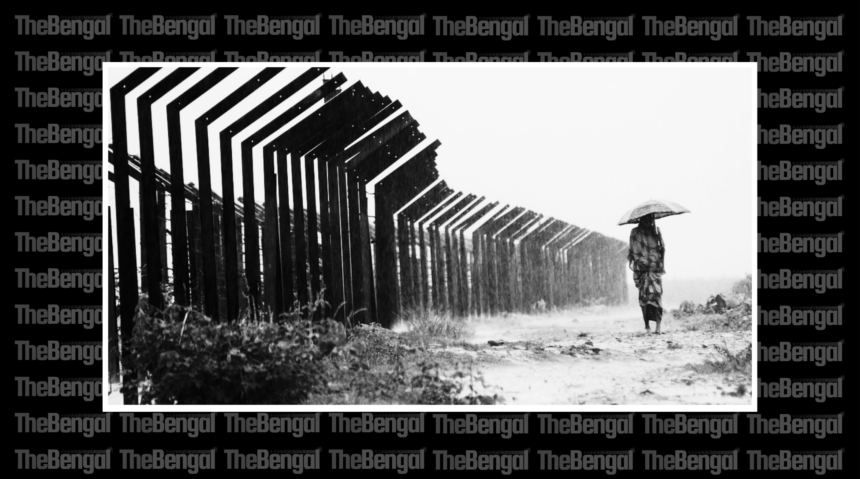
Today, the border is heavily guarded. In many sections, there is barbed wire fencing and constant patrols. Floodlights illuminate fields at night. Surveillance is part of everyday life. For border residents, this is normal, even if it is never easy.
Shared Culture, Divided Reality
Despite political boundaries, cultural life flows across the border. Bengali is spoken on both sides. Folk songs, food habits, and religious traditions are remarkably similar. Durga Puja, Eid, weddings, and harvest festivals feel familiar whether one is in Kushtia or Nadia, Dinajpur or Malda.
Markets near the border often sell similar goods. Farmers grow the same crops. Fishermen depend on shared rivers. In Assam, Tripura, and West Bengal, border communities have deep historical ties with neighboring regions of Bangladesh.
Yet, the border changes how these shared cultures are lived. A festival cannot be attended freely across the line. A cousin’s wedding may remain unreachable. Even visiting a family grave can require permission, documents, and long waits.
This gap between shared identity and divided reality creates quiet pain. It is rarely spoken about, but it is deeply felt.
The Economics of the Edge
For many border residents, survival depends on land and labor. Farming is the main occupation. But border fencing often cuts through agricultural fields. In some cases, farmers must cross gates at fixed times to reach their own land. Missing the time can mean losing a day’s work.
Trade is another major issue. Informal cross-border trade has existed for generations. People exchanged rice, cattle, vegetables, and daily goods long before modern customs posts existed. Today, such exchanges are often labeled as smuggling.
While illegal trade does exist, many border dwellers argue that the line between survival and crime is thin. When legal trade routes are distant or inaccessible, informal routes become the only option. Crackdowns often punish the poorest while larger networks remain untouched.
Women play a key role in this informal economy. Many carry small goods across short distances to support their families. Their risks are high, and their protection is low.
Fear, Force, and Fragility
One of the most painful aspects of border life is fear. Encounters with border security forces can turn deadly. Over the years, reports of shootings, detentions, and abuse have surfaced, particularly involving civilians accused of crossing illegally.
Each death or injury sends shockwaves through border villages. Families lose breadwinners. Children grow up with trauma. Trust erodes. While both countries stress border security, human rights concerns remain serious.
It is important to note that security personnel also operate under pressure. They work in difficult conditions, often with limited resources. But when force becomes routine, civilians pay the price.
True security cannot be built only with fences and guns. It must include trust, accountability, and dialogue.
Women, Children, and the Hidden Burden
Border life places extra burdens on women and children. Women often manage households while men migrate for work or face border-related risks. They handle farming, childcare, and sometimes illegal crossings, all under constant stress.
Children grow up seeing armed guards and restricted zones as part of daily life. Schools may be far away. Access to healthcare can be limited by border controls. Many young people leave, seeking better futures elsewhere.
Those who stay learn resilience early. But they also inherit uncertainty.
Voices Missing from Policy
Perhaps the greatest injustice faced by border communities is invisibility. Policies are made in capitals. Decisions are framed in national interest. The everyday experiences of border residents rarely shape these discussions.
Local voices are seldom consulted when fencing is planned, rules are changed, or operations are intensified. As a result, policies often ignore ground realities.
A humane border policy must start by listening. Border residents are not threats. They are citizens. Their safety, dignity, and livelihoods matter.
Towards a More Human Border
The Bangladesh–India relationship is complex but vital. Both countries share history, trade, security concerns, and regional responsibilities. Improving border life should be part of strengthening bilateral ties.
Confidence-building measures, easier local movement permits, fair trade access, and joint community programs can reduce tension. More importantly, accountability and restraint in the use of force are essential.
Borders will remain. Sovereignty matters. But humanity matters too.
Beyond Borders, Beyond Silence
Life along the Bangladesh–India border is not just a story of division. It is a story of endurance. Of people who adapt, survive, and continue to hope.
They deserve to be seen. They deserve to be heard. And they deserve policies that recognize that beyond borders, there are lives.
That is a truth no fence can erase.